There are several
mechanisms to activate the Charter.
It is based on a pre-defined list of appointed users, known as
'Authorized Users' (AUs). Until now AUs are typically disaster
management authorities, from countries of Charter member agencies, able
to request Charter support for emergencies in their own country, or in a
country with which they cooperate for disaster relief.
Since its inception, the Charter has demonstrated a strong commitment
to expanding its number of users. Initiatives include collaboration with
UNITAR/UNOSAT and UN OOSA, active in many countries and who can submit
requests to support in-country UN relief agencies, and Sentinel Asia, a
regional network for Earth observation-based Emergency Response in 32
countries.
Universal Access
Building on a decade of success in making satellite data available for
disaster response, the International Charter is now opening its doors
even wider. The Charter Members have adopted the principle of Universal
Access to further strengthen the Charter's contribution to disaster
management worldwide. Any national disaster management authority will be
able to submit requests to the Charter for emergency response. Proper
procedures will have to be followed, but the affected country will not
have to be a Charter member.
Universal Access benefits national disaster management authorities in
countries beyond those of the Charter members, previously unable to make
direct requests to the Charter.
A registration process is in place for national authorities interested
in participating in the Charter as an "Authorized User". This process
will validate the ability of national authorities to access and use
Charter assets for disaster response, in accordance with Charter
operational procedures. Steps and applicable conditions are explained in
the Charter's
Universal Access Information Brochure available together with its
Registration form.
Map showing countries (in dark blue) with direct access to the
Charter in July 2016. Universal Access allows national users from new
countries to directly submit emergency requests as Authorized Users. In
addition the Charter collaborates with Sentinel Asia, a regional network
for Earth observation-based Emergency response in 26 countries (87
national organisations) and 15 International Organizations, and with
UNITAR/UNOSAT and UNOOSA, active in many countries and who can submit
requests to support in-country relief agencies of the United Nations.
All countries of the world can benefit from the Charter by any of the
ways described above. Since 2000 there have been 499 disasters covered
in 118 countries worldwide.
Sequence of Events
The following illustration depicts the sequence of events that occur
once the Charter is activated. Beginning with the authorized user
(bottom left), follow the sequence with your mouse for a brief
description of each step, and click on any of the steps for more
in-depth information.
An Authorized User can call a single number to request the mobilization
of the space and associated ground resources associated with Charter
members in order to obtain data and information on a disaster
occurrence.
A 24-hour on-duty operator receives the call, checks the identity of
the requestor and verifies that the User Request form, sent by the
Authorized User, is correctly completed.
The operator passes the information to an Emergency On-Call Officer who
analyzes the request and the scope of the disaster with the Authorized
User, and prepares an archive and acquisition plan using available
satellite resources.
Data acquisition and delivery takes place on an emergency basis, and a
Project Manager, who is qualified in data ordering, handling and
application, assists the user throughout the process.
Charter Operational Loop
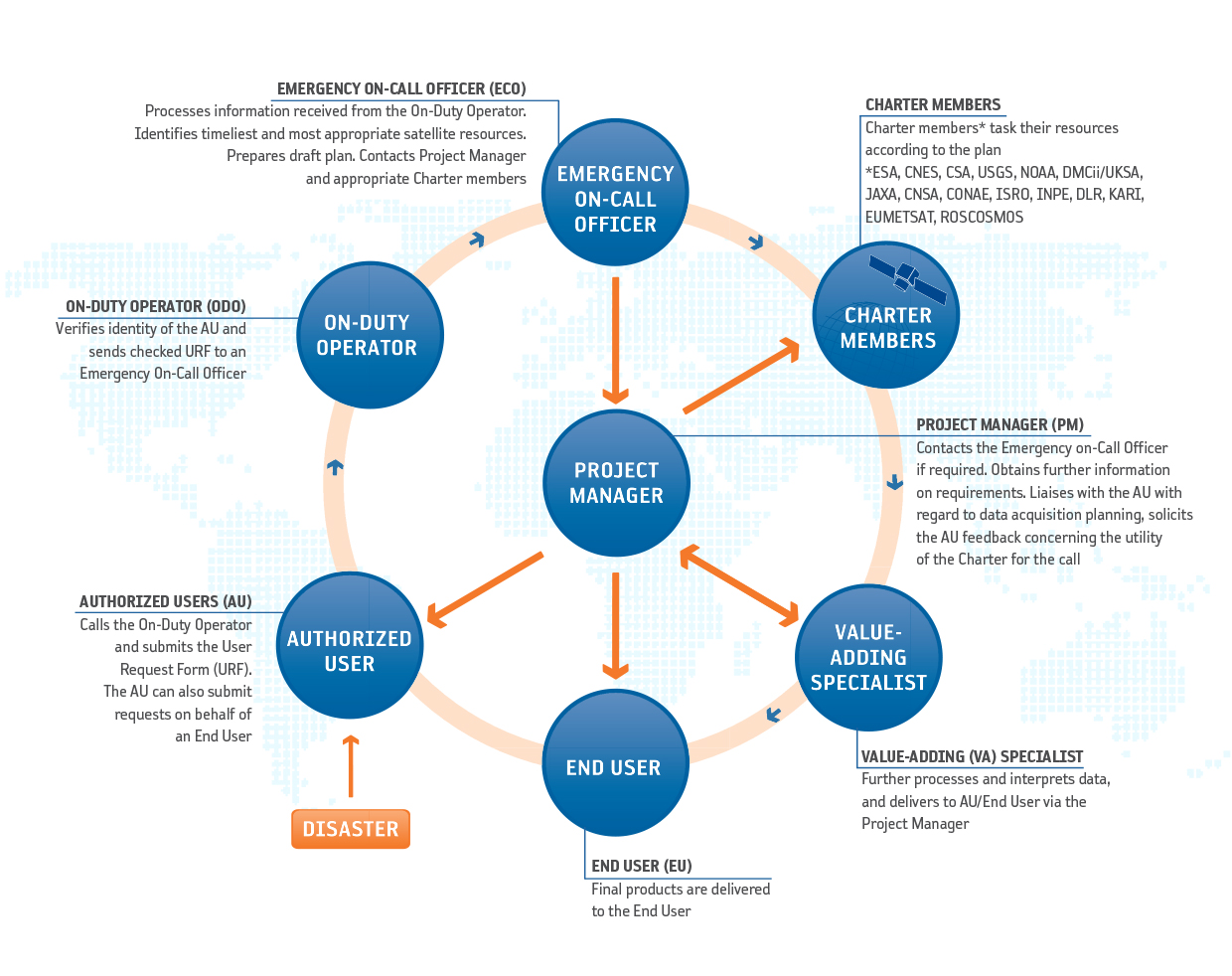
Authorized Users (AU)
|
 |
-
They are the bodies authorized to request the services of the Charter
-
Typically they are national civil protection, rescue, defense and security bodies
-
They are recognized to be the Charter Associated Bodies
-
They receive the single (ODO) phone number
|
|
|
|
Exceptionally, the Board may allow certain organizations with which
the Charter Parties and Partner Agencies have an interest to cooperate,
or 'Cooperating Bodies', to request the Charter data. |
|
|
On-Duty Operator (ODO)
|
 |
-
Available 24h/day, 7 days/week
-
Receives calls requesting space data images and information
-
Identifies the caller as being an AU
-
Obtains and confirms with the AU the information required
-
Transmits the information to the ECO (AU coordinates)
-
Contacts the ECO within an hour
|
|
|
Emergency On-Call Officer (ECO)
|

|
-
Available 24h/day, 7 days/week
-
Processes the information received from the ODO
-
Verifies the validity of the disaster relief data request
-
Identifies the most timely and appropriate satellite resource and prepares a draft plan
-
Gets the Space Agency user's approval
-
AAP (Archives / Acquisition plan)
-
Tasks the appropriate Space Agency
-
Submits request for new images or archives
-
Gathers all relevant information in the dossier
-
Transfers dossier to the Project Manager
-
Informs Space Agencies of the status of their space resources
|
Members (Space Agencies)
|
 |
-
Plan acquisitions according to request submitted by ECO
-
Resolve any conflicts and suggest alternate acquisitions if necessary
-
Program their respective space resources (satellites) to acquire the requested data over the area affected by the disaster
-
Not all of the space resources can provide relevant data for all types of disasters.
-
Hence, not all of the space resources are necessarily tasked for each Charter request
|
Value Added Reseller
|
 |
-
Once the data is acquired, it is processed into images
-
VA further processes and interprets the data acquired over the
area affected by the disaster and delivers the images to the End User
|
Project Manager (PM)
|
 |
-
Identified by Executive Secretariat when Charter is activated
-
Available during normal working hours
-
Ensures data is sent to the end user
-
Confirms accuracy of data sent to user
-
Ability to interpret data
-
Coordinates, when required, the delivery of value-added products and information
-
Completes dossier with a report submitted to the International Charter Executive Secretariat
|
Mechanisms to activate the Charter
There are several mechanisms for a user organisation to submit a request to activate the Charter:
Direct activation
A pre-defined list of appointed users, known as 'Authorized Users'
(AUs), can submit a request for a disaster occurring in their country.
The only bodies authorised to directly request the Charter to be
activated are the AUs (typically civil protection agencies, governmental
relief organisations, or other authorities with a mandate related to
disaster management).
Activation via an Authorised User on behalf of a user from a non-member country ('sponsor Authorised User')
Authorised Users can access the Charter to request support for a
disaster in a country with which they cooperate for relief purposes.
Activation via the UN for UN users
The Charter has an agreement with UN OOSA (Vienna) and UNITAR/UNOSAT
(Geneva) to provide support to UN agencies. UN OOSA and UNITAR/UNOSAT
may submit requests on behalf of users from the United Nations.
Activation for Asia Pacific users via Sentinel Asia's partner, the Asian Disaster Reduction Centre
Sentinel Asia is a regional collaboration for Earth observation based emergency response in 31 Asia Pacific countries.
Since 2009 the Charter has granted the Asian Disaster Reduction Centre
the right to submit activation requests on behalf of national users of
Sentinel Asia.
Further actions to improve Charter access with GEO
In response to a request from the Group on Earth Observation (GEO) to
improve access to the Charter during emergencies, collaboration has
started with primary focus on users from African countries that do not
have a direct access to the Charter. In 2009, the Charter initiated a
formal user consultation to address the improvement of Charter access in
African countries.
Universal Access Information Brochure & User Registration Form
Emergency related enquiries
New users without direct access to the Charter should address emergency related enquiries to:
executivesecretariat@disasterscharter.org
General information enquiries
General enquiries concerning the Charter operations and provisions should be addressed to:
webmaster@disasterscharter.org


