Powered By Blogger

Sonntag, 26. Februar 2017

CHARTER ACTIVATIONS


Tsunami, Indonesia and Thailand

 https://www.disasterscharter.org/web/guest/-/tsunami-indonesia-and-thail-45

Tuesday, 28 December 2004

 Type of Event:
Tsunami, Earthquake
Location of Event:
Indonesia and Thailand
Date of Charter Activation:
27/12/2004
Charter Requestor:
UNOOSA on behalf of UNOPS
Project Management:
UNOSAT

Description of the event

On December 26, 2004, an earthquake of magnitude 9.0 struck off the west coast of Sumatra in the Indonesian Archipelago. This earthquake triggered a devastating tsunami and caused tremors that killed over 104,000 people in Indonesia and over 5,000 in Thailand.
Indonesia was the worst affected followed by Sri Lanka, India, Thailand, Somalia, Maldives, Malaysia and Myanmar.
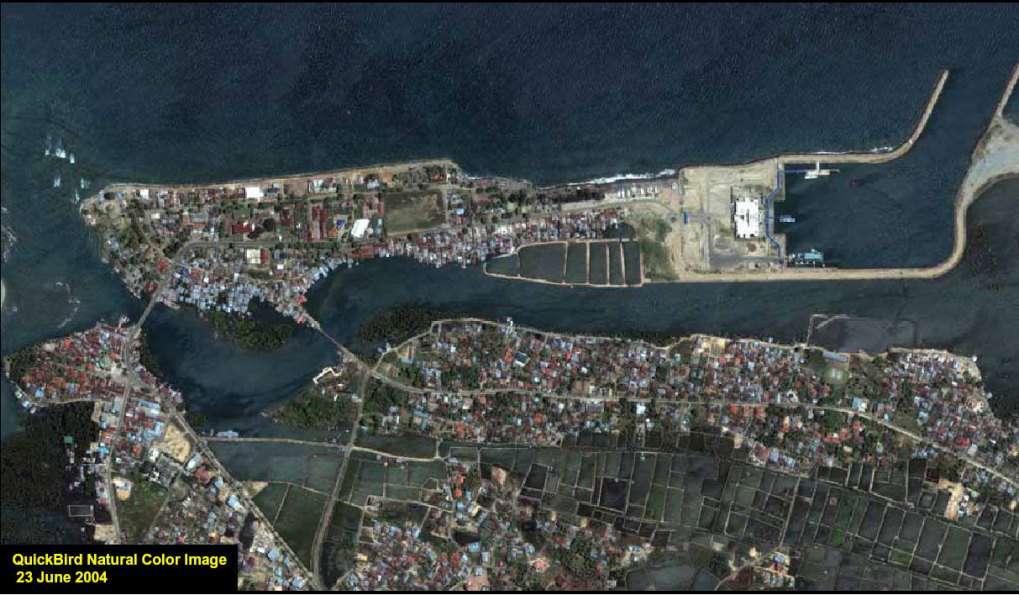


QuickBird Image, 23 June 2004

Source: --
Acquired: --

Copyright: --

Other info: --
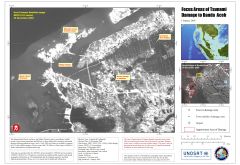
Satellite map of Banda Aceh Damage.

Source: GLCF, JPL, Global Insight; SPOT 5.
Acquired: --

Copyright: Map produced 30/12/2004 by UNOSAT.
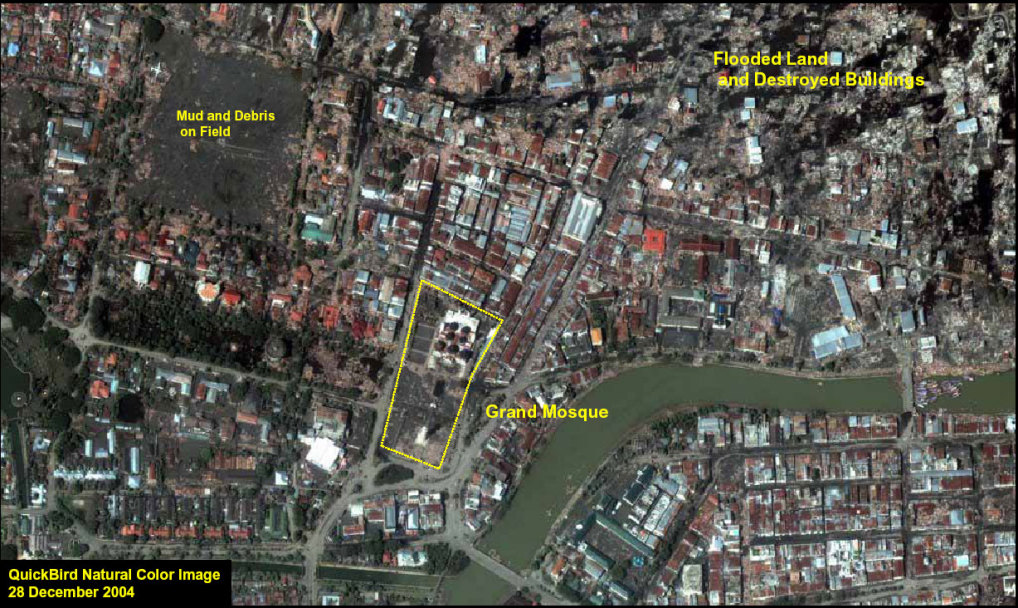
QuickBird Image, 28 December 2004

Source: --
Acquired: --

Copyright: --

Other info: --
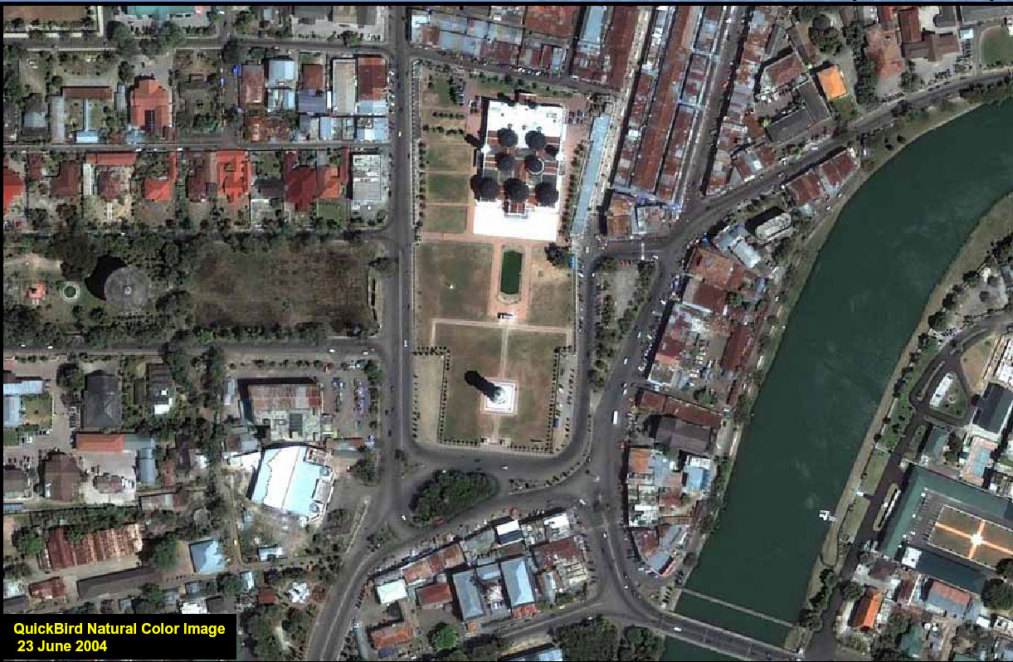
QuickBird Image, 6 June 2004

Source: --
Acquired: --

Copyright: ---

Other info: --
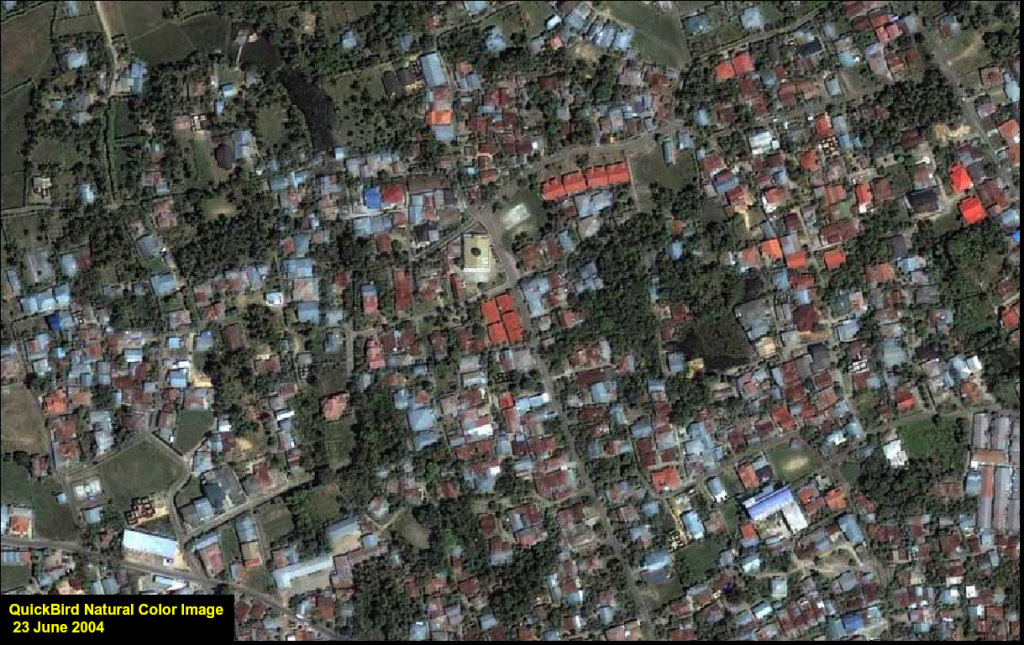
QuickBird Image, 23 June 2004

Source: --
Acquired: --

Copyright: --

Other info: --
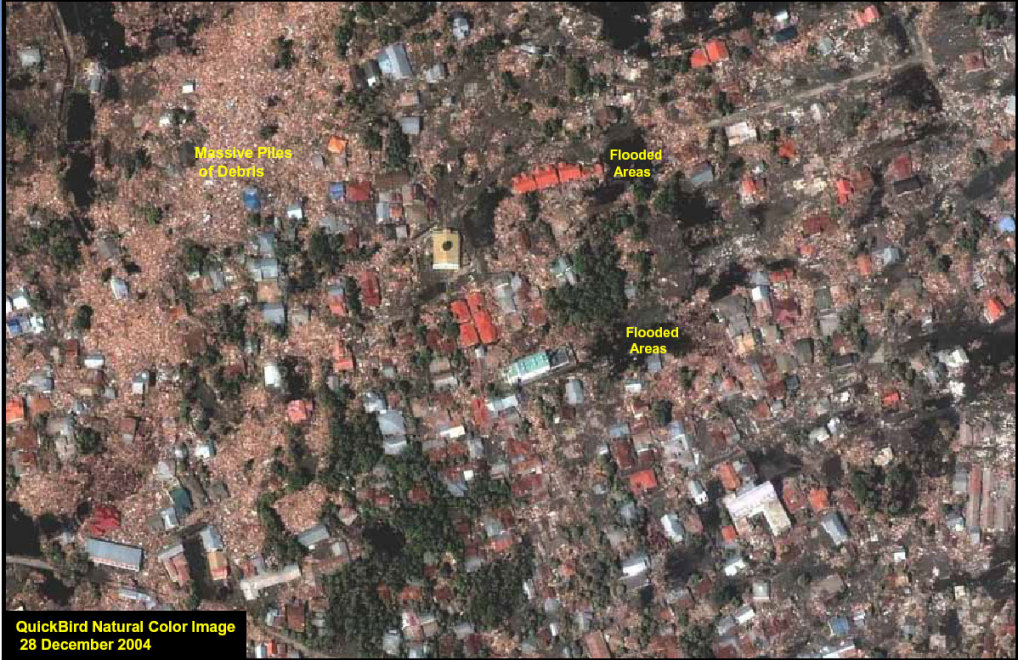
QuickBird Image, 28 December 2004

Source: --
Acquired: --

Copyright: --

Other info: --
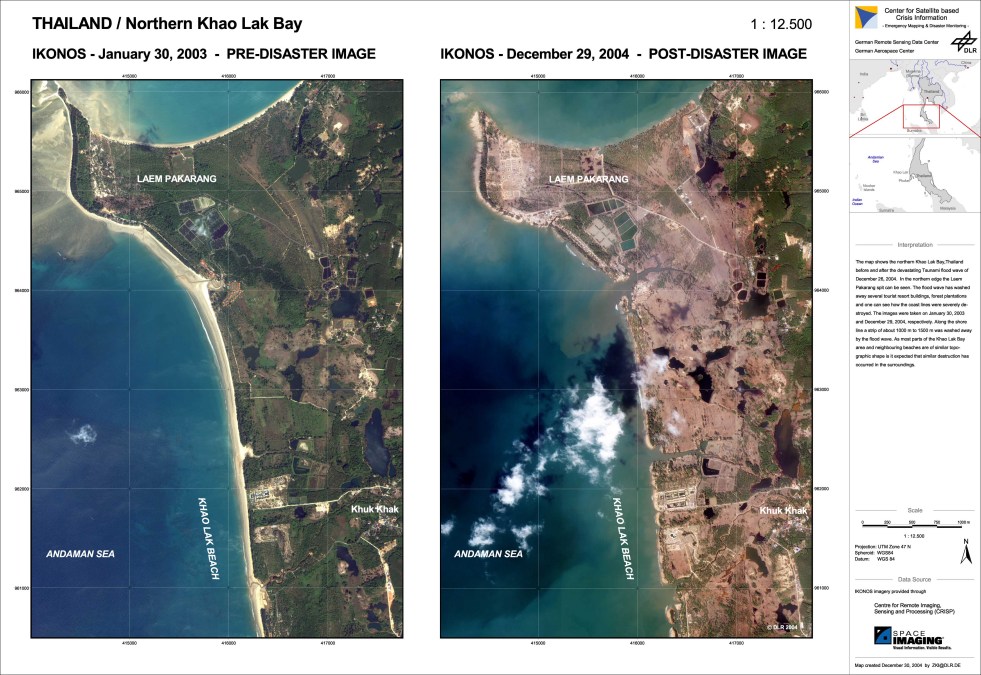
Thailand Khao Lak north

Source: Ikonos images, 30/01/2003 and 29/12/2004, before and after the devastating tsunami.
Acquired: 30/01/2003 and 29/12/2004

Copyright: Remote Sensing Data Centre, DLR - German Aerospace Center Ikonos imagery provided through Center for Remote Imaging, Sensing and Processing, Space Imaging.
Scale 1:12.500 Map created 30 December 2004 by zki@dlr.de

Other info: --
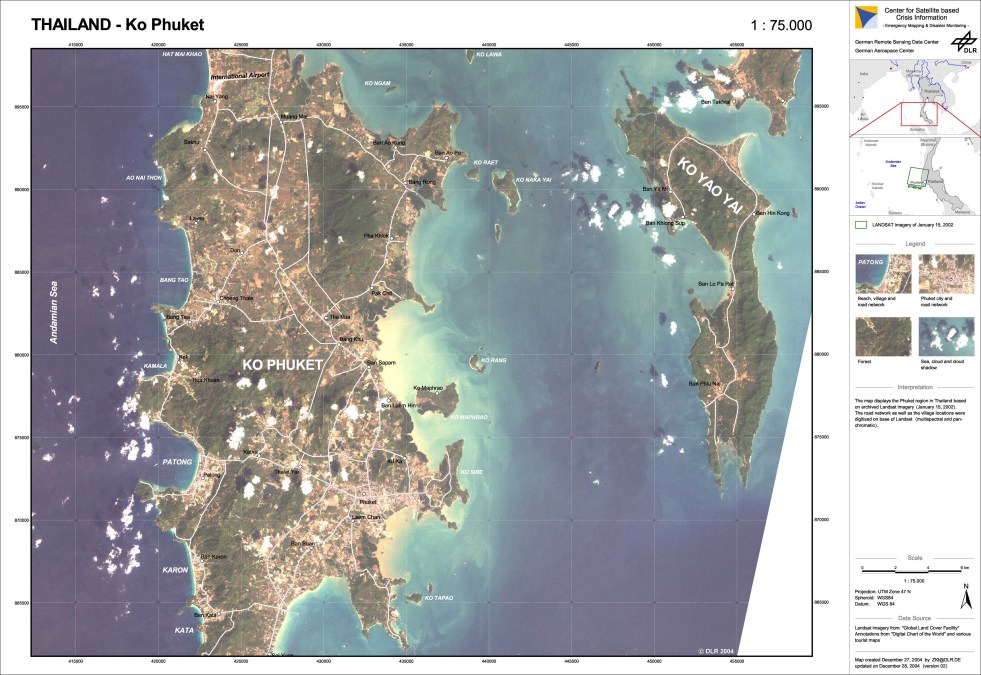
Thailand Phuket

Source: Scale 1:75,000 Landsat imagery, 15/01/2002.
Acquired: 15/01/2002.

Copyright: German Remote Sensing Data Centre, DLR - German Aerospace Center
Map created 30 December 2004 by zki@dlr.de
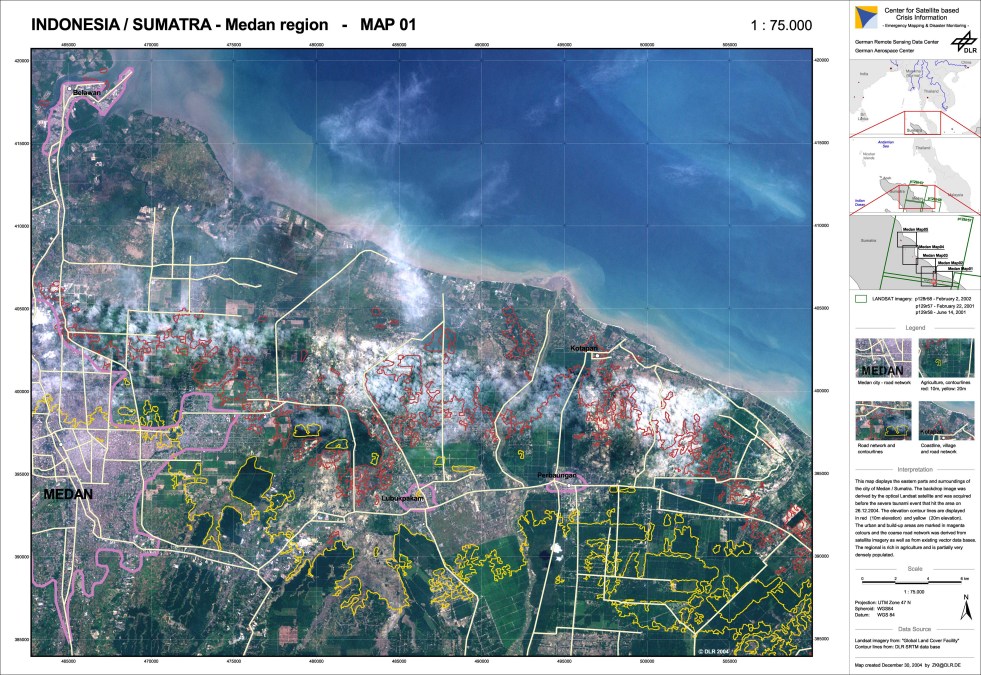
Indonesia, Medan, Scale 1:75,000

Source: Landsat images, 02/02/2002, 22/02/2001, and 14/05/2001.
Acquired: 02/02/2002, 22/02/2001, and 14/05/2001.

Copyright: German Remote Sensing Data Centre, DLR - German Aerospace Center
Map created 30 December 2004 by zki@dlr.de
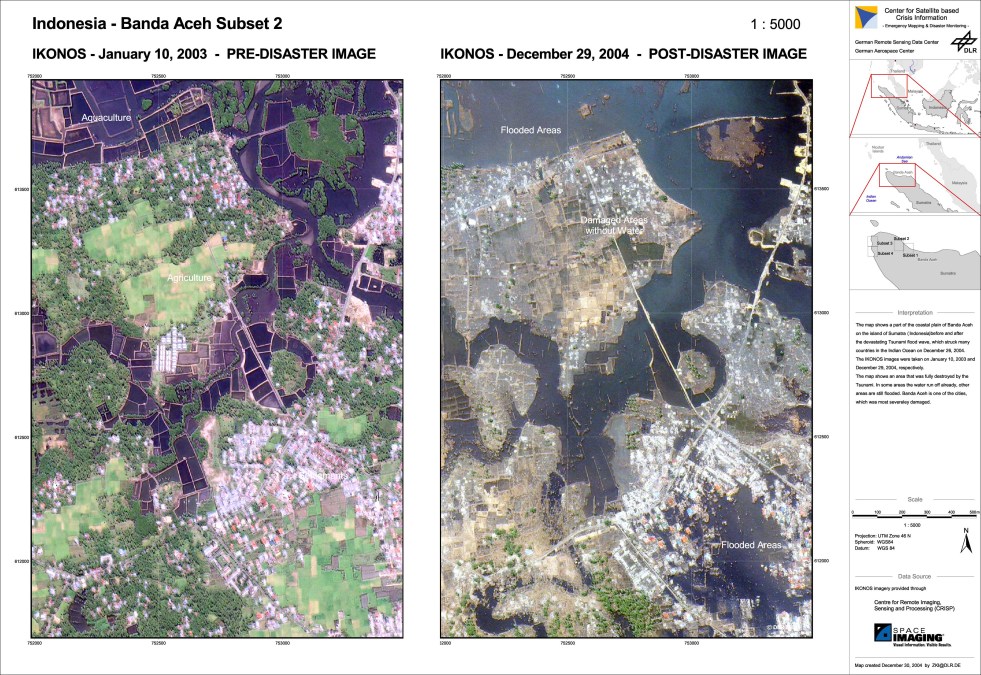
Indonesia Aceh, Scale 1:5000

Source: Ikonos images, 30/01/2003 and 29/12/2004, before and after the devastating tsunami.
Acquired: 30/01/2003 and 29/12/2004

Copyright: German Remote Sensing Data Centre, DLR - German Aerospace Center Ikonos imagery provided through Center for Remote Imaging, Sensing and Processing, Space Imaging.
Scale 1:12.500 Map created 30 December 2004 by zki@dlr.de
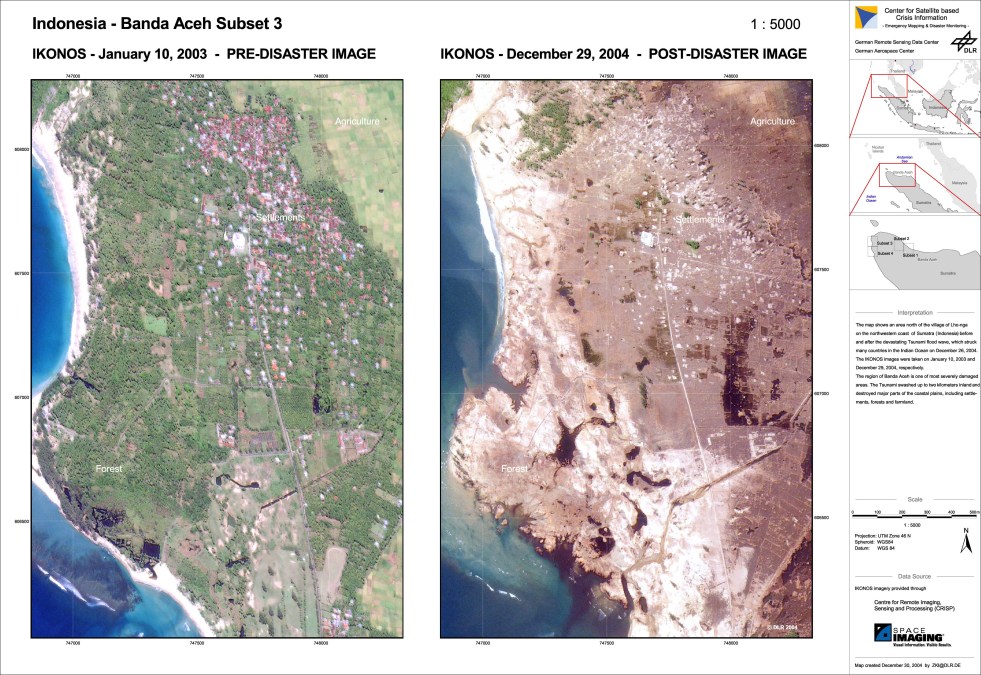
Indonesia Aceh, Scale 1:5000

Source: Ikonos images, 30/01/2003 and 29/12/2004, before and after the devastating tsunami.
Acquired: 30/01/2003 and 29/12/2004

Copyright: German Remote Sensing Data Centre, DLR - German Aerospace Center Ikonos imagery provided through Center for Remote Imaging, Sensing and Processing, Space Imaging.
Scale 1:12.500 Map created 30 December 2004 by zki@dlr.de
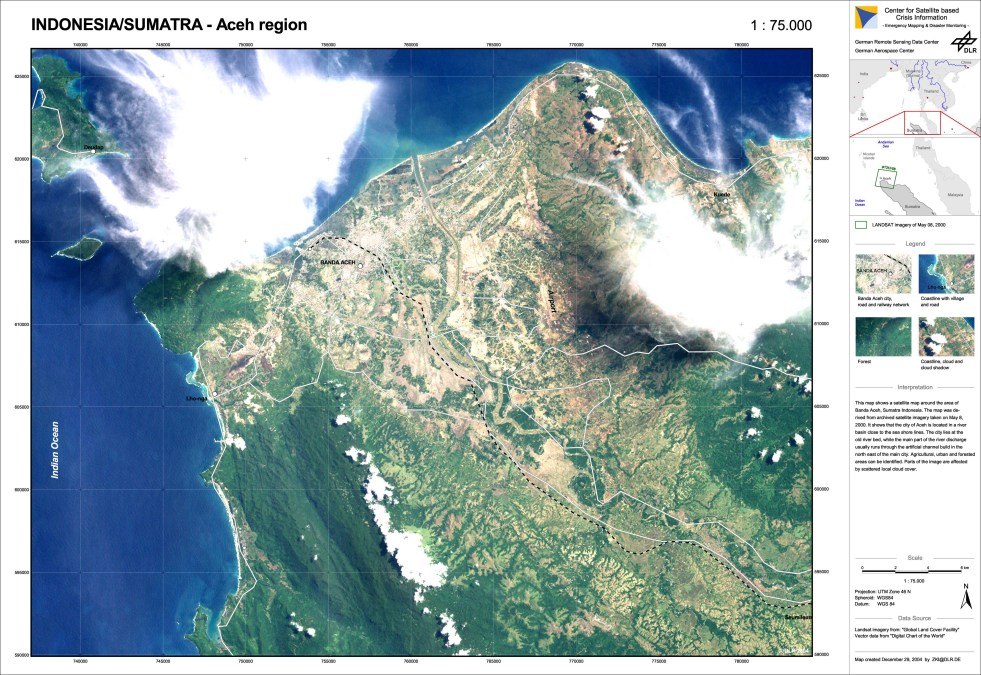
Indonesia aceh, Scale 1:75,000

Source: Landsat imagery, 08/05/2000
Acquired: 08/05/2000

Copyright: German Remote Sensing Data Centre, DLR - German Aerospace Center
Map created 30 December 2004 by zki@dlr.de
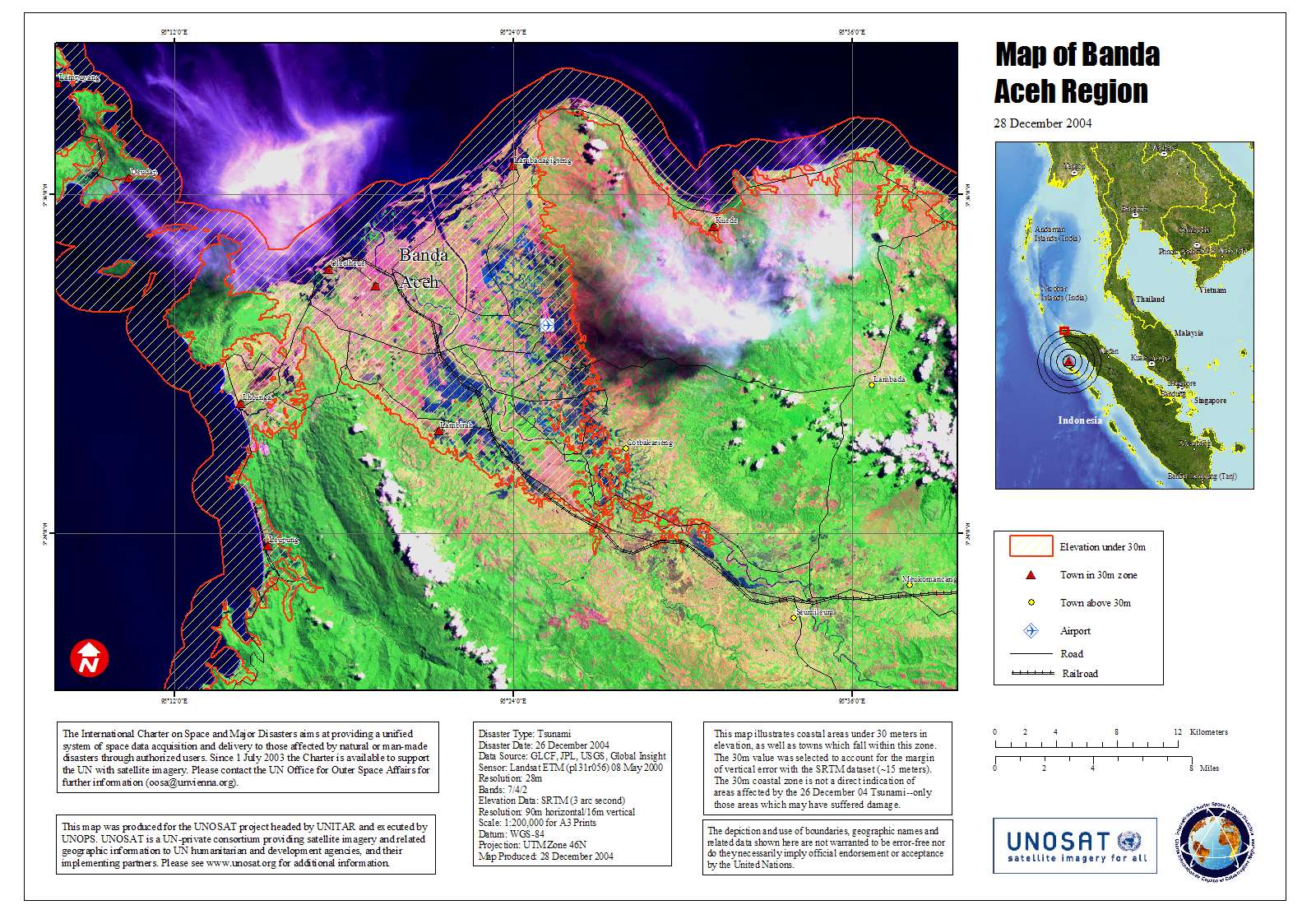
Satellite map of Banda Aceh region, scale: 1:200,000.

Source: GLCF, JPL, Global Insight.
Acquired: 8 Mai 2000

Copyright: Landsat ETM data acquired 8 May 2000, bands 7/4/2, 28 m resolution Elevation data: SRTM (3 arc seconds). Shows coastal areas under 30 meters elevation.
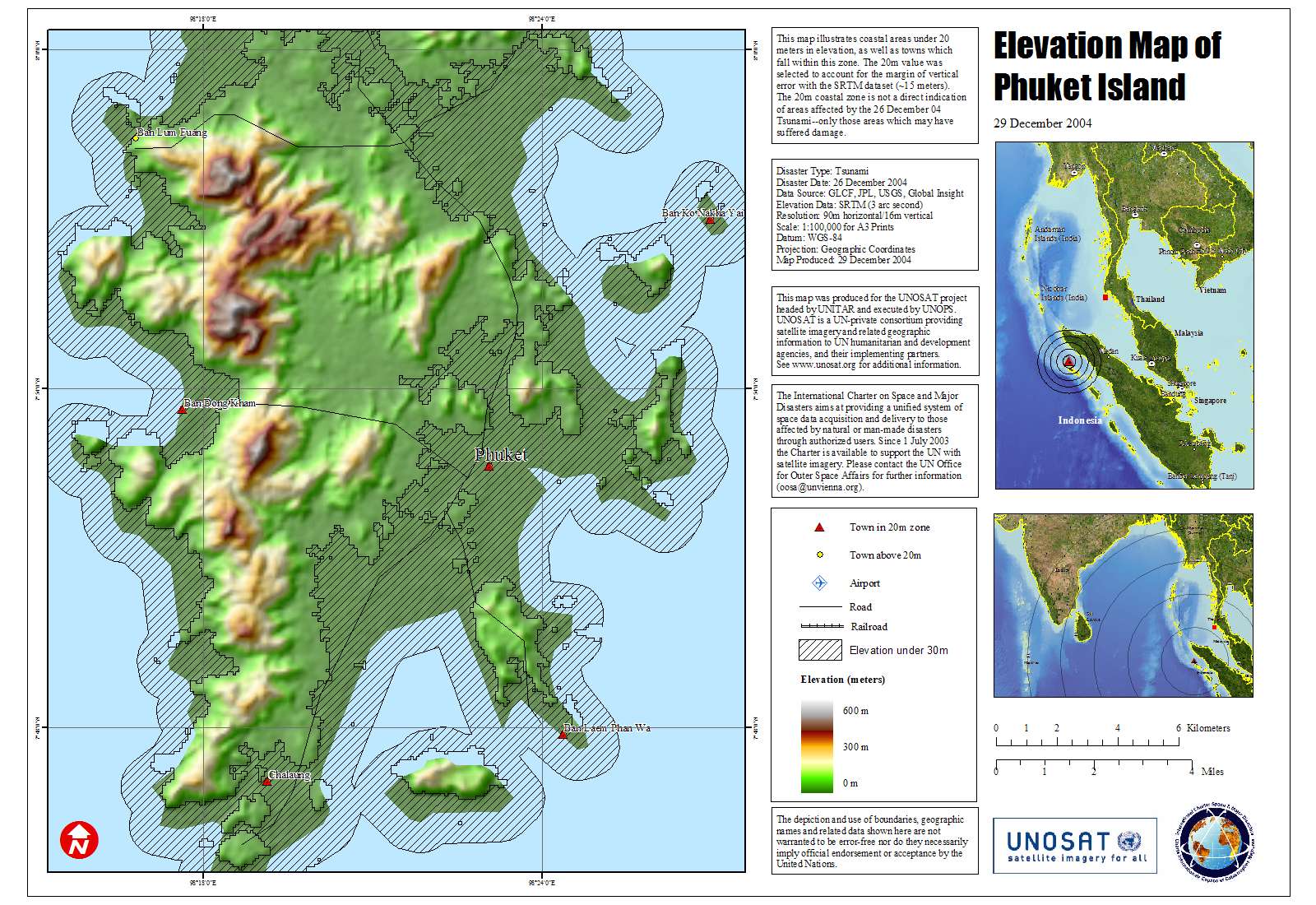
Elevation map of Phuket Island, scale: 1:100,000.

Source: GLCF, JPL, USGS, Global Insight. Elevation data: SRTM (3 arc seconds). Shows coastal areas under 20 meters elevation.
Acquired: --

Copyright: Map produced 29/12/2004 by UNOSAT.

Other info: --
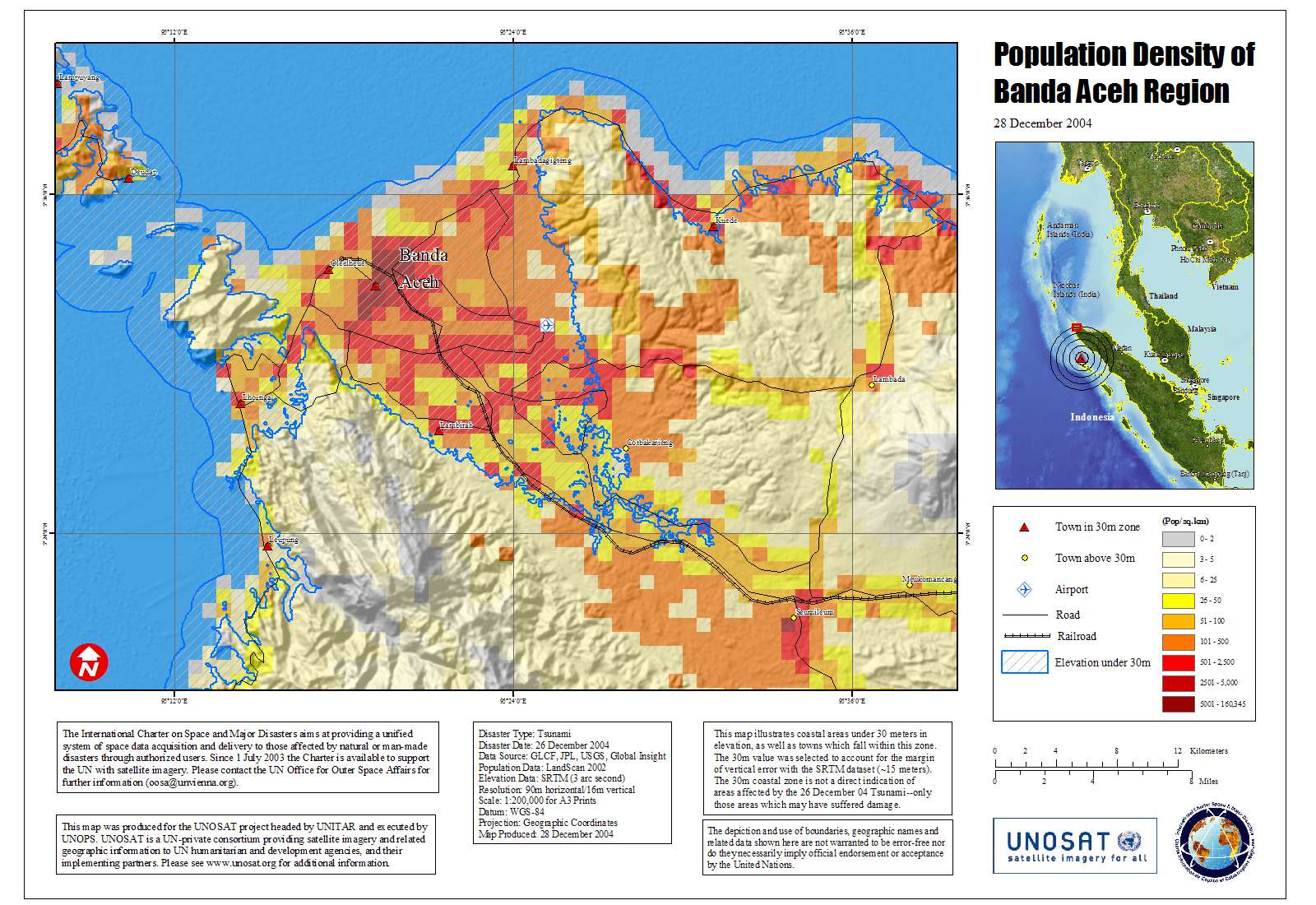
Population density map of Banda Aceh region, scale: 1:200,000.

Source: GLCF, JPL, Global Insight. Elevation data: SRTM (3 arc seconds). Population data: LandScan 2002. Shows coastal areas under 30 meters elevation.
Acquired: --

Copyright: Map produced 28/12/2004 by UNOSAT.

Other info: --
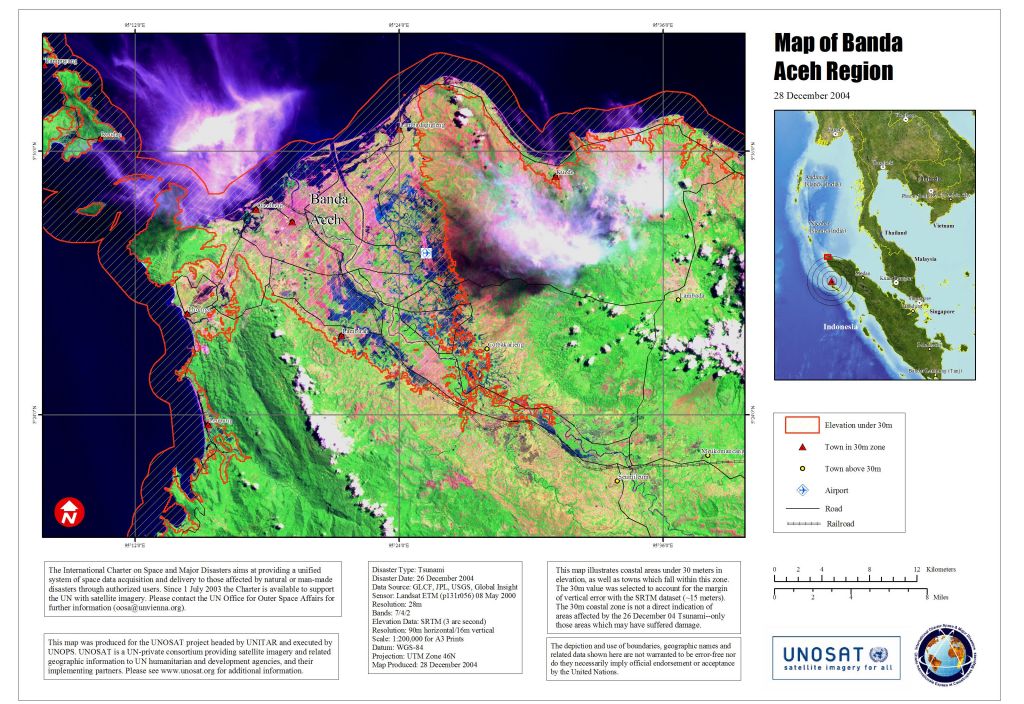
Satellite map of Aceh Etm.

Source: GLCF, JPL, Global Insight; Landsat.
Acquired: --

Copyright: Map produced 01/01/2005 by UNOSAT.
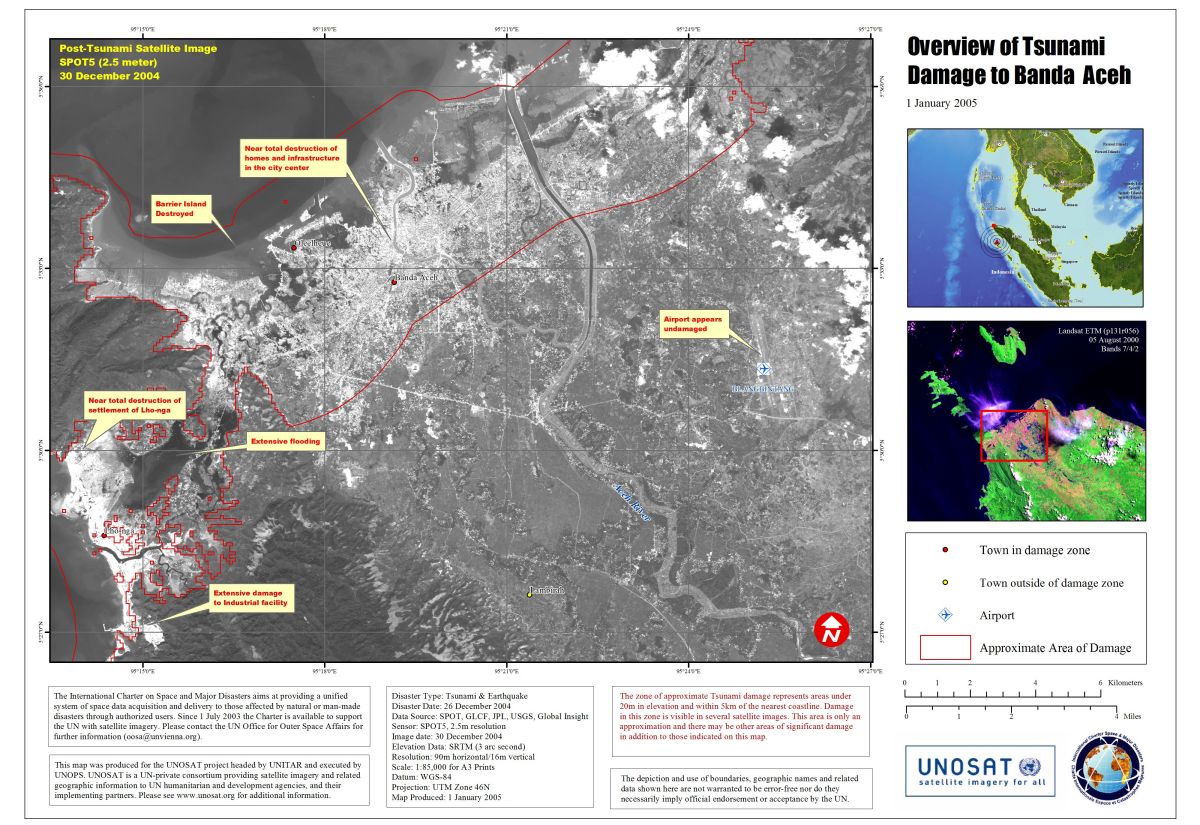
Satellite map of Banda Aceh Damage.

Source: GLCF, JPL, Global Insight; SPOT 5.
Acquired: --

Copyright: Map produced 01/01/2005 by UNOSAT.
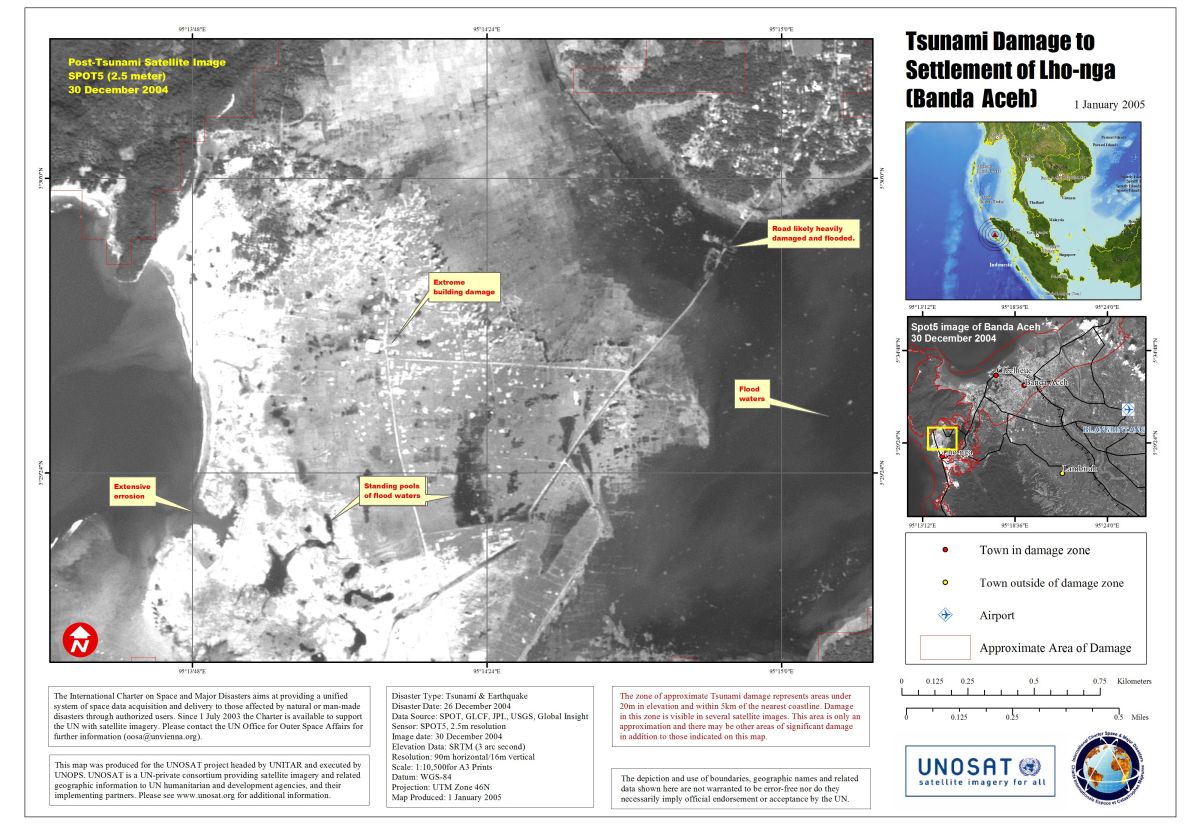
Satellite map of Banda Aceh Damage.

Source: GLCF, JPL, Global Insight; SPOT 5.
Acquired: --

Copyright: Map produced 30/12/2004 by UNOSAT.
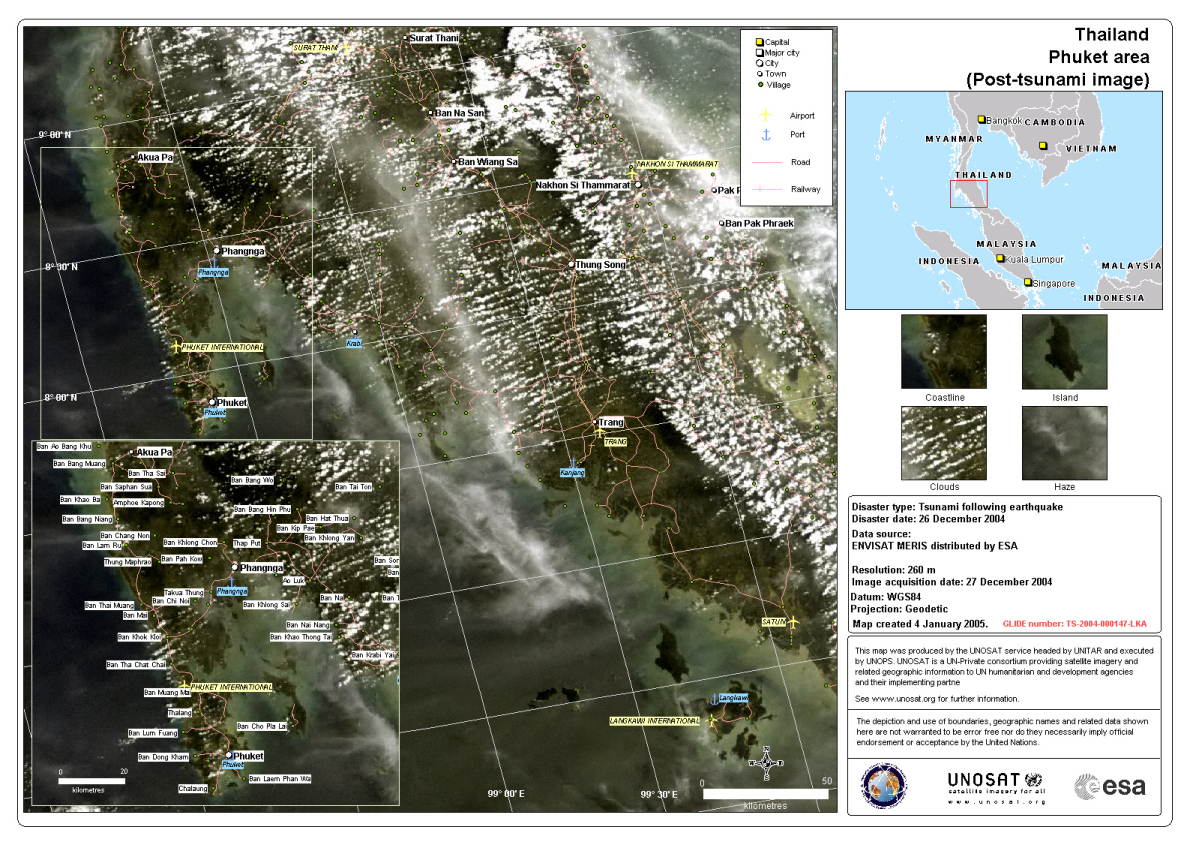
Satellite map of Phuket Envisat MERIS RGB Overview.

Source: ESA; Envisat MERIS.
Acquired: 27 December 2004

Copyright: Map produced 04/01/2005 by UNOSAT.
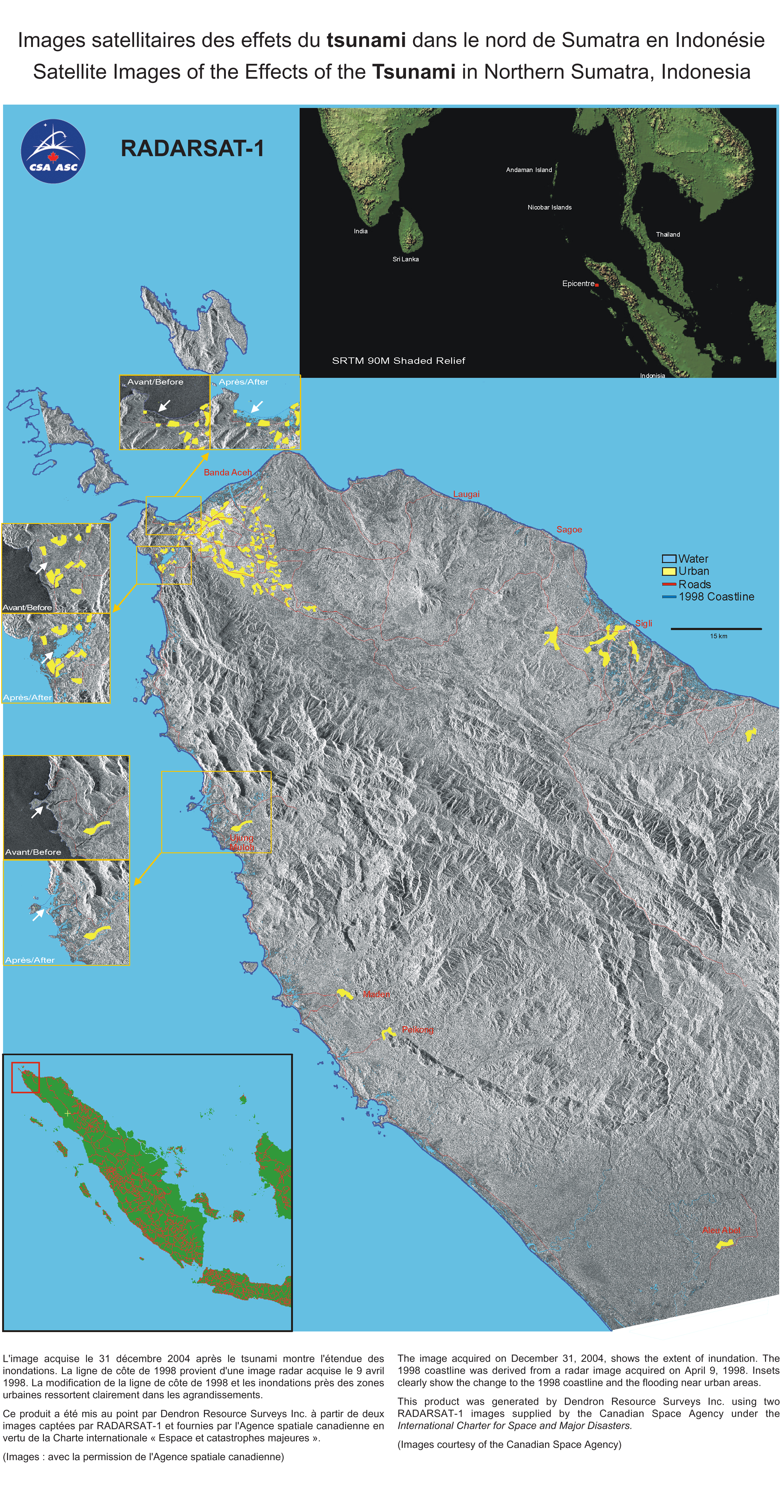
Dendron Poster: Sumatra.

Source: --
Acquired: --

Copyright: --
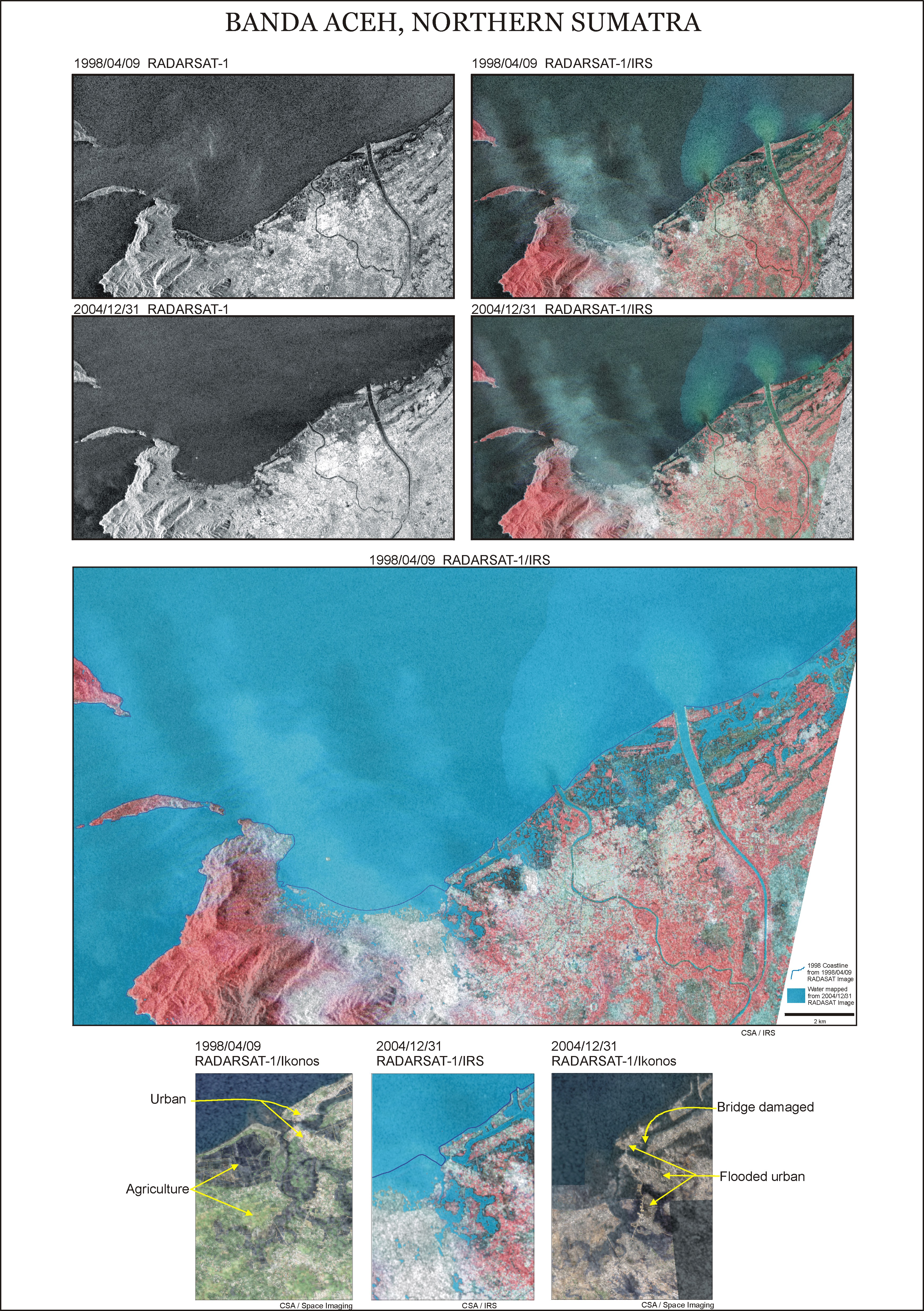
Dendron Poster: Banda Aceh.

Source: --
Acquired: --

Copyright: --
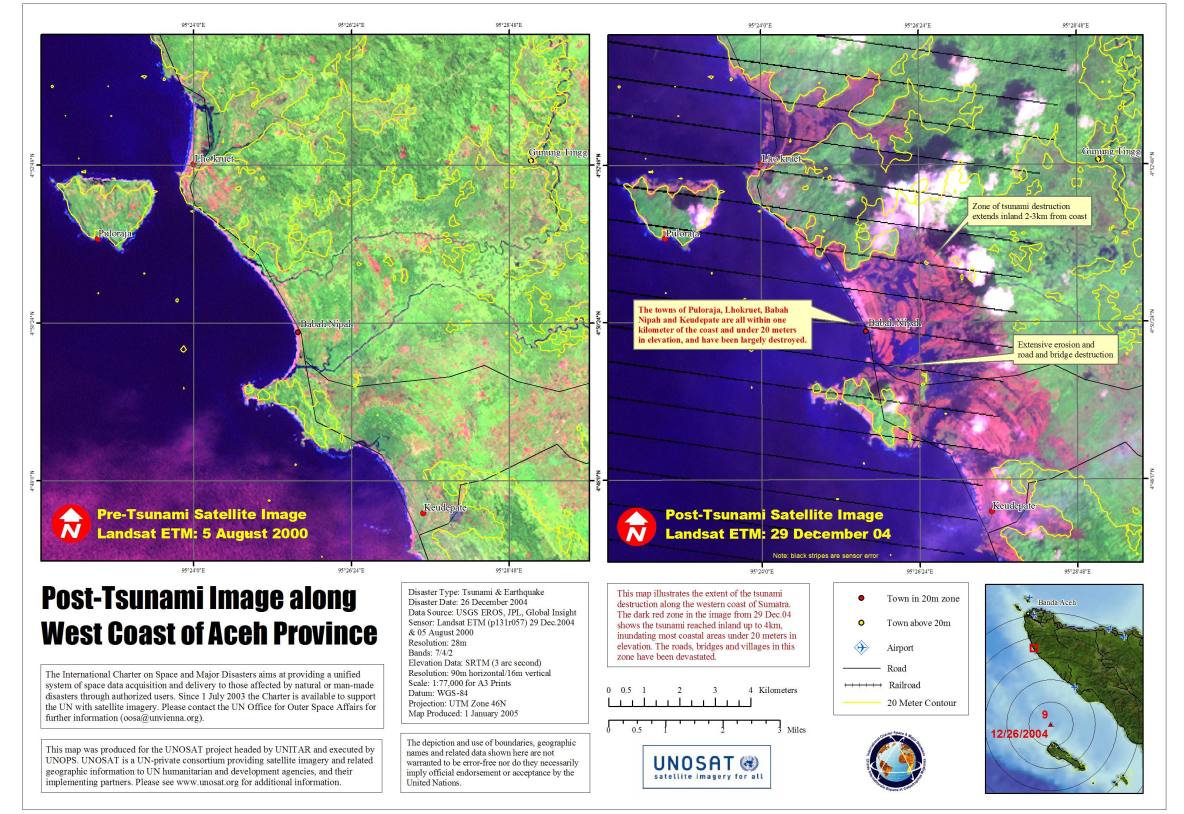
Satellite map of Aceh Coast Landsat ETM.

Source: GLCF, JPL, Global Insight; Landsat.
Acquired: --

Copyright: Map produced 01/01/2005 by UNOSAT
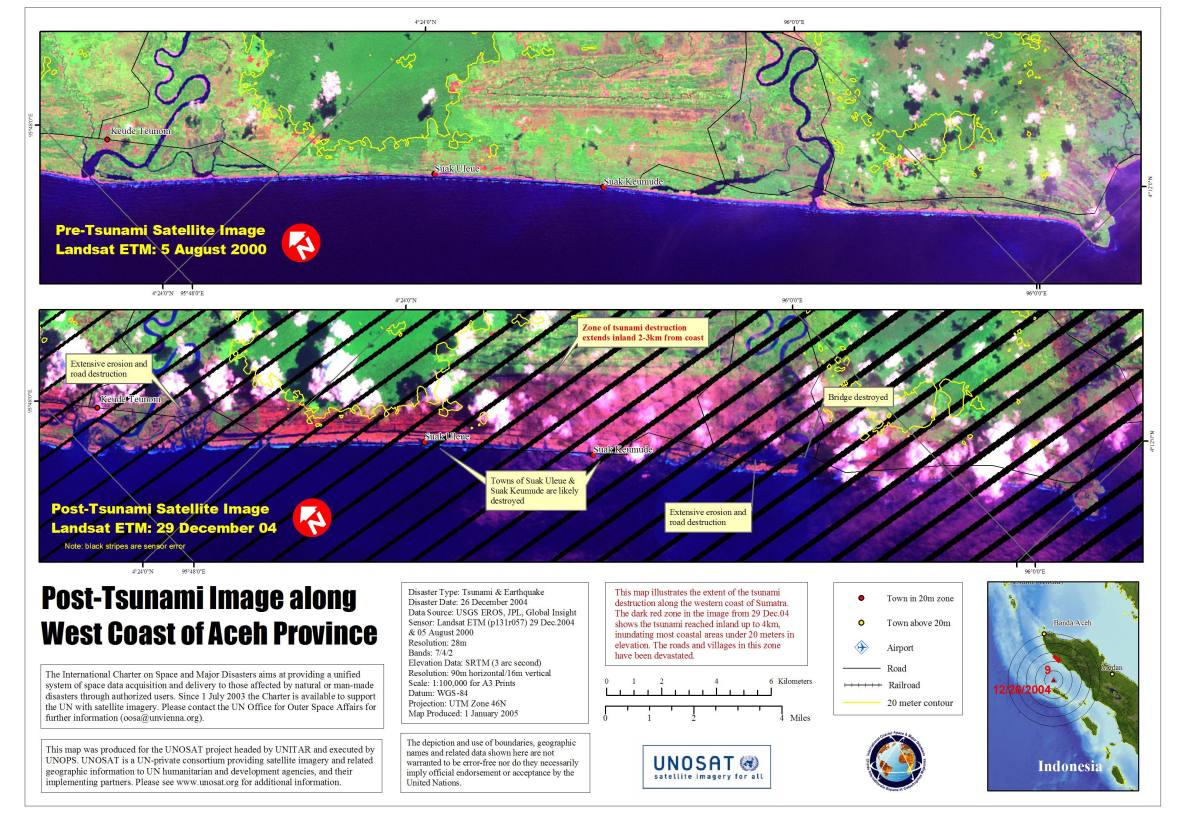
Satellite map of Aceh Coast Landsat ETM.

Source: GLCF, JPL, Global Insight; Landsat.
Acquired: --

Copyright: Map produced 01/01/2005 by UNOSAT.
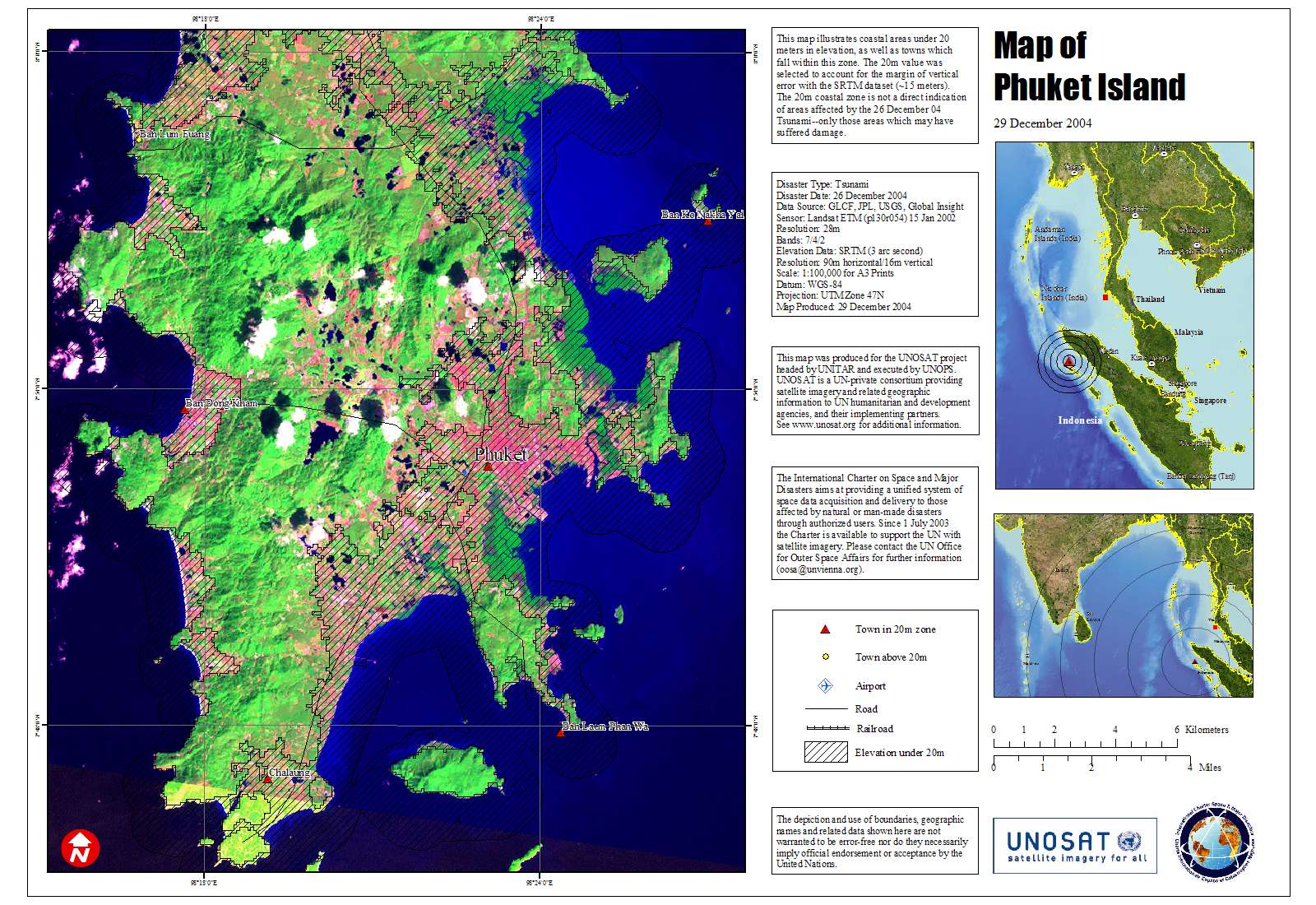
Satellite map of Phuket Island, scale: 1:100,000.

Source: GLCF, JPL, Global Insight. Landsat ETM data acquired 8 Jan 2002, bands 7/4/2, 28 m resolution Elevation data: SRTM (3 arc seconds). Shows coastal areas under 20 meters elevation.
Acquired: 8 Jan 2002

Copyright: Map produced 29/12/2004 by UNOSAT.

Other info: --
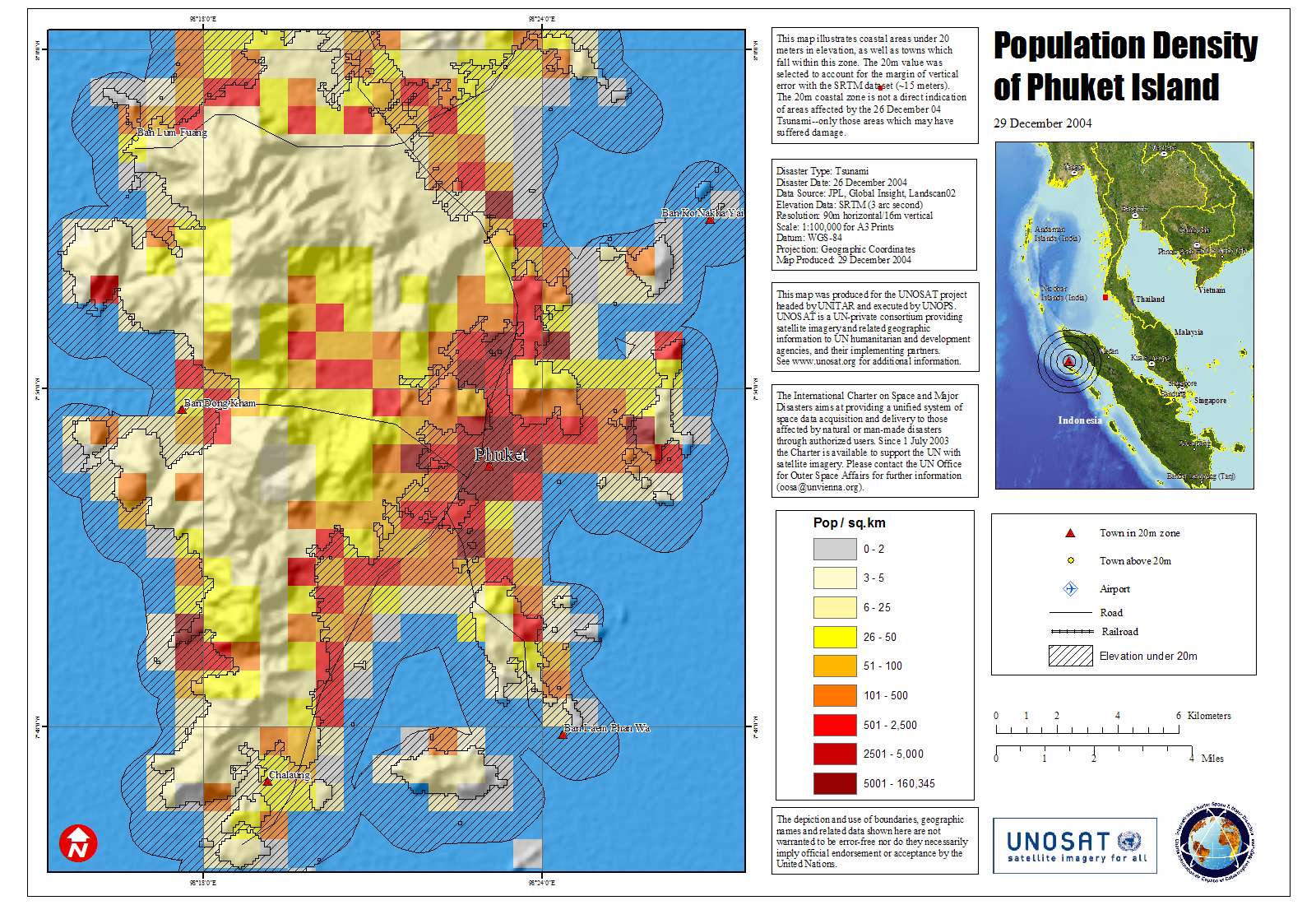
Population density map of Island, scale: 1:100,000.

Source: GLCF, JPL, Global Insight. Elevation data: SRTM (3 arc seconds). Population data: LandScan 2002. Shows coastal areas under 20 meters elevation.
Acquired: --

Copyright: Map produced 29/12/2004 by UNOSAT.

Other info: --
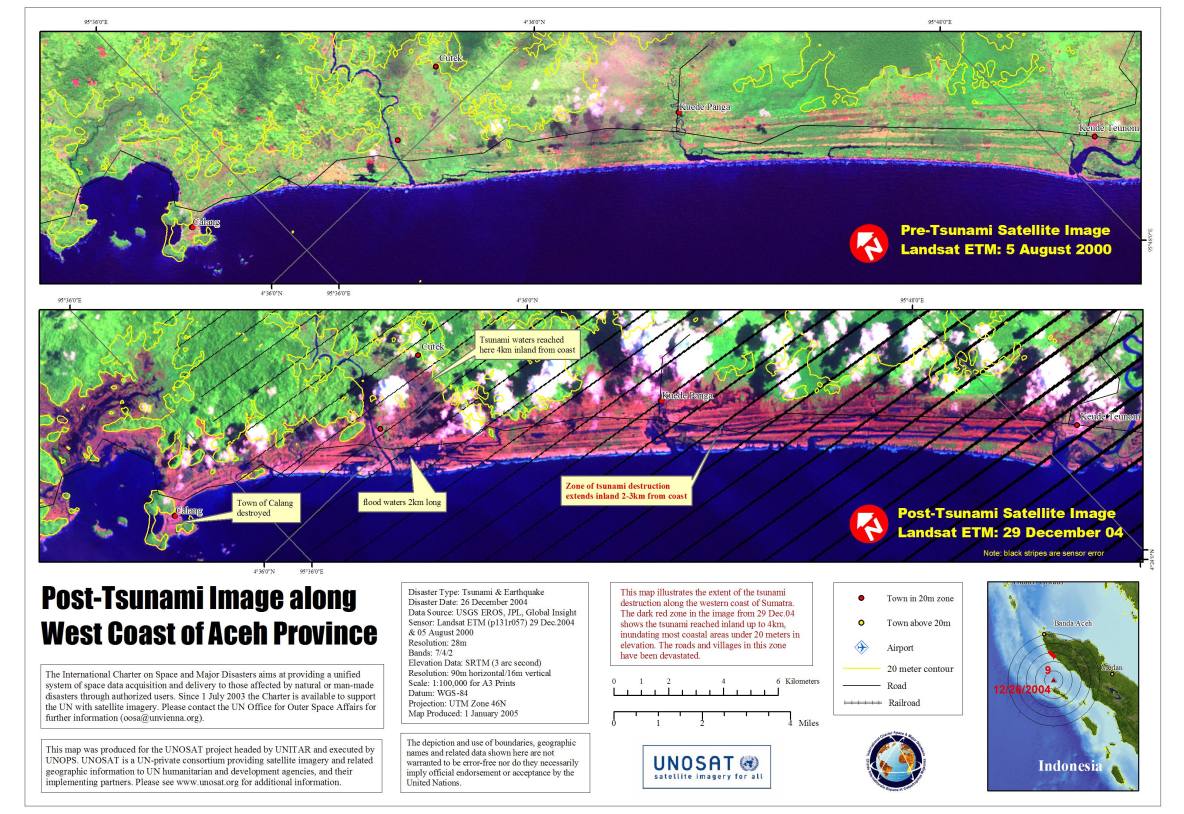
Satellite map of Aceh Coast Landsat ETM.

Source: GLCF, JPL, Global Insight; Landsat.
Acquired: --

Copyright: Map produced 01/01/2005 by UNOSAT

Other info: --
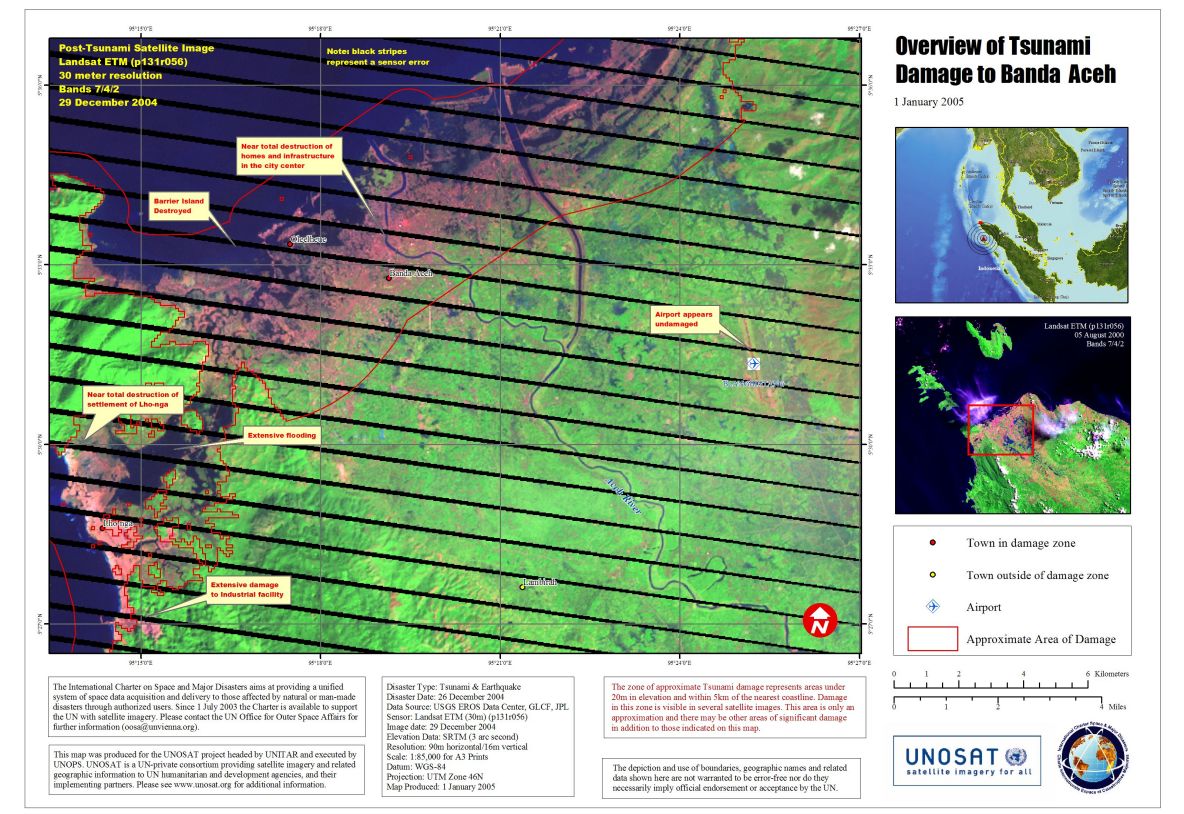
Satellite map of Banda-aceh ETM

Source: GLCF, JPL, Global Insight; Landsat.
Acquired: --

Copyright: Map produced 01/01/2005 by UNOSAT
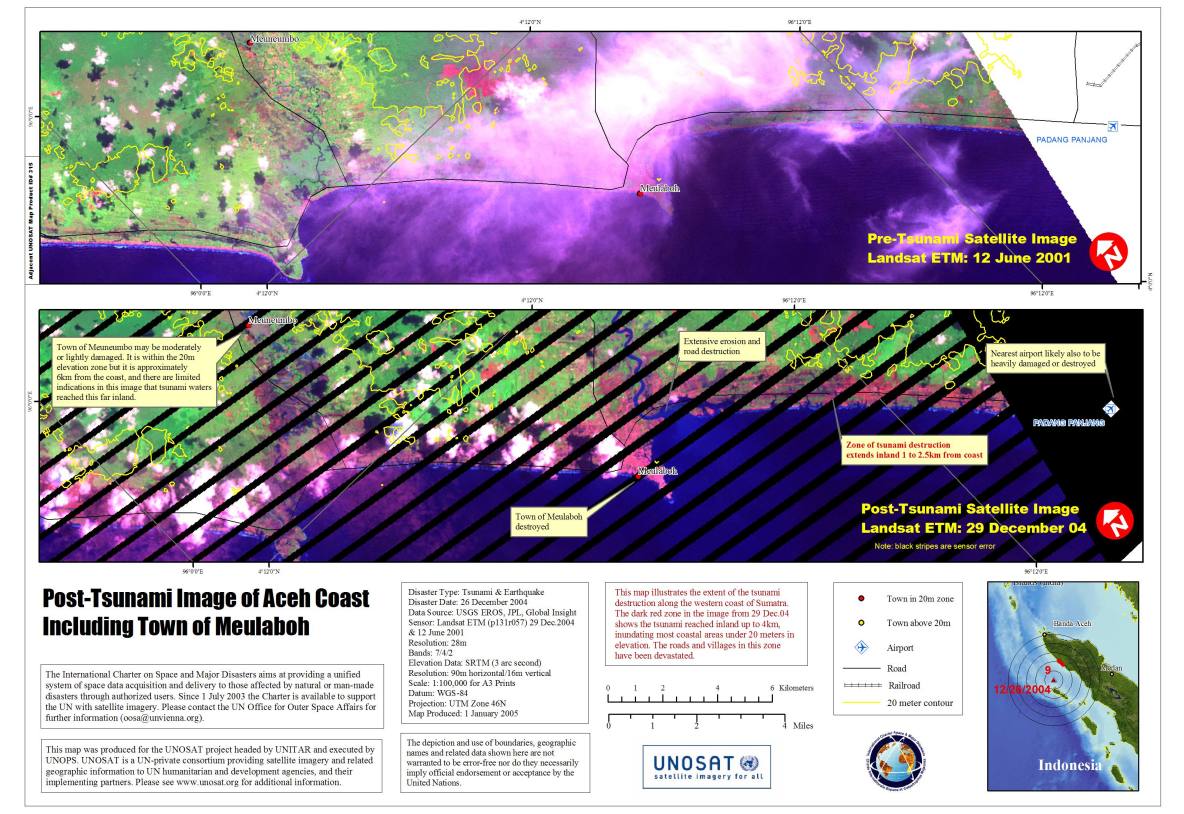
Satellite map of Aceh Coast Landsat ETM.

Source: GLCF, JPL, Global Insight; Landsat.
Acquired: --

Copyright: Map produced 01/01/2005 by UNOSAT
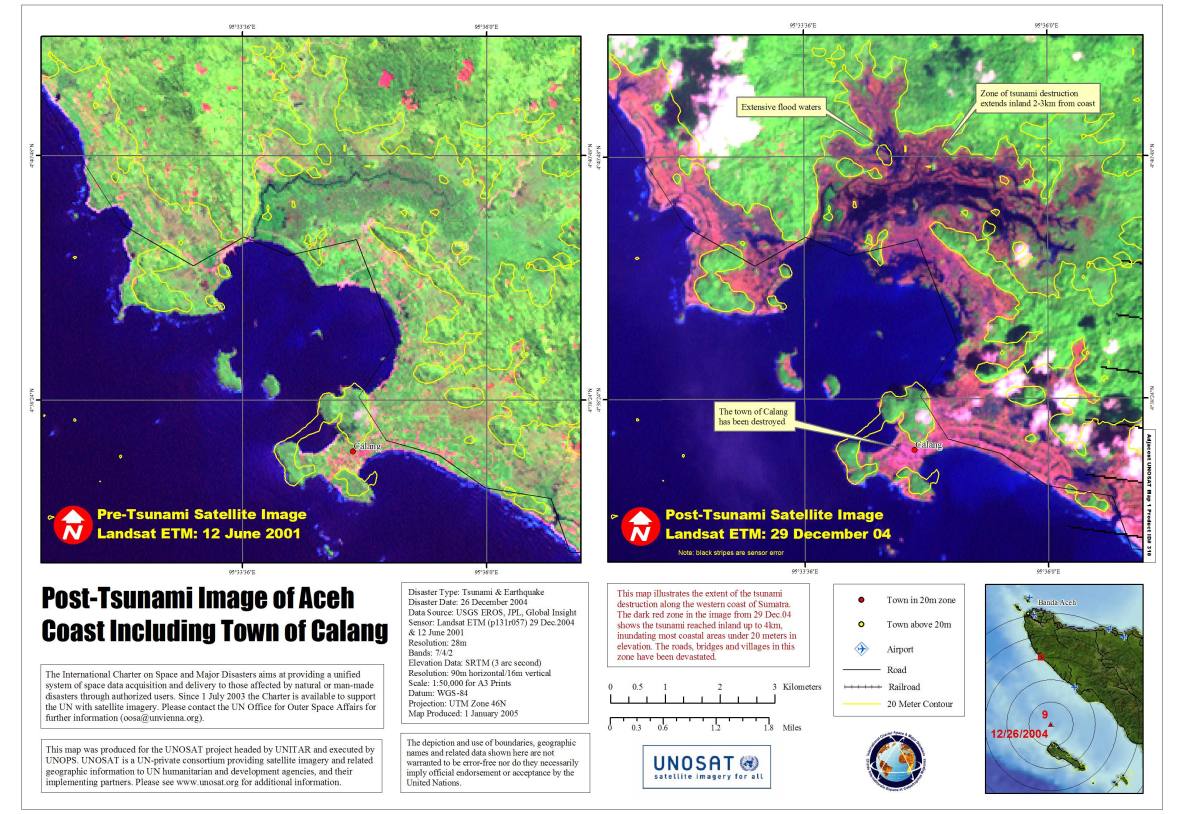
Satellite map of Aceh Coast Landsat ETM

Source: GLCF, JPL, Global Insight; Landsat.
Acquired: --

Copyright: Map produced 01/01/2005 by UNOSAT.
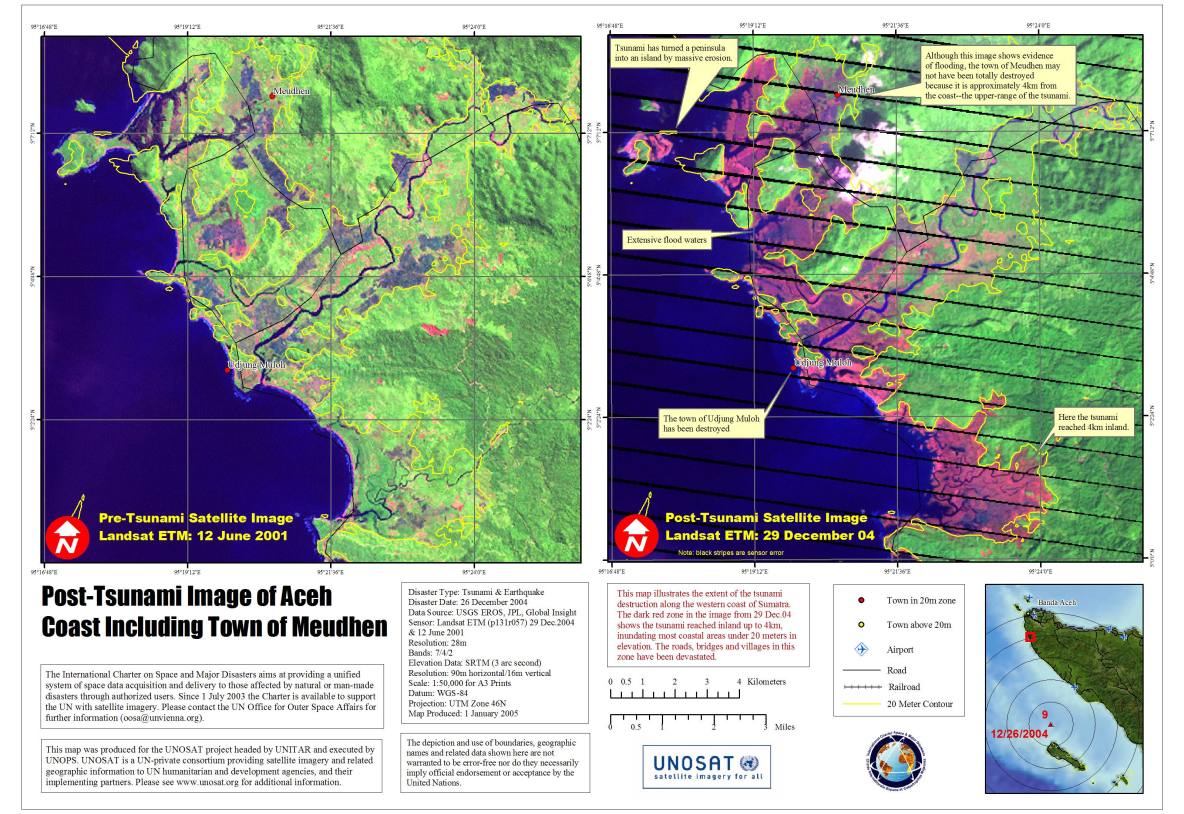
Satellite map of Aceh Coast Landsat ETM.

Source: GLCF, JPL, Global Insight; Landsat.
Acquired: --

Copyright: Map produced 01/01/2005 by UNOSAT.
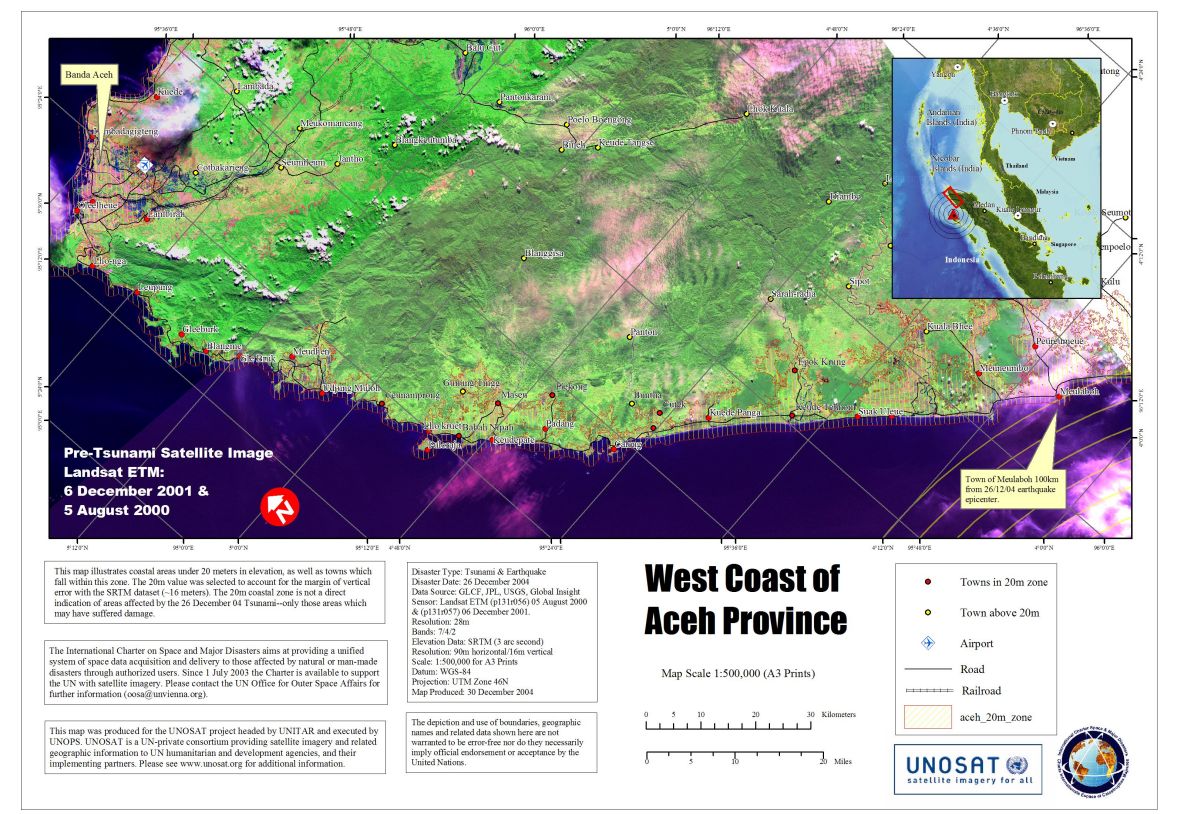
Satellite map of Aceh Coast.

Source: GLCF, JPL, Global Insight; Landsat.
Acquired: --

Copyright: Map produced 01/01/2005 by UNOSAT.
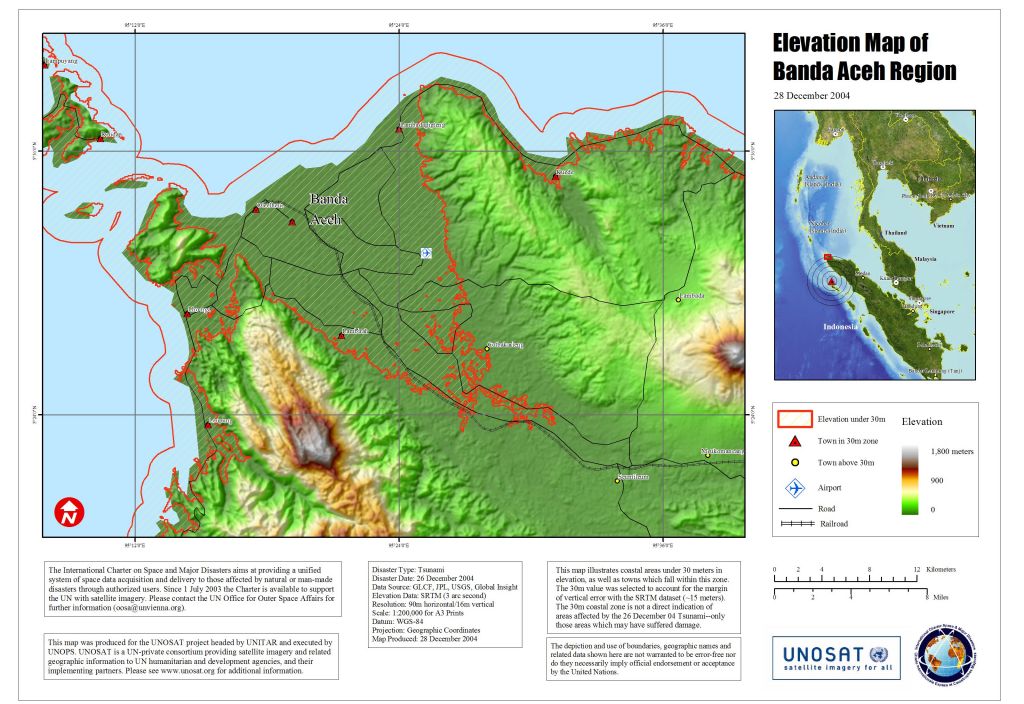
Satellite map of Aceh Elevation at 200 dpi.

Source: GLCF, JPL, Global Insight; Landsat.
Acquired: --

Copyright: Map produced 01/01/2005 by UNOSAT.
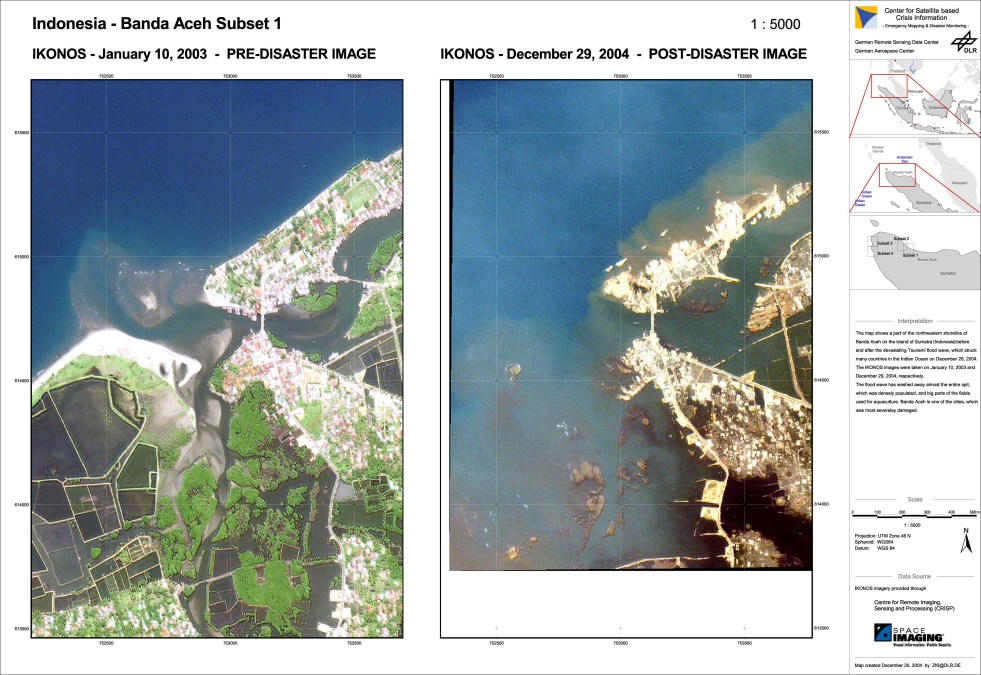
Indonesia Aceh

Source: Scale 1:5000 Ikonos images, 30/01/2003 and 29/12/2004, before and after the devastating tsunami. Scale 1:12.500
Acquired: 30/01/2003 and 29/12/2004

Copyright: German Remote Sensing Data Centre, DLR - German Aerospace Center Ikonos imagery provided through Center for Remote Imaging, Sensing and Processing, Space Imaging.
Map created 30 December 2004 by zki@dlr.de
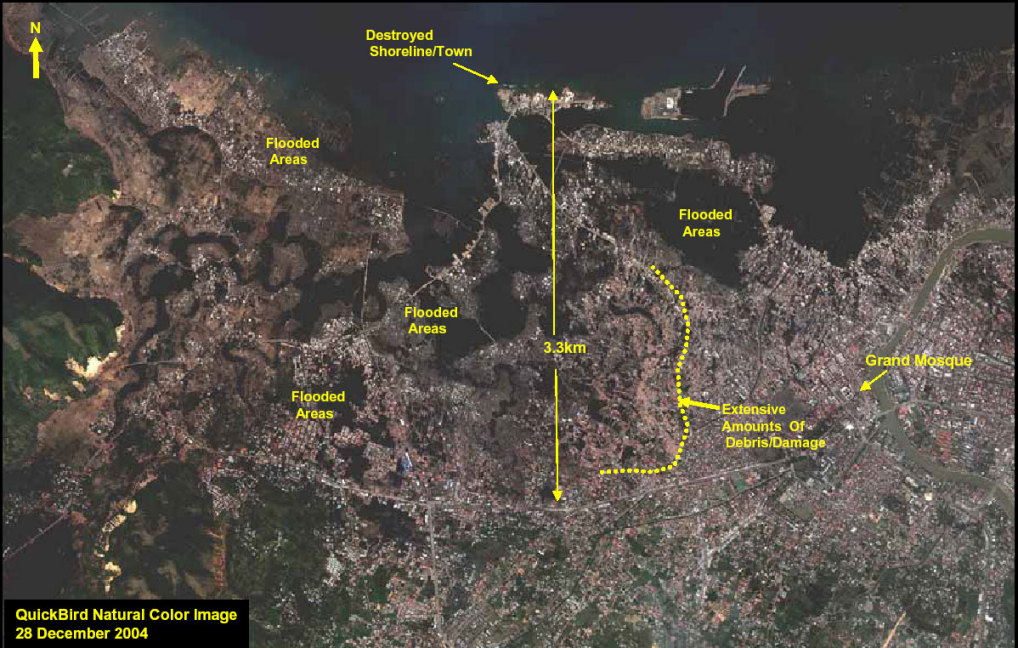
QuickBird Image, 28 December 2004

Source: --
Acquired: --

Copyright: --

Other info: --
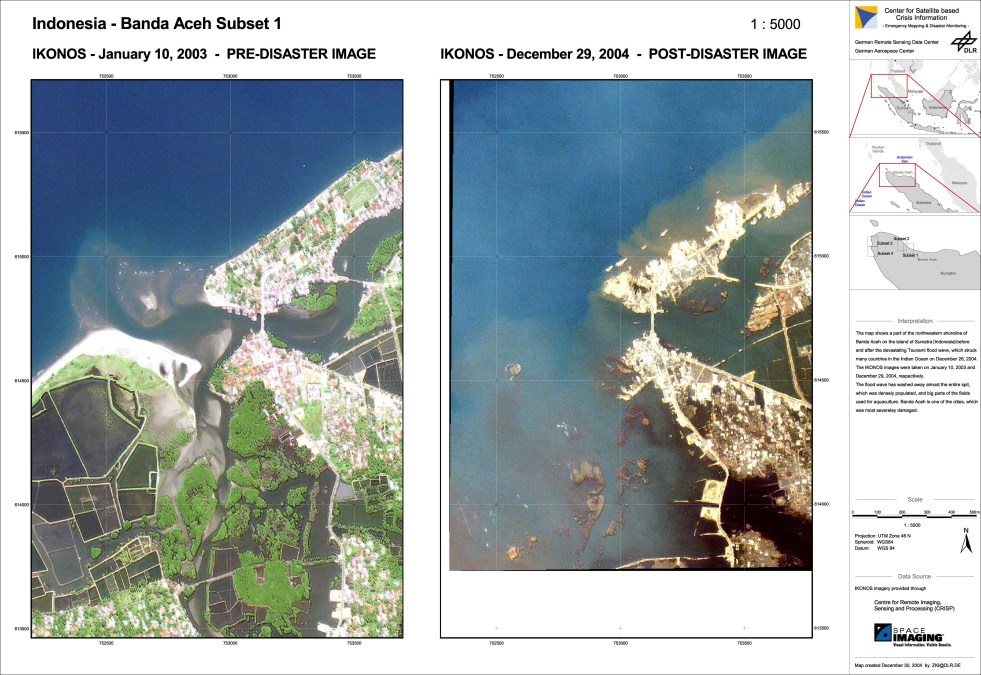
Indonesia Aceh, Scale 1:5000, before and after the devastating tsunami.

Source: Ikonos
Acquired: 30/01/2003 and 29/12/2004

Copyright: Map created 30 December 2004 by zki@dlr.de German Remote Sensing Data Centre, DLR - German Aerospace Center Ikonos imagery provided through Center for Remote Imaging, Sensing and Processing, Space Imaging.
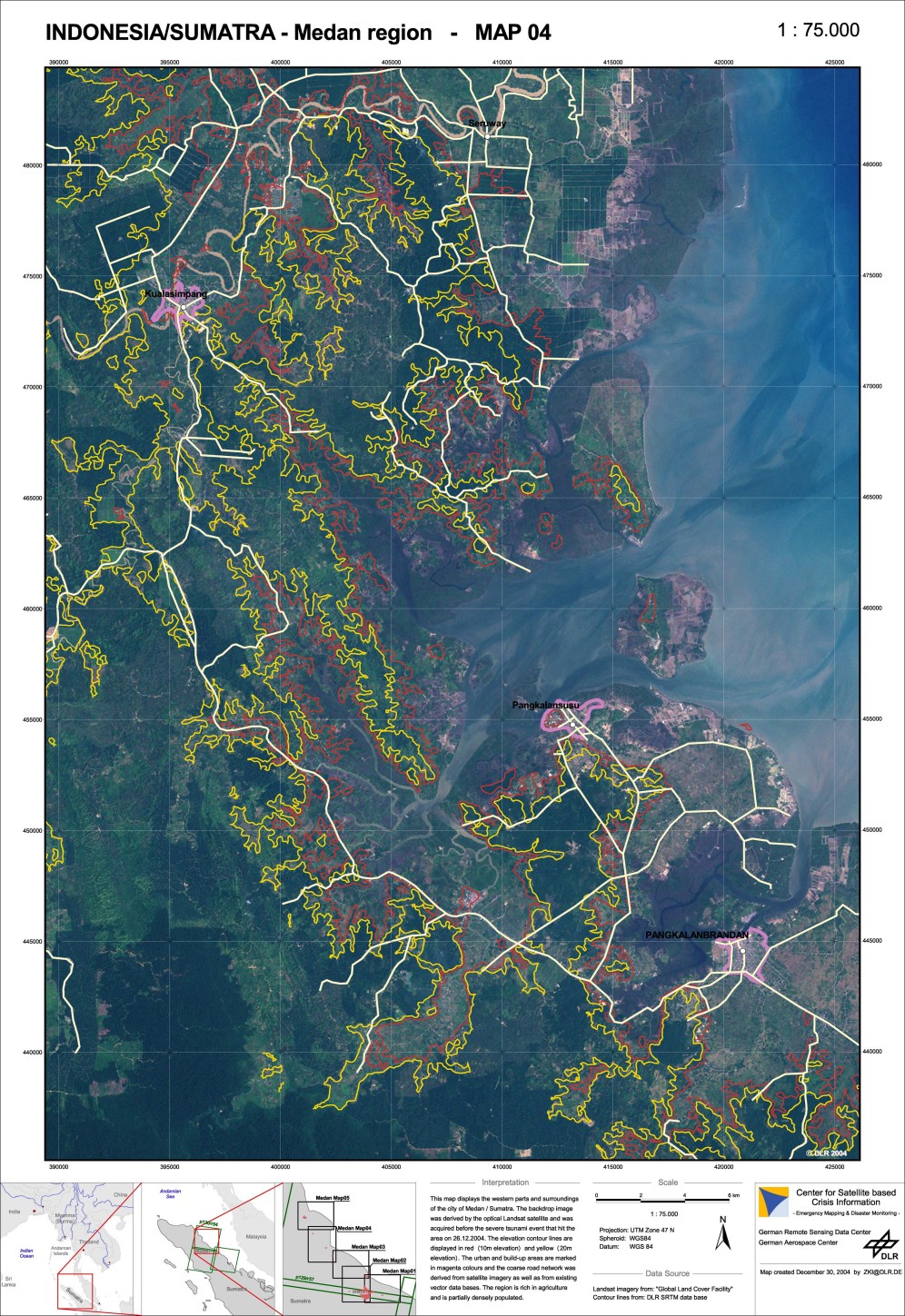
Medan, Scale 1:75,000

Source: Landsat imagery, archived data.
Copyright: German Remote Sensing Data Centre, DLR - German Aerospace Center
Map created 30 December 2004 by zki@dlr.de
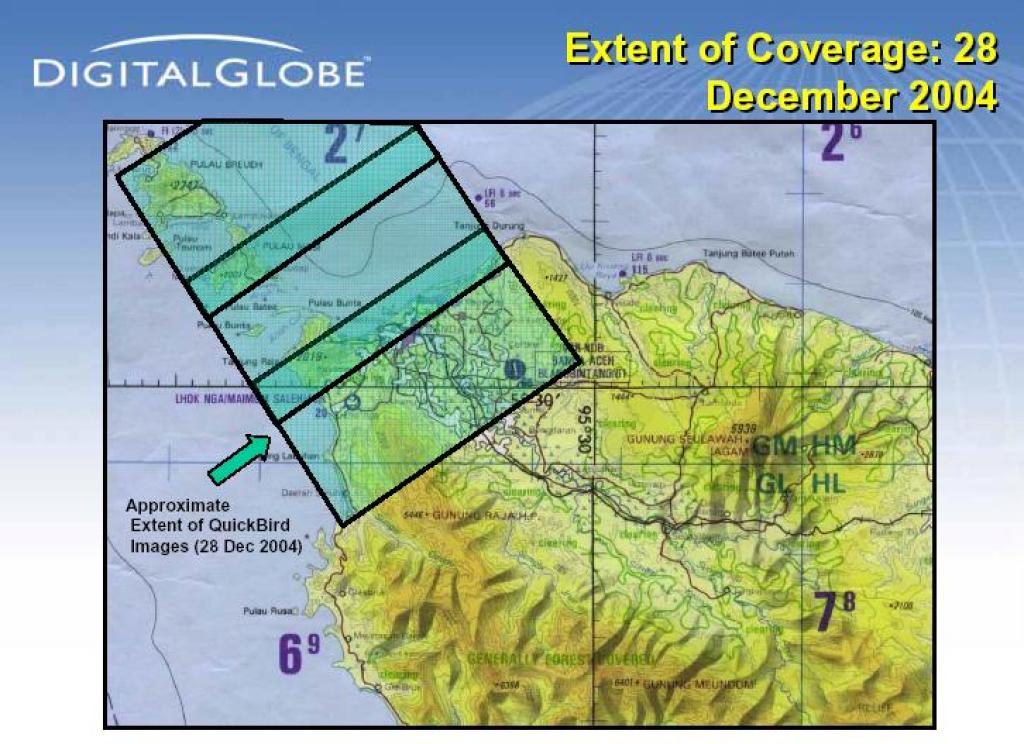
QuickBird Coverage, 28 December 2004

Source: --
Acquired: --

Copyright: --

Other info: --
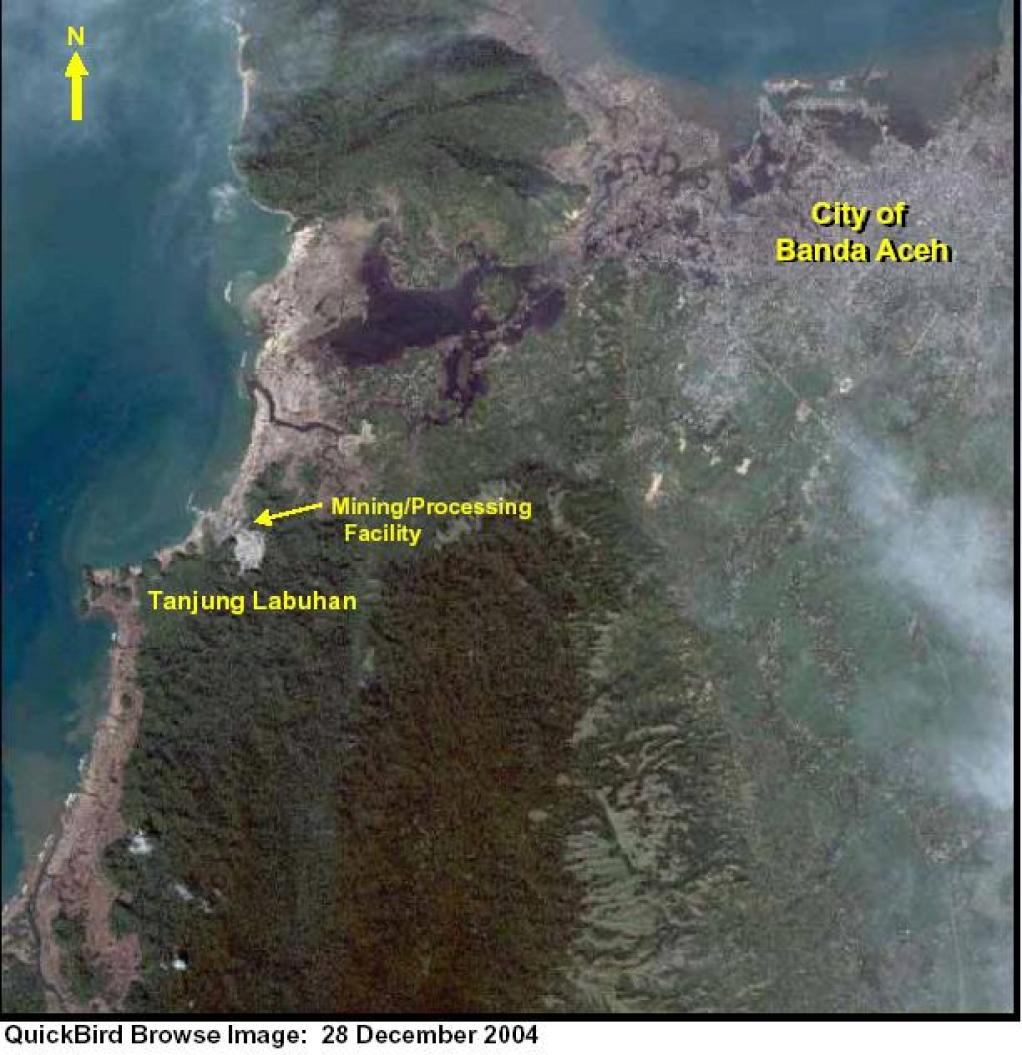
QuickBird Image, 28 December 2004

Source: --
Acquired: --

Copyright: --

Other info: --
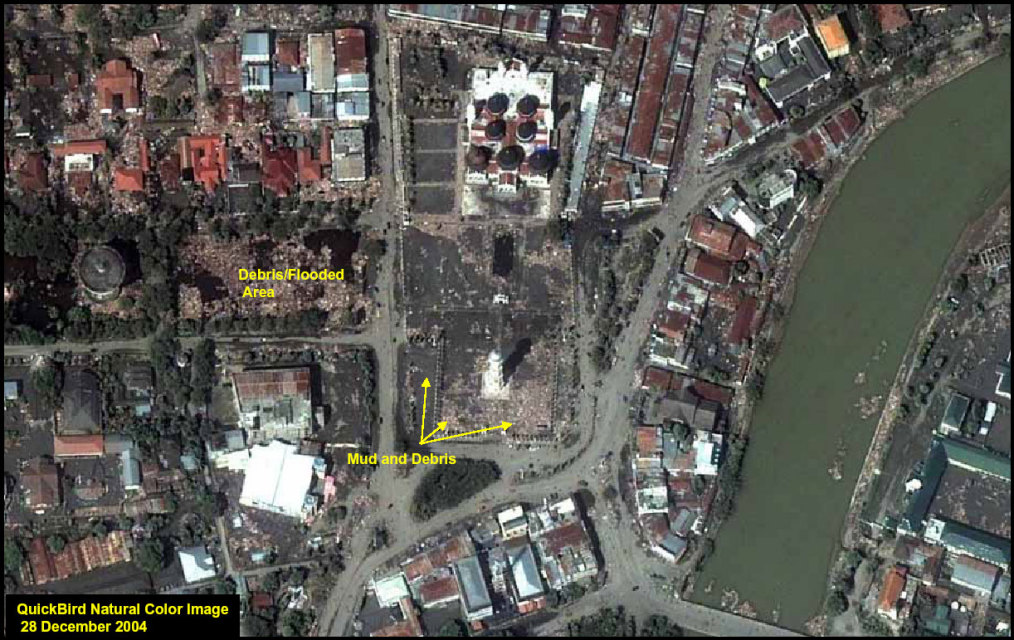
QuickBird Image, 28 December 2004

Source: --
Acquired: --

Copyright: --

Other info: --
Medan, Scale 1:75,000

Source: Ikonos images, 30/01/2003 and 29/12/2004, before and after the devastating tsunami.
Acquired: 30/01/2003 and 29/12/2004

Copyright: German Remote Sensing Data Centre, DLR - German Aerospace Center Ikonos imagery provided through Center for Remote Imaging, Sensing and Processing, Space Imaging.
Scale 1:12.500 Map created 30 December 2004 by zki@dlr.de
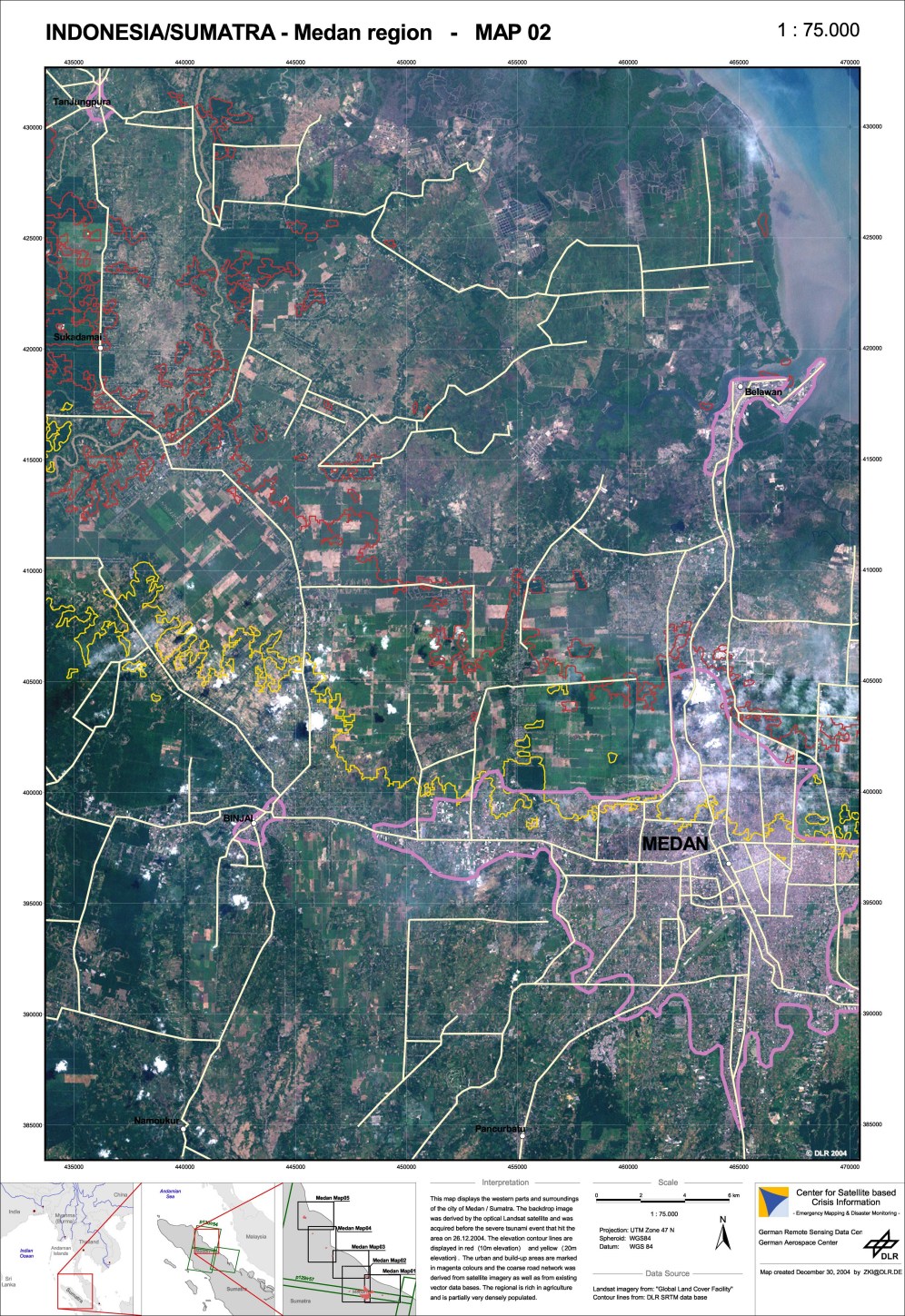
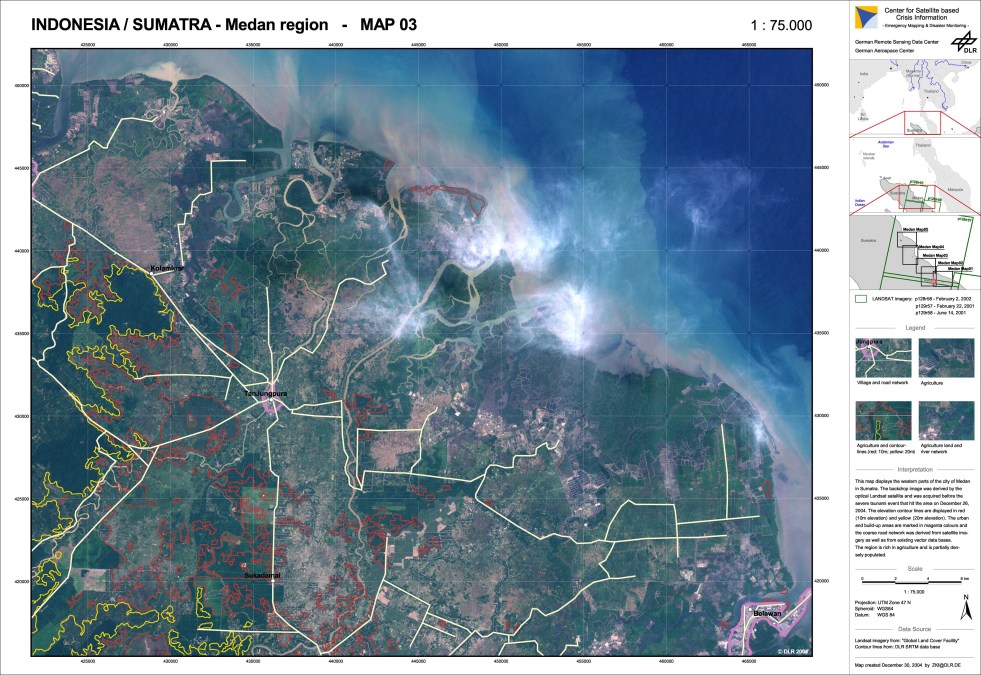
Medan Region, Scale 1:75,000

Source: Landsat imagery, DLR SRTM elevation data.
Copyright: German Remote Sensing Data Centre, DLR - German Aerospace Center
Map created 30 December 2004 by zki@dlr.de
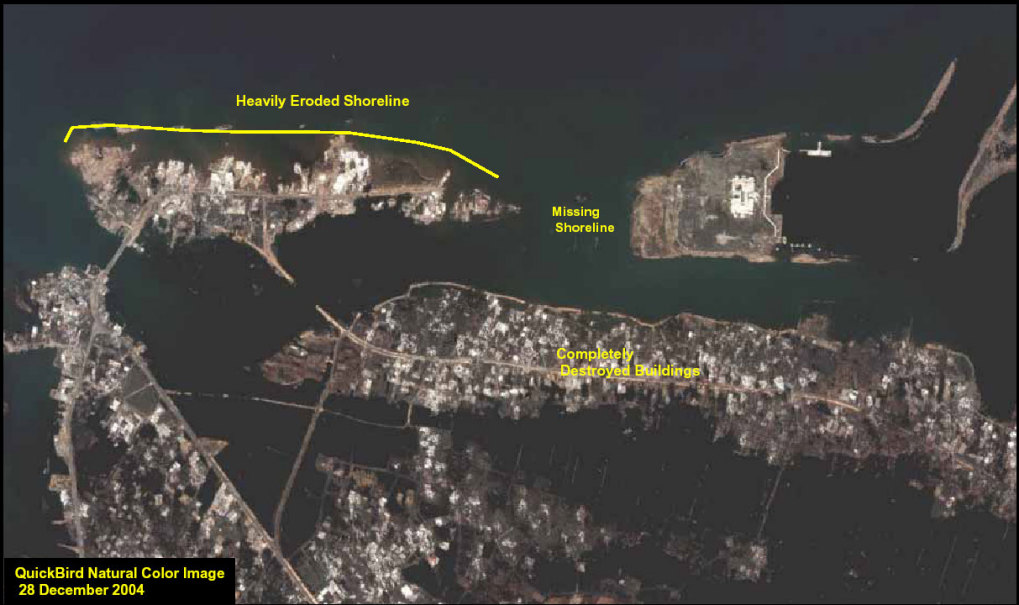
QuickBird Image, 28 December 2004

Source: --
Acquired: --

Copyright: --

Other info: --
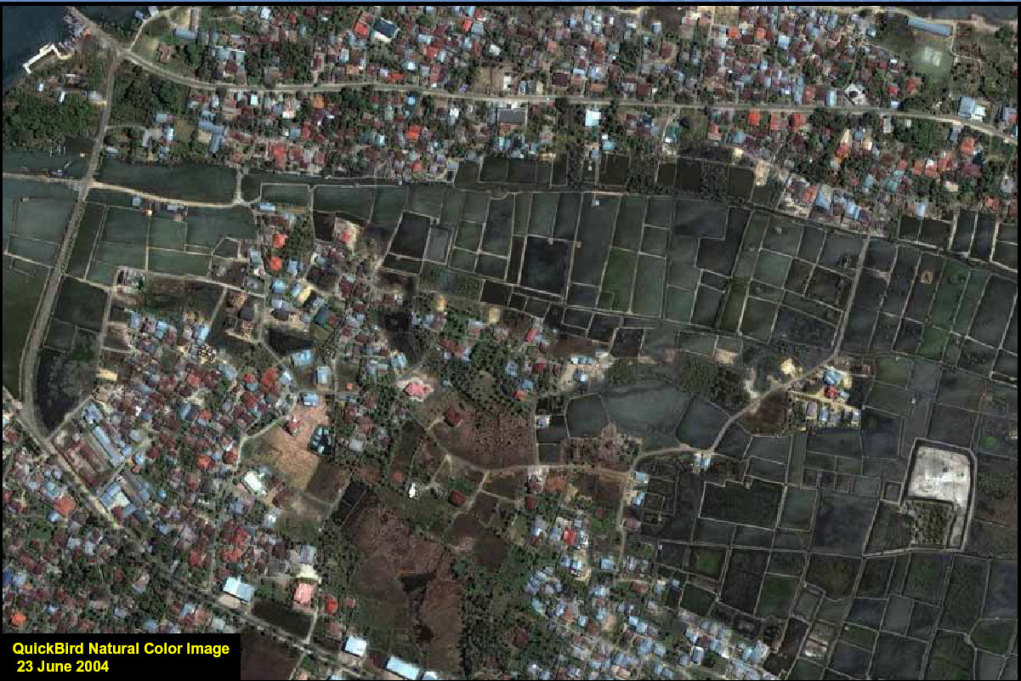
QuickBird Image, 23 June 2004

Source: --
Acquired: --

Copyright: --

Other info: --
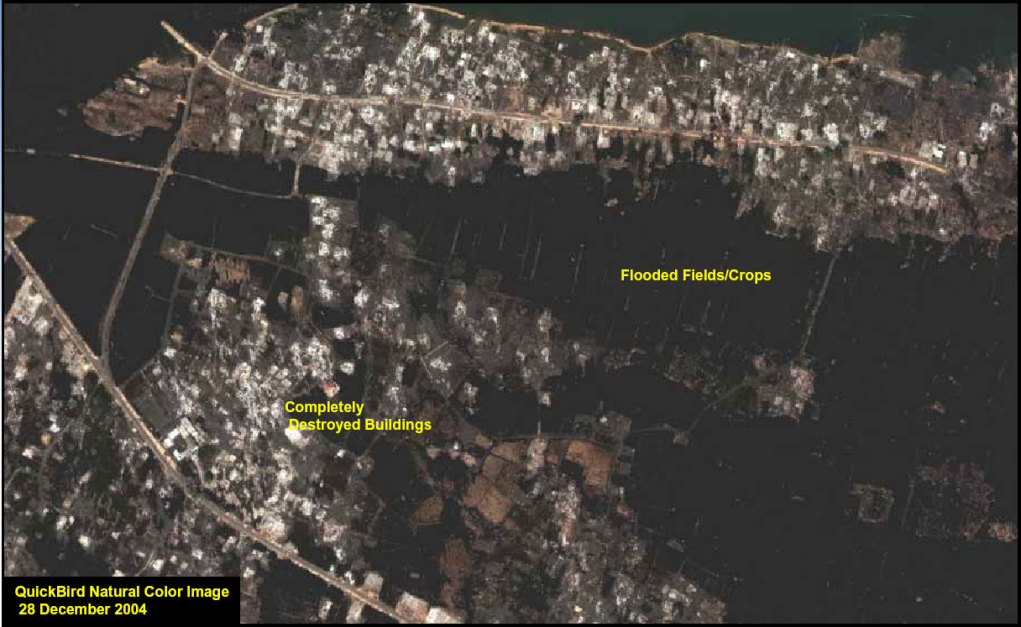
QuickBird Image, 28 December 2004

Source: --
Acquired: --

Copyright: --

Other info: --
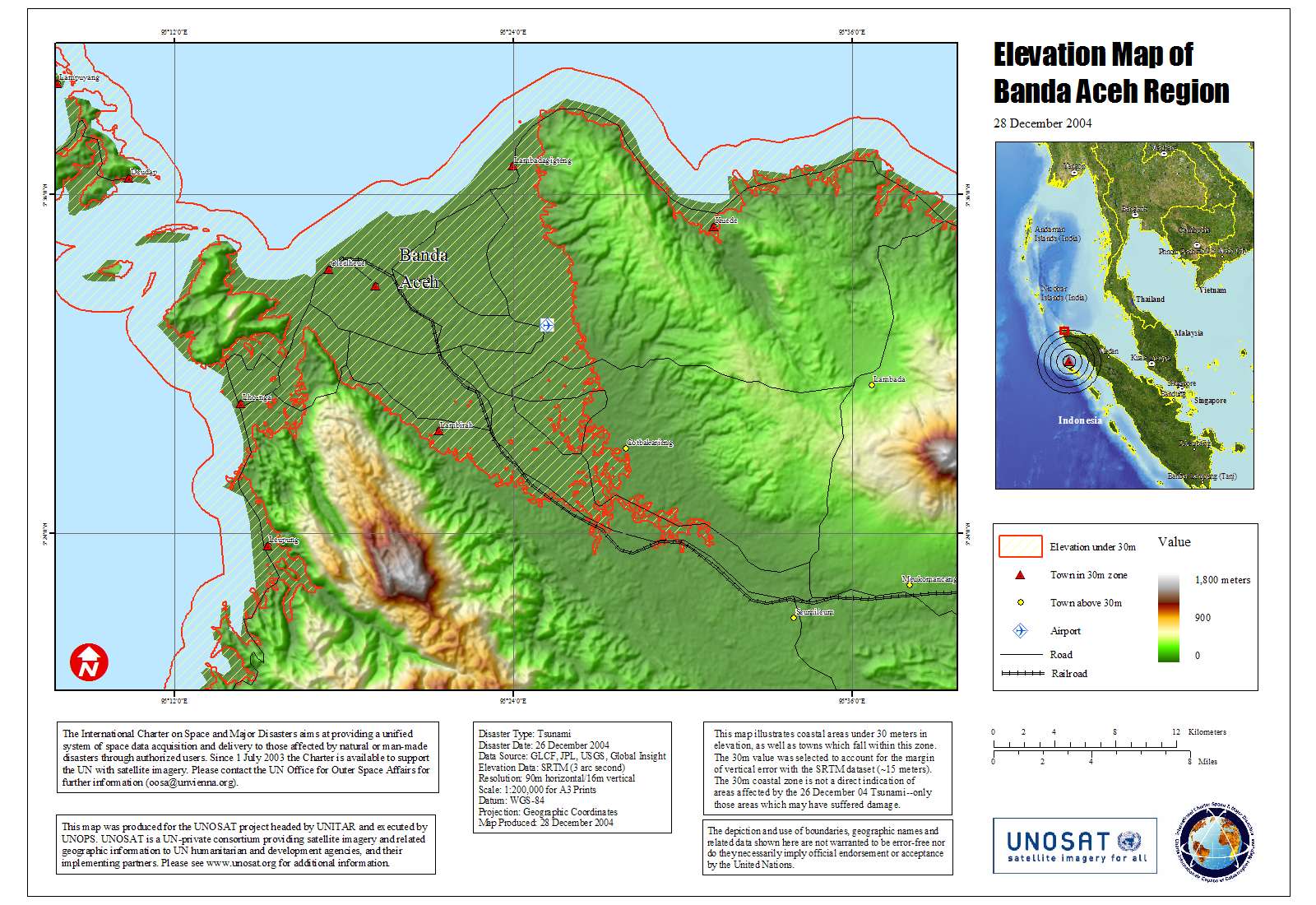
Elevation map of Banda Aceh region, scale: 1:200,000.

Source: GLCF, JPL, Global Insight. Elevation data: SRTM (3 arc seconds). Shows coastal areas under 30 meters elevation.
Acquired: --

Copyright: Map produced 28/12/2004 by UNOSAT.
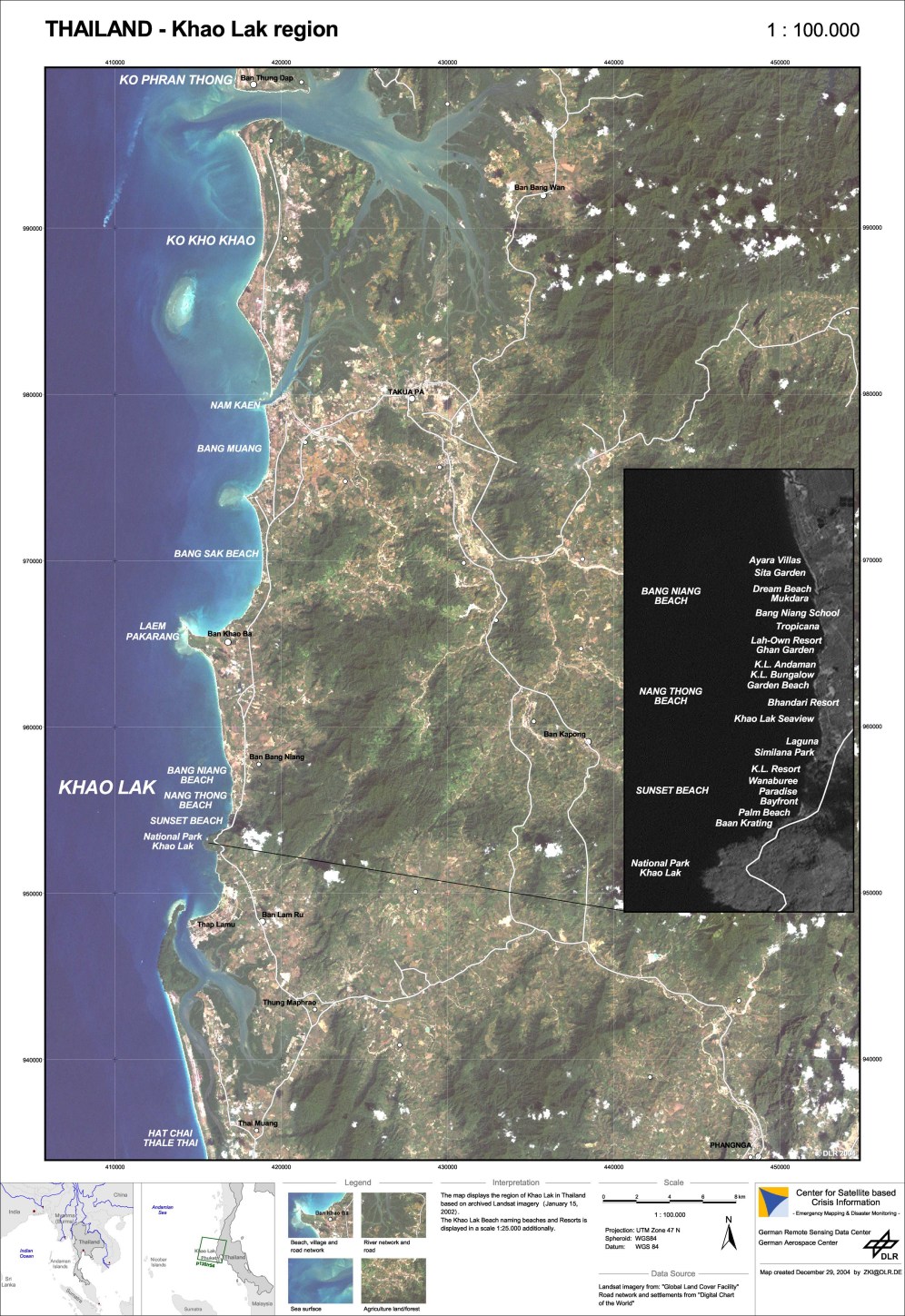
Thailand Khao Lak

Source: Scale 1:100,000 Landsat imagery, 15/01/2002.
Acquired: 15/01/2002.

Copyright: German Remote Sensing Data Centre, DLR - German Aerospace Center
Map created 30 December 2004 by zki@dlr.de
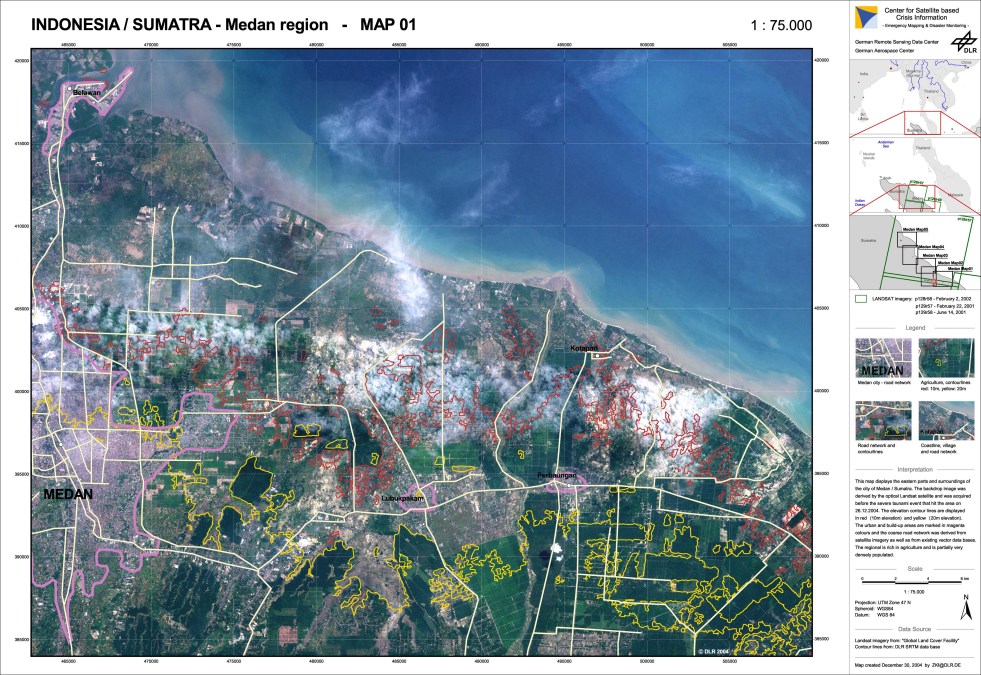
Medan, Scale 1:75,000

Source: Landsat
Acquired: 02/02/2002, 22/02/2001, 14/05/2001

Copyright: Map created 30 December 2004 by zki@dlr.de German Remote Sensing Data Centre, DLR - German Aerospace Center

High resolution AVI sequences: (Indeo codec required)

##############

Earthquake, Tsunami in Southern Asia

 https://www.disasterscharter.org/web/guest/-/earthquake-tsunami-in-southern-as-6

 Sunday, 26 December 2004

Type of Event:
Earthquake, tsunami
Location of Event:
India; Sri Lanka, Thailand, Indonesia, Maldives, Malaysia, Myanmar (Burma)
Date of Charter Activation:
26/12/2004
Charter Requestor:
Project Management:
ISRO, NRSA; UNOOSA, CNES

Description of the event

A high-magnitude earthquake, 9.0 on the Richter scale, struck southern Asia at 00:58 UTC, 6:58 AM local time. The epicentre was 320 km west of Medan, just off the west coast of the Indonesian island of Sumatra. The earthquake was followed by tsunamis that killed nearly a quarter of a million people, mostly in Indonesia, Sri Lanka, and India. The coastal regions of India, Sri Lanka, Thailand, Indonesia, Maldives, Malaysia, and Myanmar were all severely affected. Bangladesh, the Seychelles, Somalia, Kenya, and Tanzania also suffered damage and loss of life.
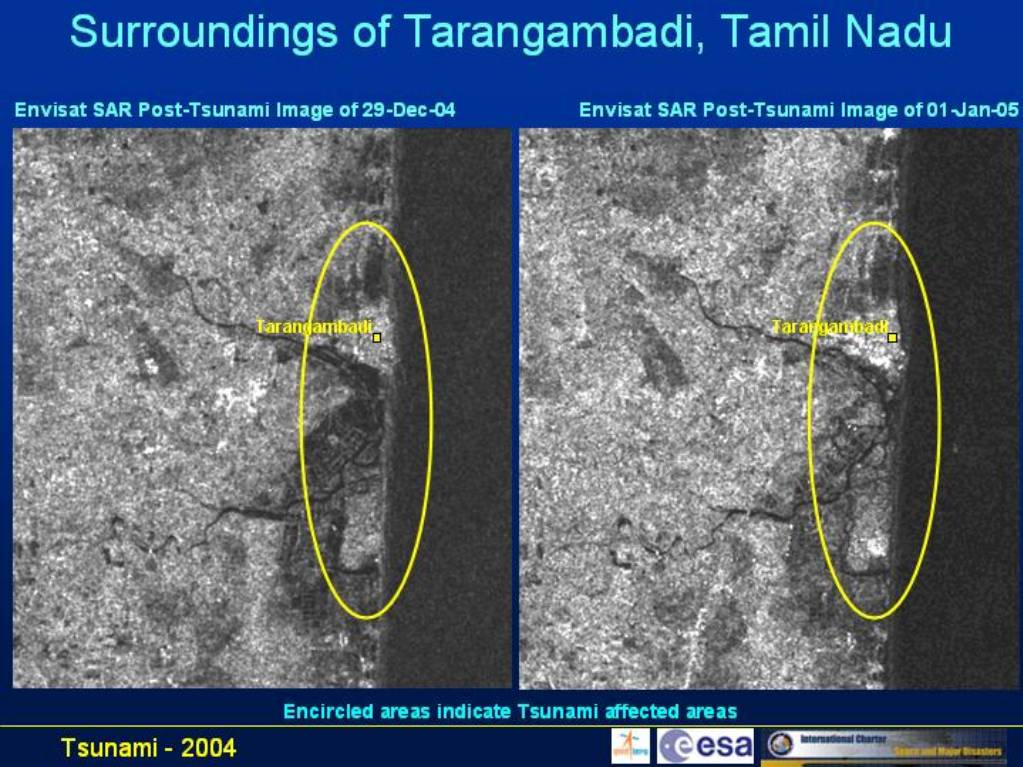
Before and after tsunami satellite images, Tarangambadi Surroundings Tamil Nadu

Source: Envisat SAR data, 29/12/04 and 01/01/05
Acquired: 01/01/05

Copyright: Courtesy National Remote Sensing Agency, Govt. of India
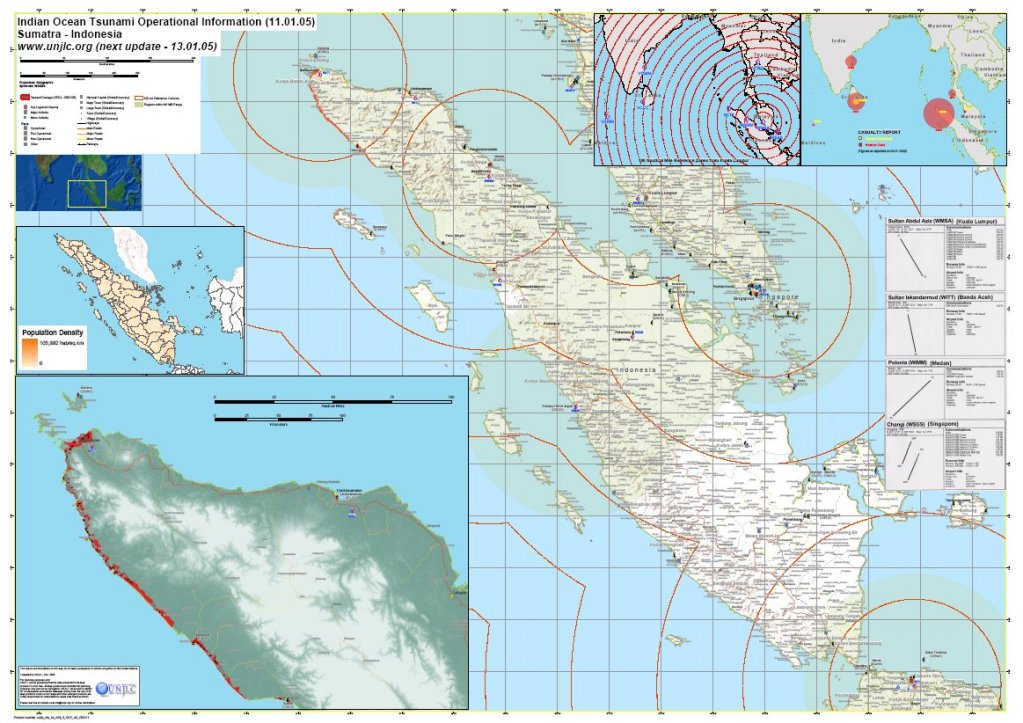
Regional Topographic map, with affected areas, population density and digital elevation model.

Source: UNJLC
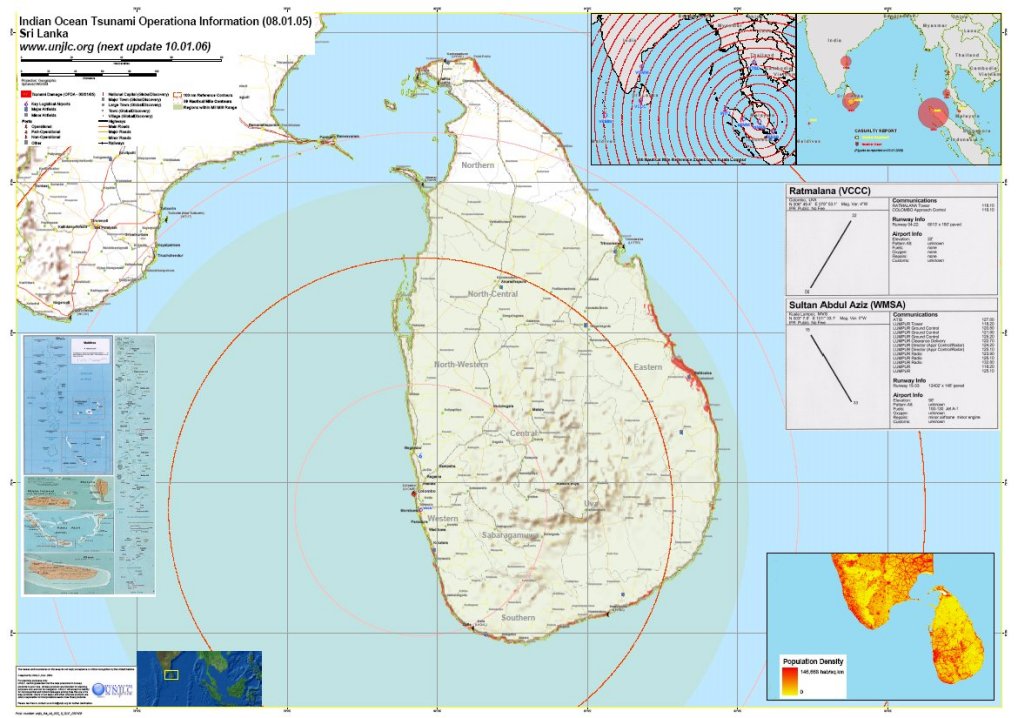
Topographic map of Sumatra, with affected areas, population density and digital elevation model.

Source: UNJLC.
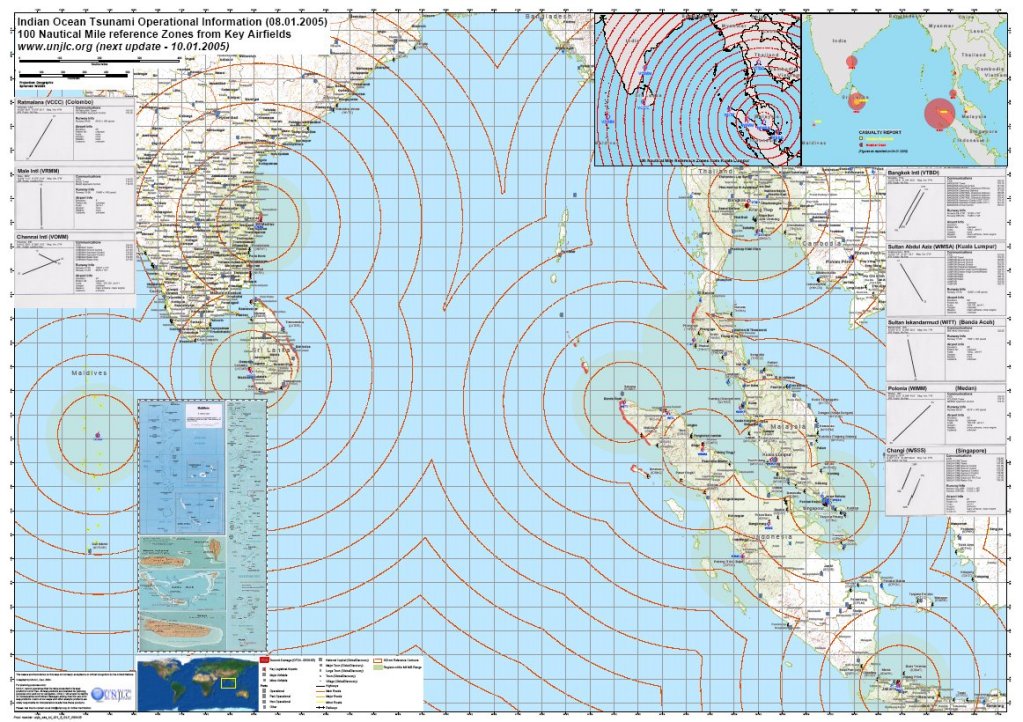
Carte topographique régionale, montrant des zones touchées, densité de la population et modèle numérique du terrain.

Source: Centre de logistique des Nations Unies.
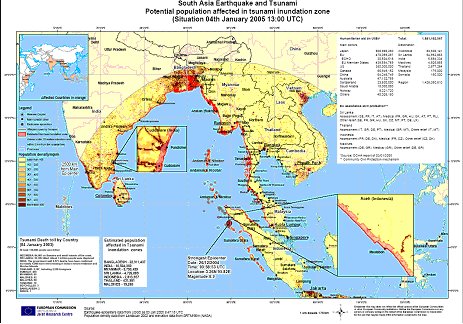
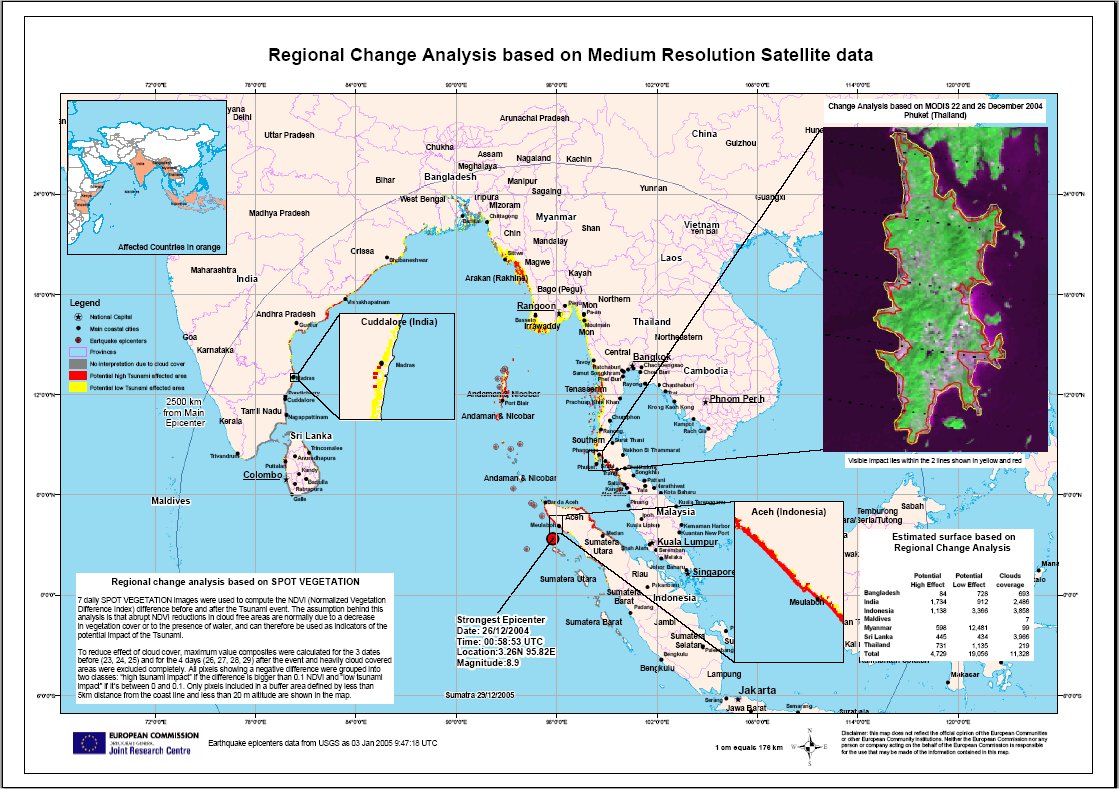
Potential population affected by Tsunami over the whole area.

Source: European Commission, Joint Research Institute.
Copyright: Population density data from Landscan 2002 Elevation data from SRTM (NASA)
Regional map of countries most affected by the Tsunami. Show zones under 30 meters elevation.

Source: UNOSAT, USGS, NASA (SRTM30/ETOPO2/MODIS), Global Insight.
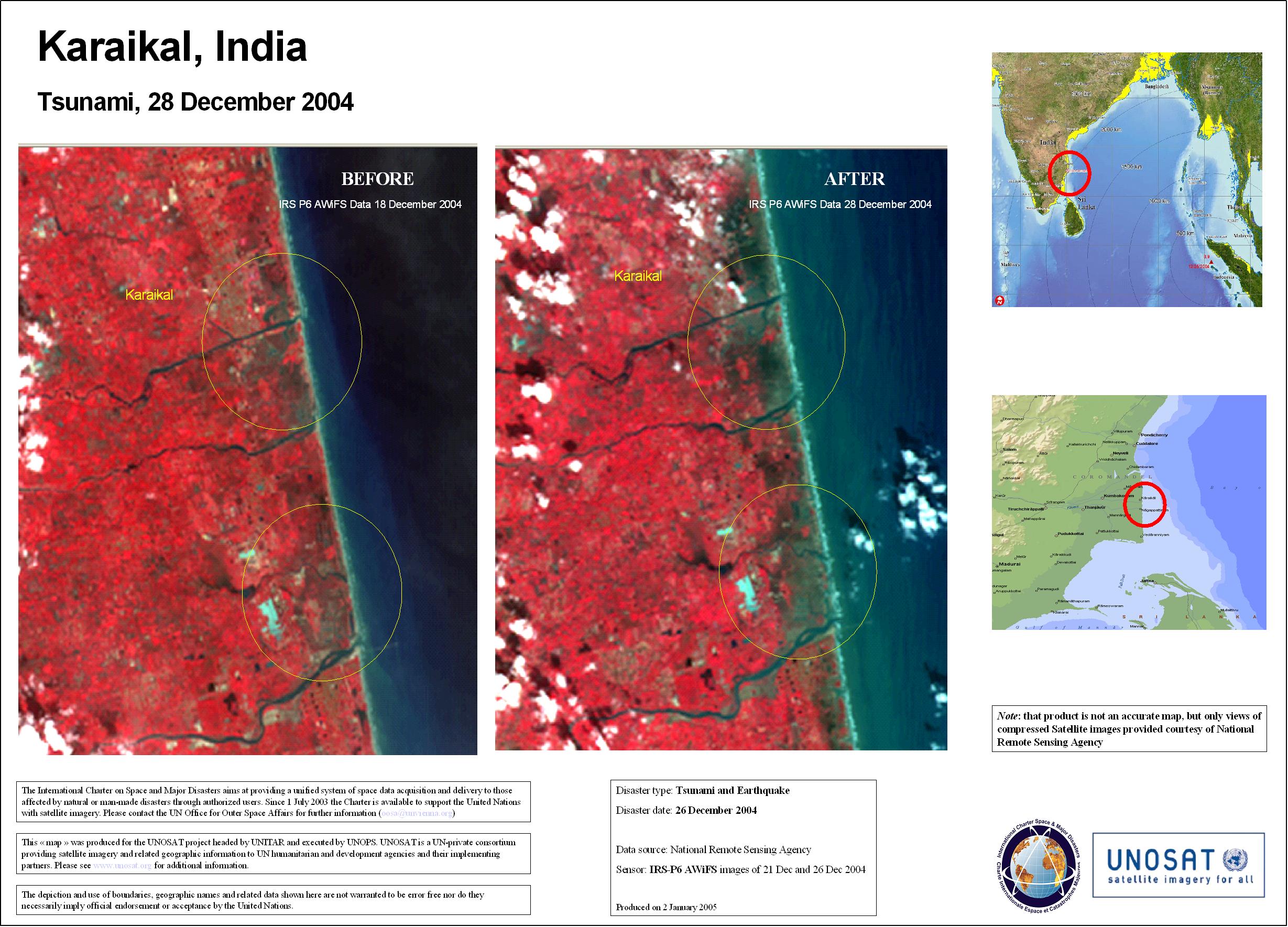
Post-tsunami satellite map, IRS Before After Tsunami Karaikal India

Source: IRS-P6 AWiFS data
Acquired: 02/01/2005

Copyright: Map produced 02/01/2005 by UNOSAT
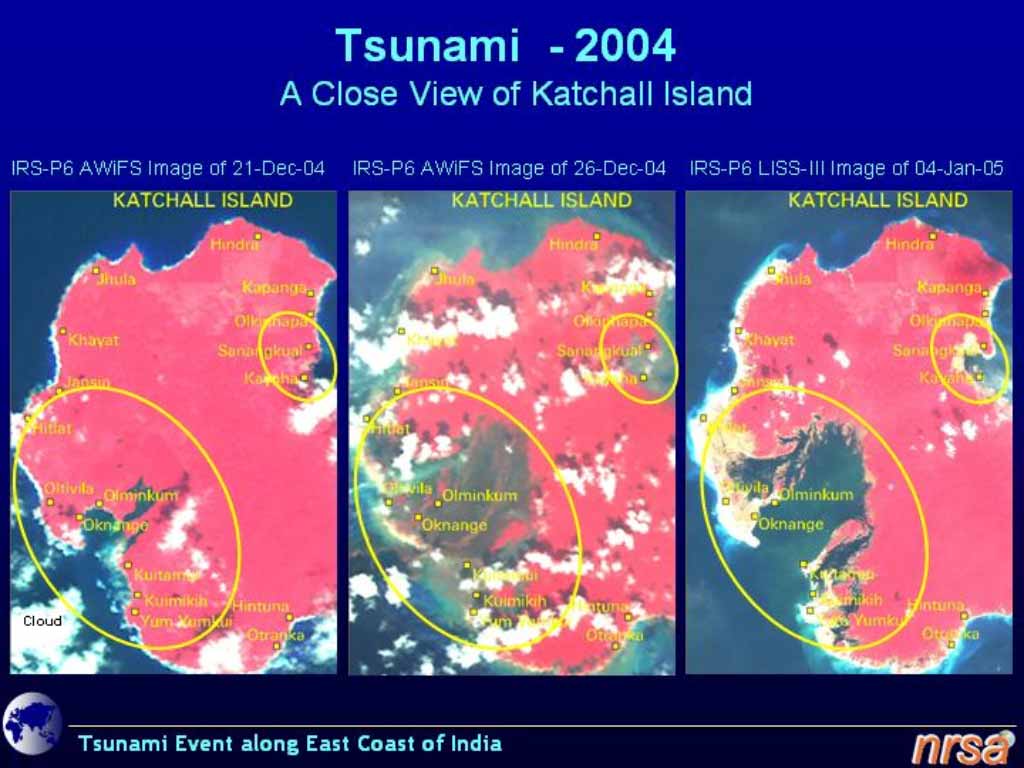
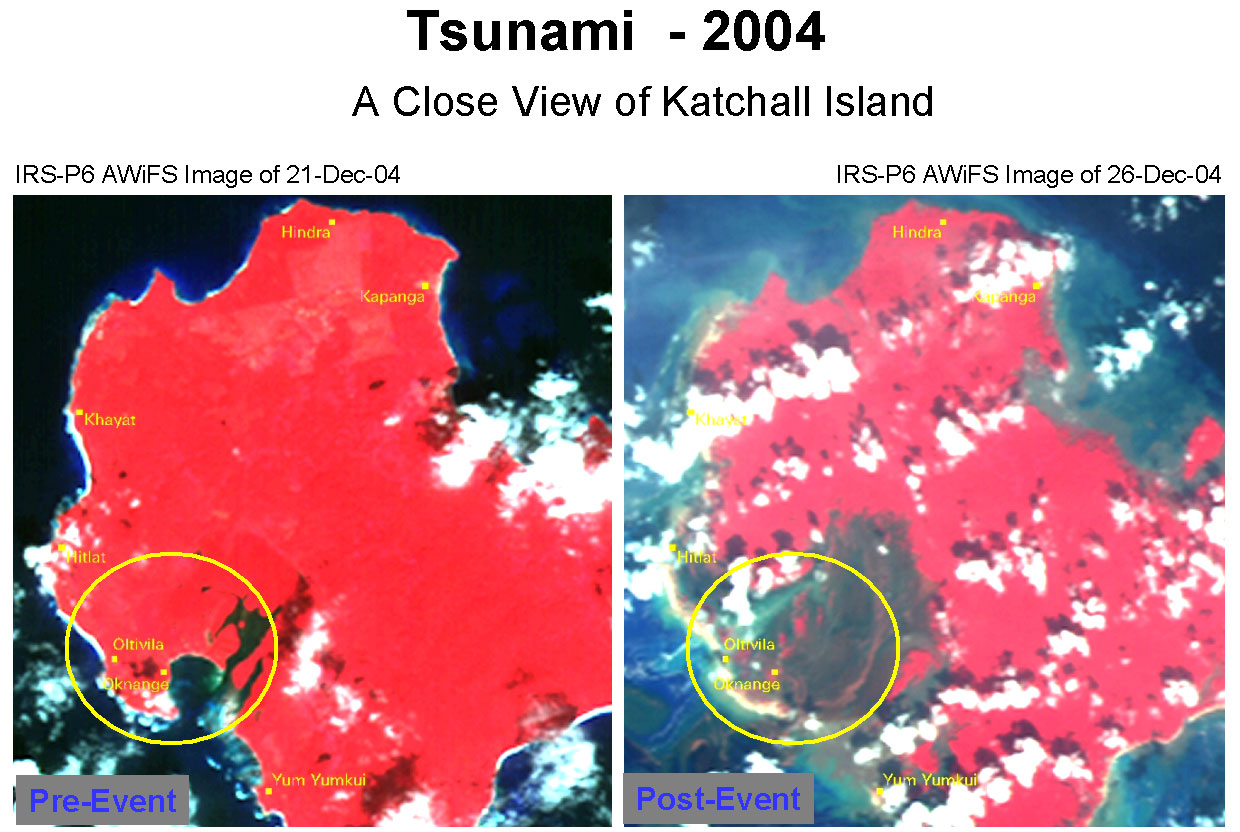
Before and after tsunami satellite images, Katchall

Source: IRS-P6 AWiFS data, 21/12/04, 26/12/04, and IRS-P6 LISS-III data, 04/01/05
Acquired: 21/12/04, 26/12/04, 04/01/05

Copyright: Courtesy National Remote Sensing Agency, Govt. of India
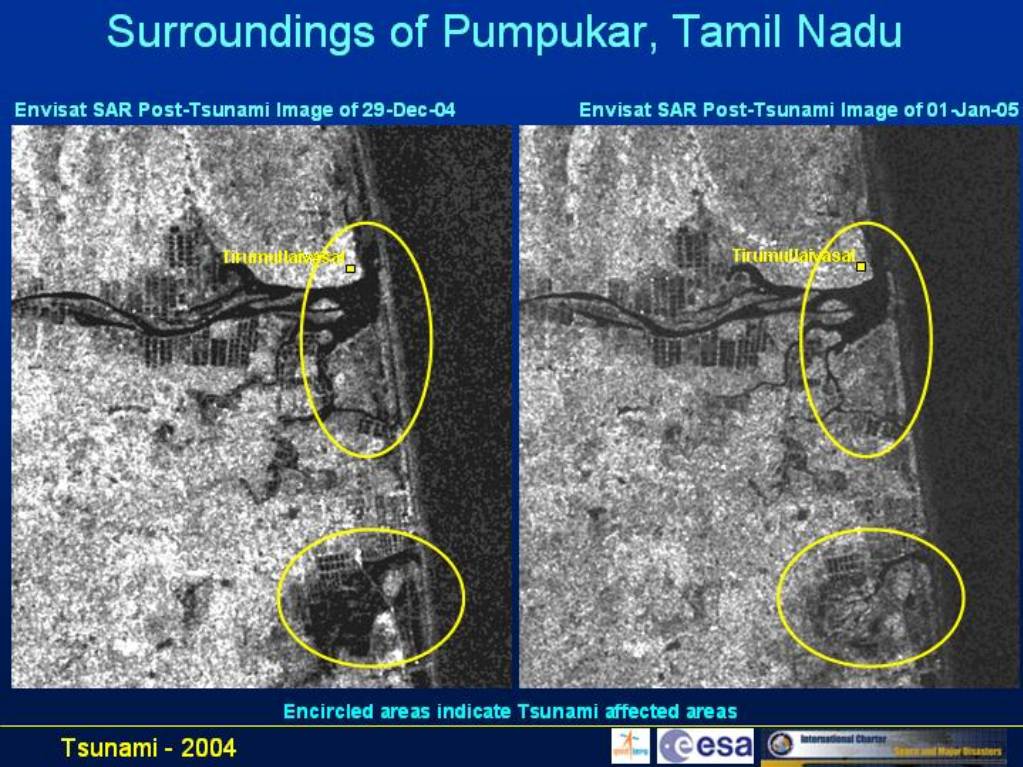
Before and after tsunami satellite images, Pumpukar Surroundings Tamil Nadu

Source: Envisat SAR data, 29/12/04 and 01/01/05
Acquired: 01/01/05

Copyright: Courtesy National Remote Sensing Agency, Govt. of India
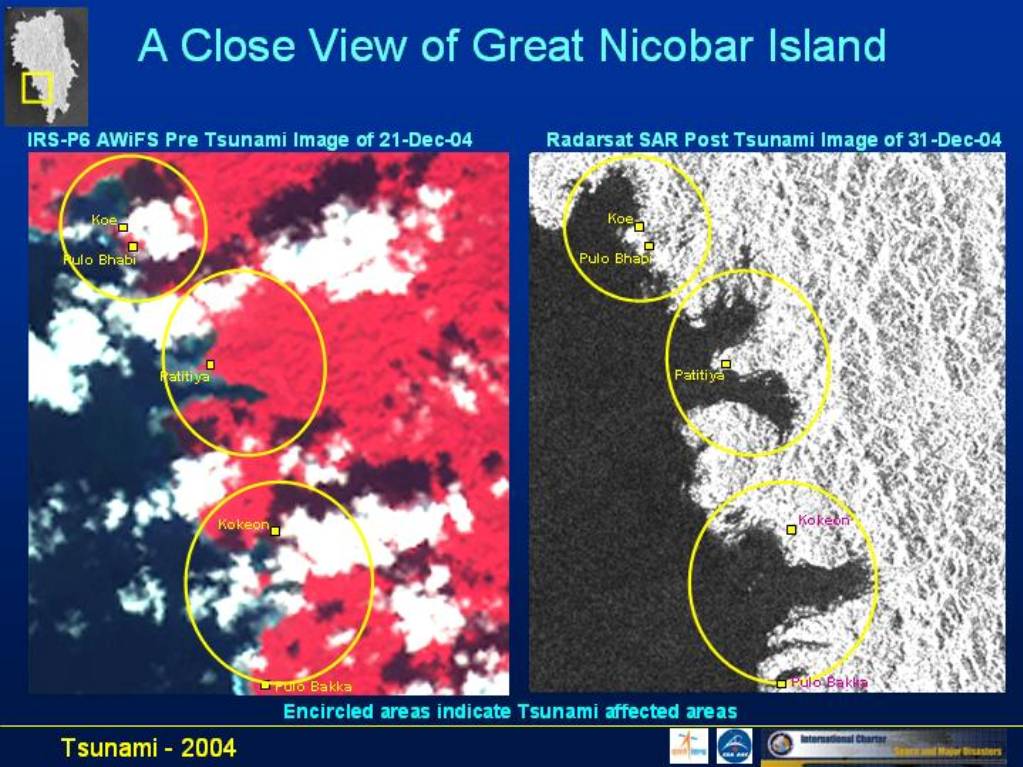
Before and after tsunami satellite images, Great Nicobar Patitiya Nicobar Islands

Source: IRS-P6 AWiFS data, 21/12/04, and Radarsat SAR data, 31/12/04
Acquired: 21/12/04, 31/12/04

Copyright: Courtesy National Remote Sensing Agency, Govt. of India
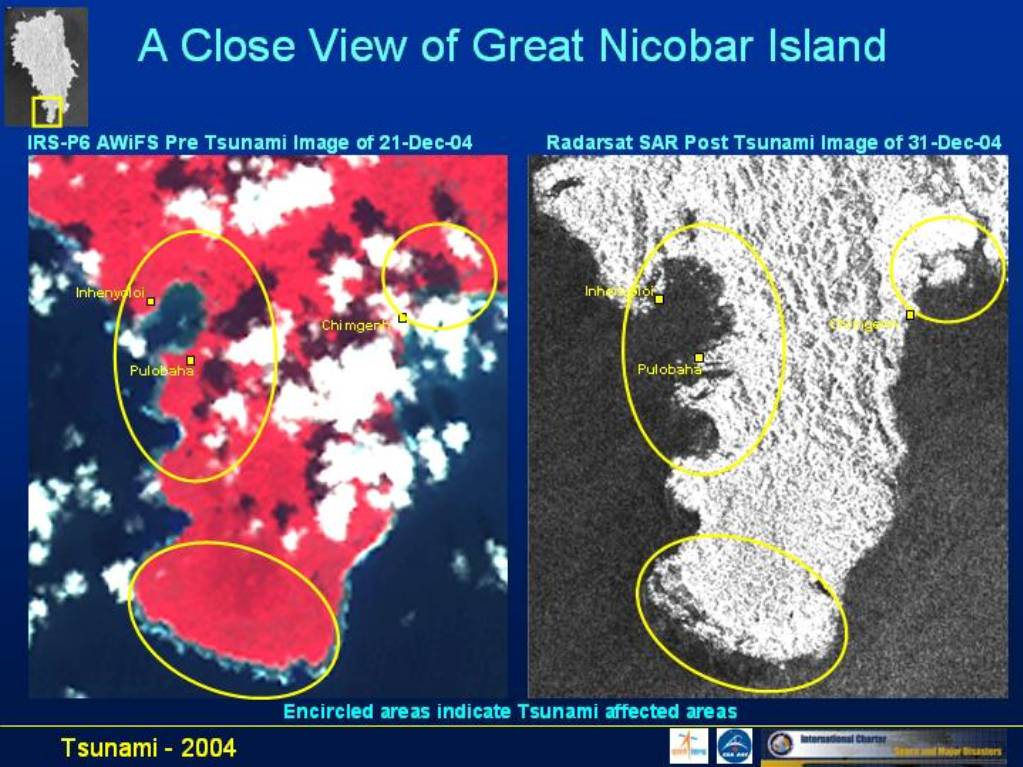
Before and after tsunami satellite images, Great Nicobar Pulobaha Nicobar Islands

Source: IRS-P6 AWiFS data, 21/12/04, and Radarsat SAR data, 31/12/04
Acquired: 21/12/04, 31/12/04

Copyright: Courtesy National Remote Sensing Agency, Govt. of India
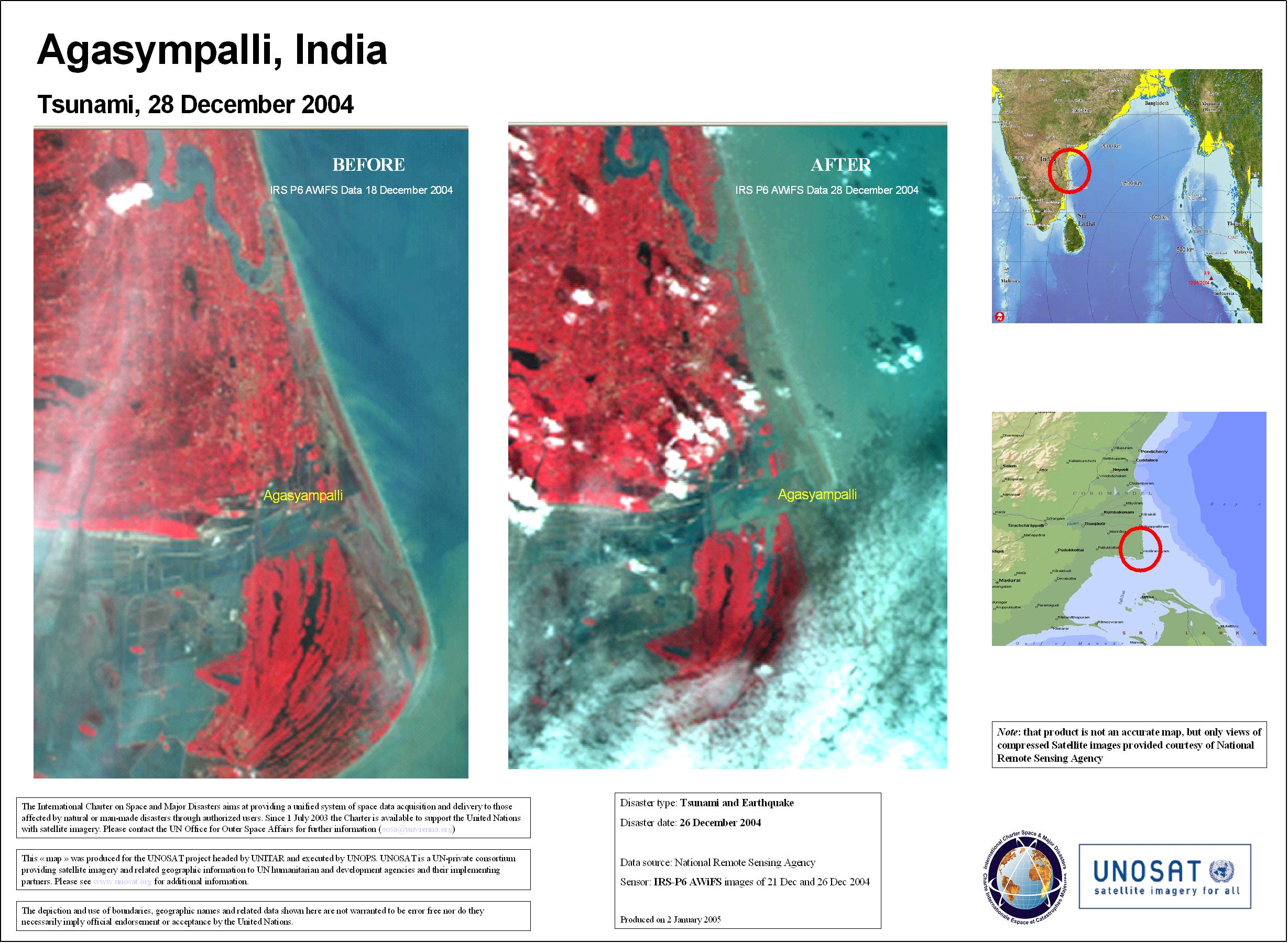
Post-tsunami satellite map, IRS Before After Tsunami Agasympalli India

Source: IRS-P6 AWiFS data
Acquired: 02/01/2005

Copyright: Map produced 02/01/2005 by UNOSAT
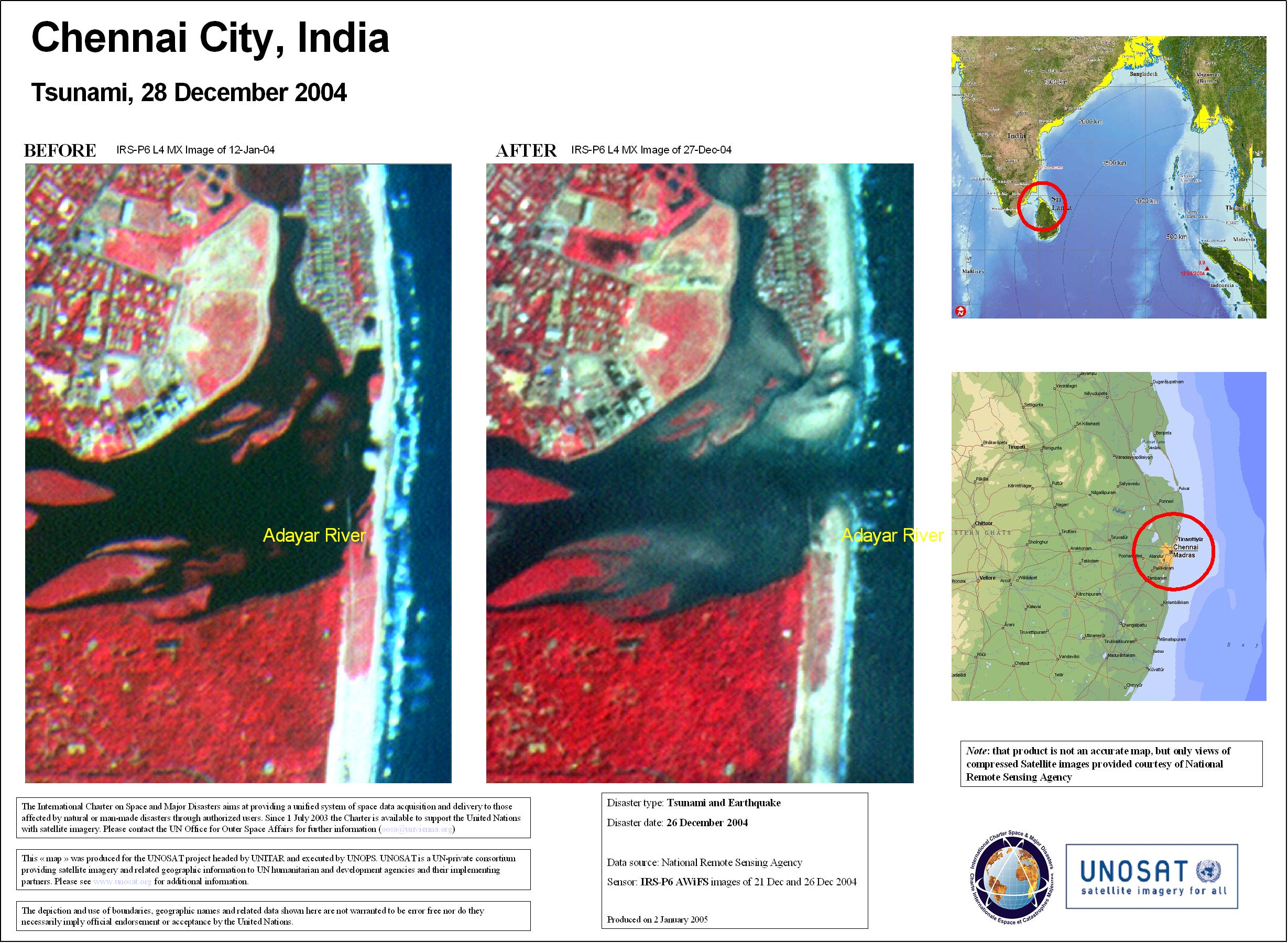
Post-tsunami satellite map, IRS Before After Tsunami Chennai Indiar

Source: IRS-P6 AWiFS data
Acquired: 02/01/2005

Copyright: Map produced 02/01/2005 by UNOSAT
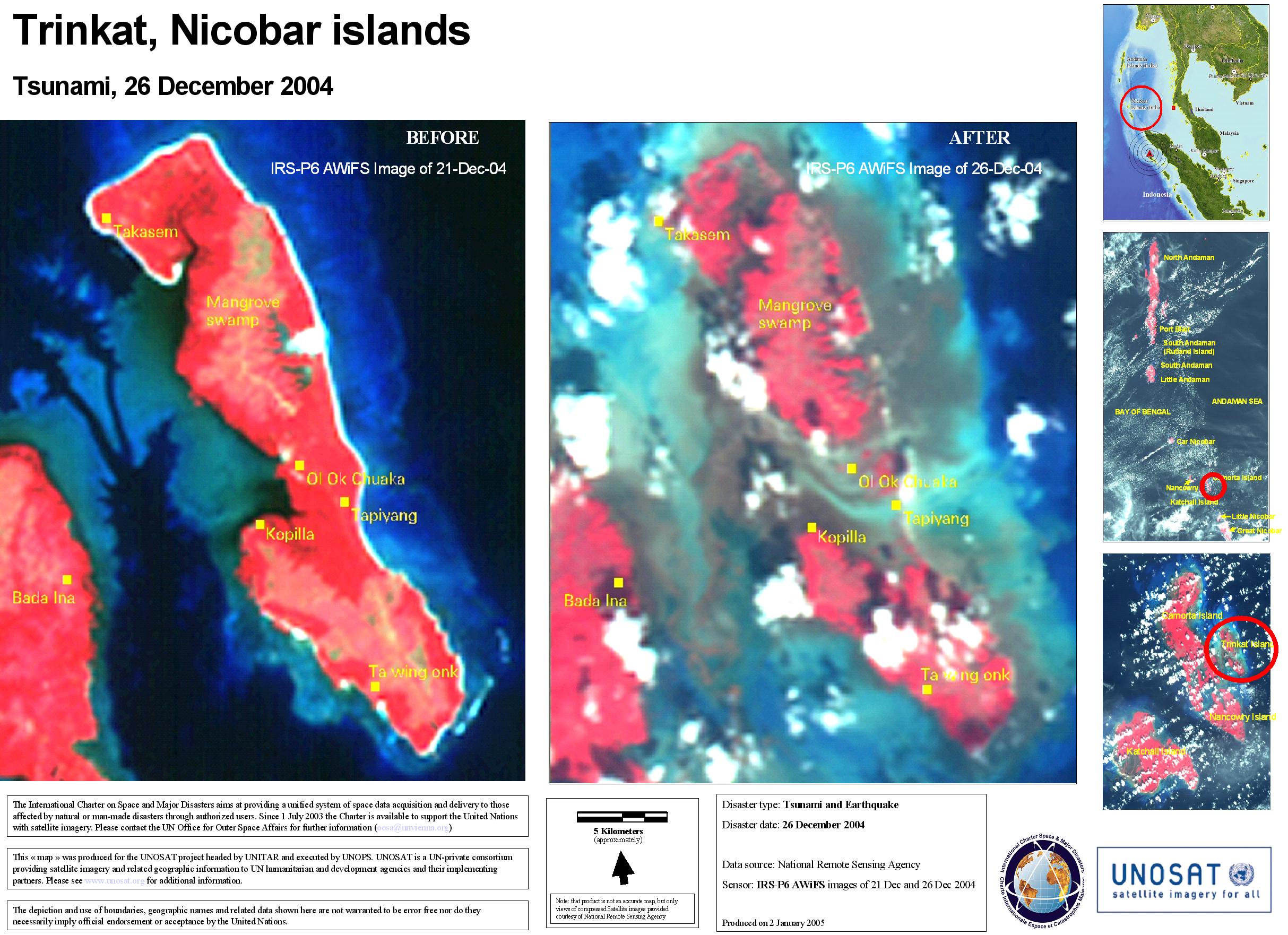
Post-tsunami satellite map, IRS Before After Tsunami Trinkat Nicobar

Source: IRS-P6 AWiFS data
Acquired: 02/01/2005

Copyright: Map produced 02/01/2005 by UNOSAT
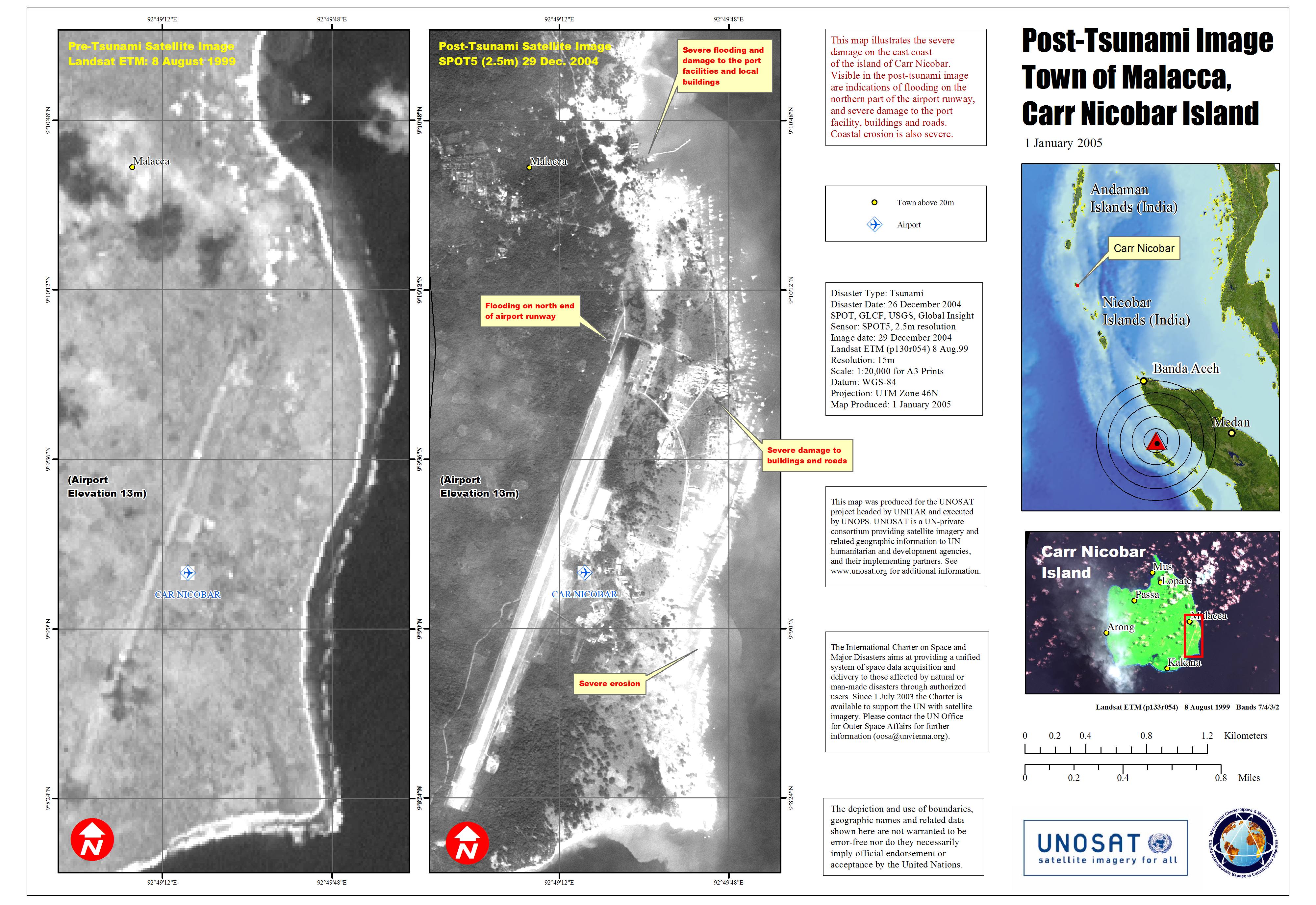
Post-tsunami satellite map, Malacca Nicobar

Source: Landsat ETM, 08/08/1999 and SPOT 5 data, 2.5 m resolution, 29/12/2004
Acquired: 01/01/2005

Copyright: Map produced 01/01/2005 by UNOSAT
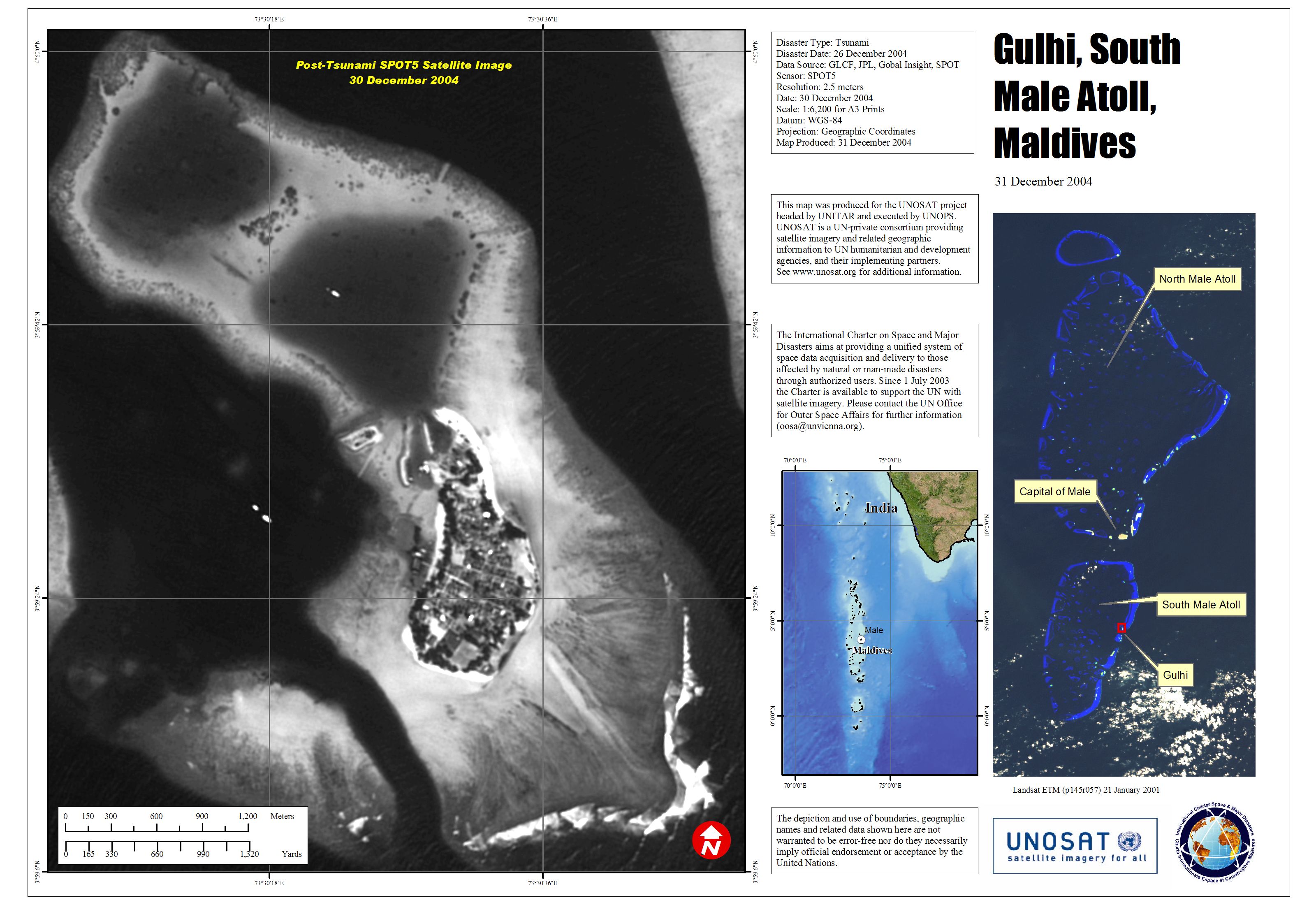
Post-tsunami satellite map, Maldives Gulhi

Source: SPOT 5 data, 2.5 m resolution.
Acquired: 31/12/2004

Copyright: Map produced 31/12/2004 by UNOSAT
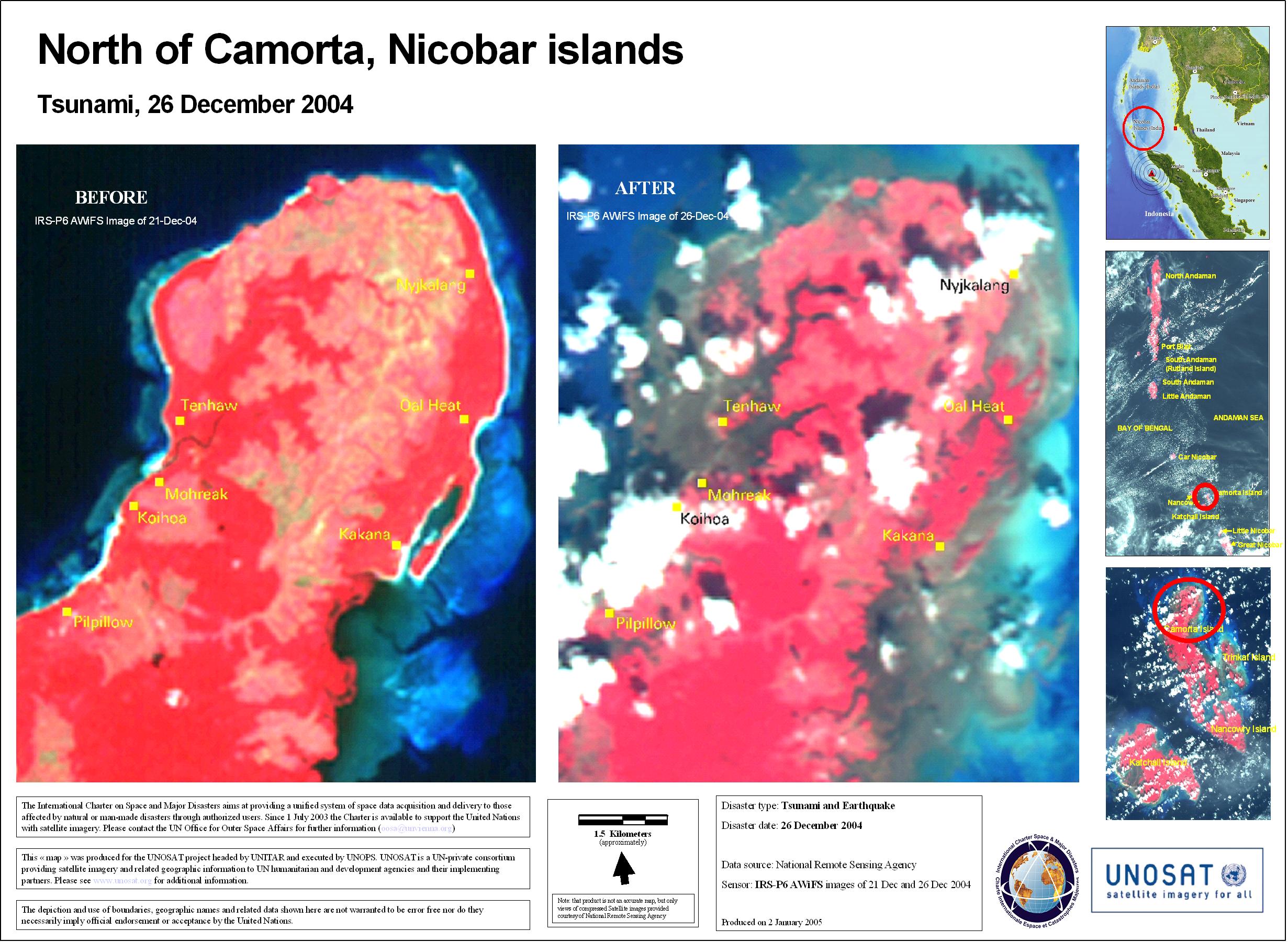
Post-tsunami satellite map, IRS Before After Tsunami North Camorta Nicobar

Source: IRS-P6 AWiFS data
Acquired: 02/01/2005

Copyright: Map produced 02/01/2005 by UNOSAT
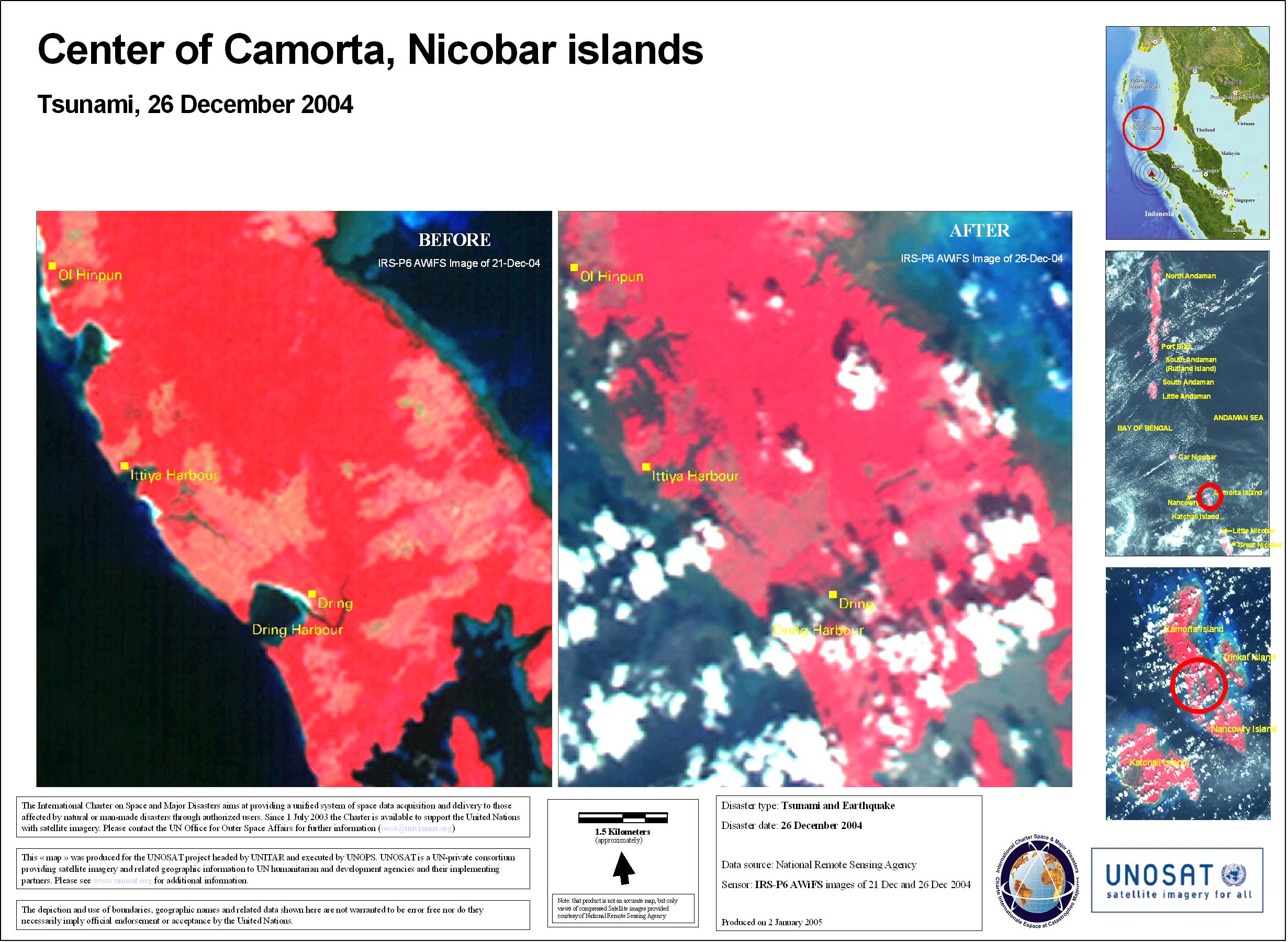
Post-tsunami satellite map, IRS Before After Tsunami North Center Nicobar

Source: IRS-P6 AWiFS data
Acquired: 02/01/2005

Copyright: Map produced 02/01/2005 by UNOSAT
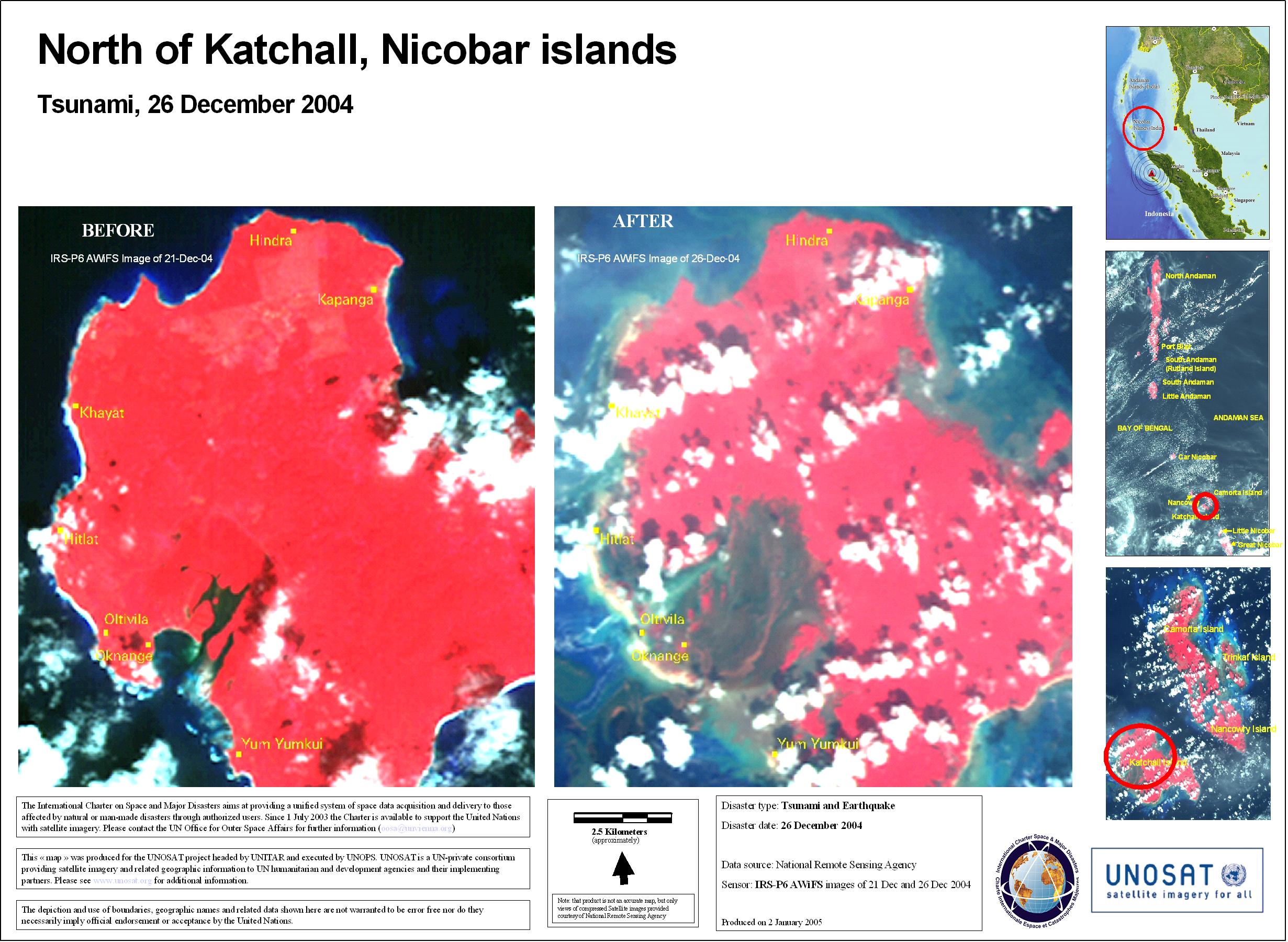
Post-tsunami satellite map, IRS Before After Tsunami North Katchall Nicobar

Source: IRS-P6 AWiFS data
Acquired: 02/01/2005

Copyright: Map produced 02/01/2005 by UNOSAT
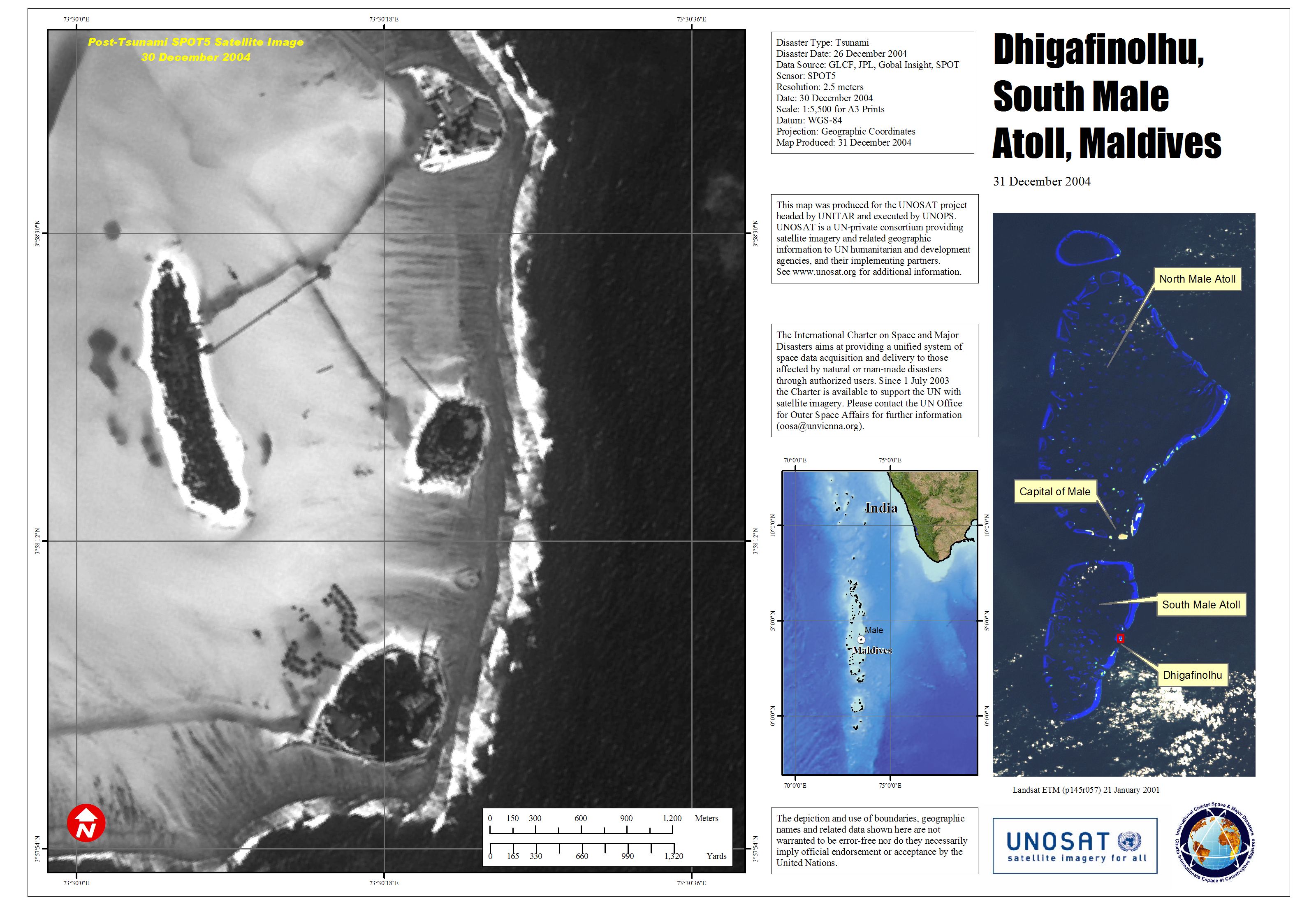
Post-tsunami satellite map, Maldives Dhigafinolhu

Source: SPOT 5 data, 2.5 m resolution.
Acquired: 31/12/2004

Copyright: Map produced 31/12/2004 by UNOSAT
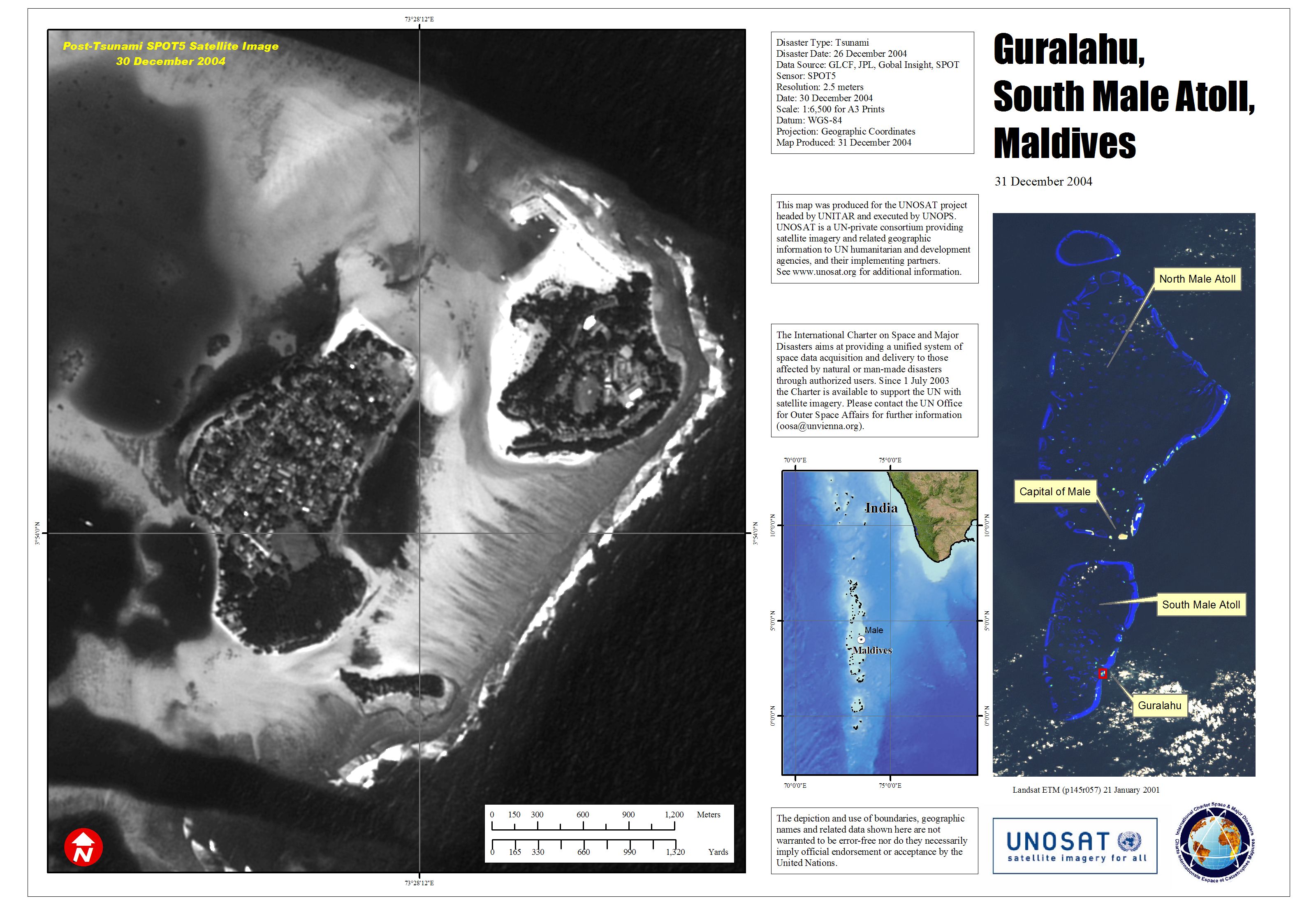
Post-tsunami satellite map, Maldives Guralahu

Source: SPOT 5 data, 2.5 m resolution.
Acquired: 31/12/2004

Copyright: Map produced 31/12/2004 by UNOSAT
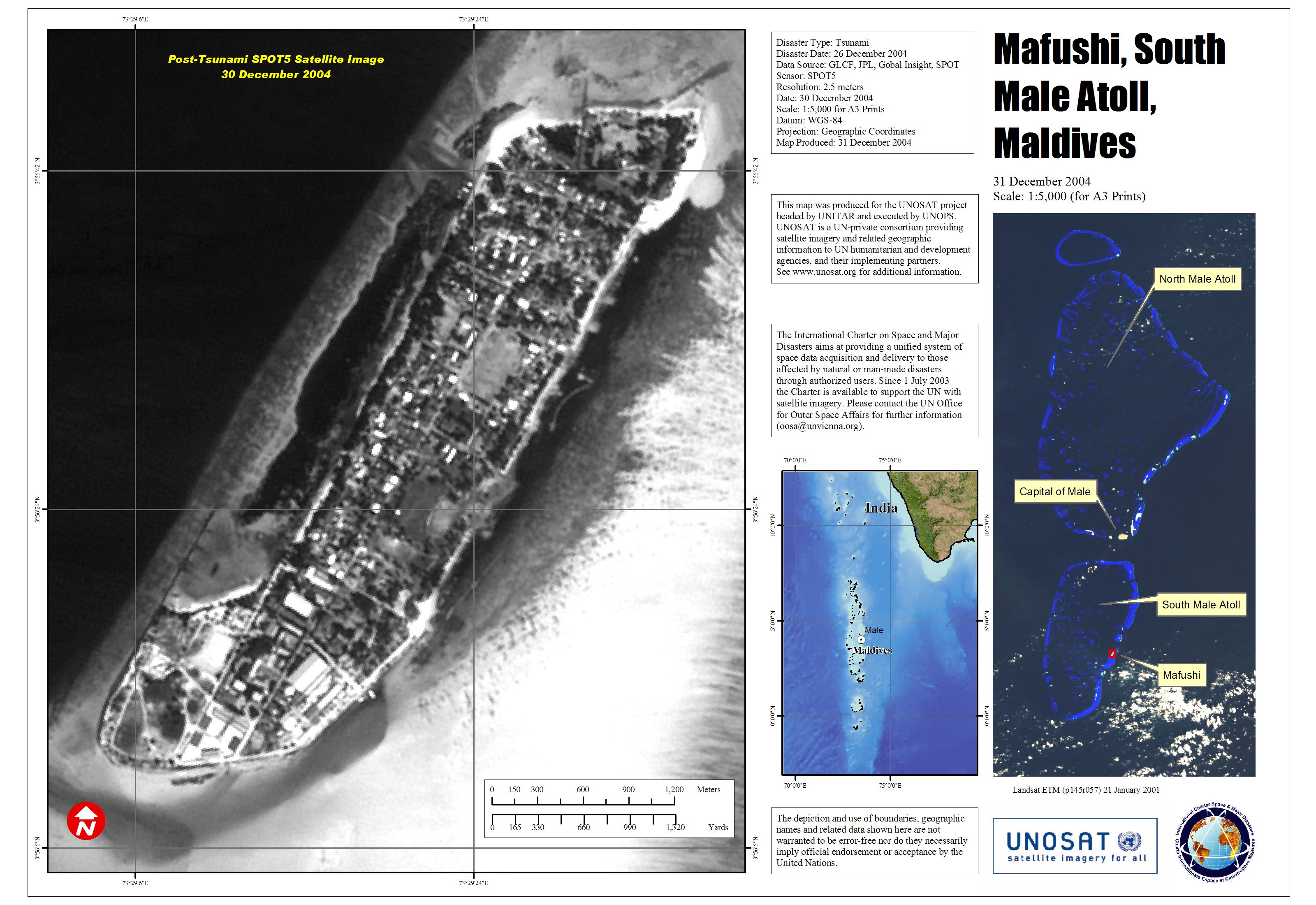
Post-tsunami satellite map, Maldives Mafushi

Source: SPOT 5 data, 2.5 m resolution.
Acquired: 31/12/2004

Copyright: Map produced 31/12/2004 by UNOSAT
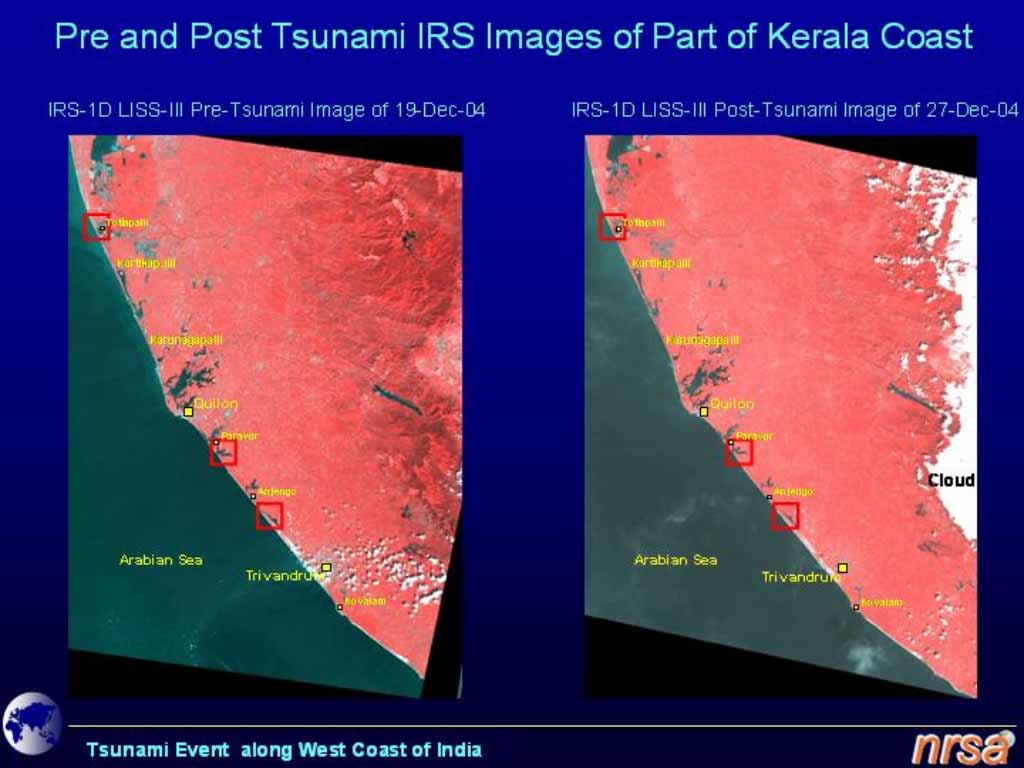
Before and after tsunami satellite images, Kerala

Source: IRS-1D LISS data, 19/12/04 and 27/12/04
Acquired: 27/12/04

Copyright: Courtesy National Remote Sensing Agency, Govt. of India
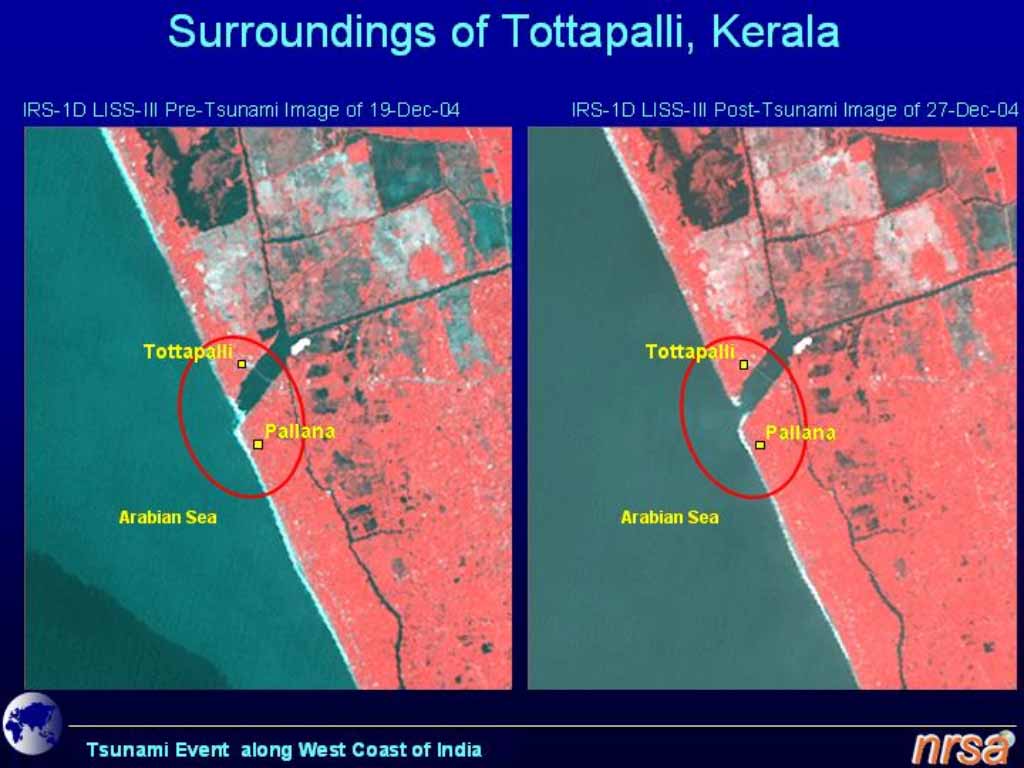
Before and after tsunami satellite images, Tottapalli, Kerala

Source: IRS-1D LISS data, 19/12/04 and 27/12/04
Acquired: 27/12/04

Copyright: Courtesy National Remote Sensing Agency, Govt. of India
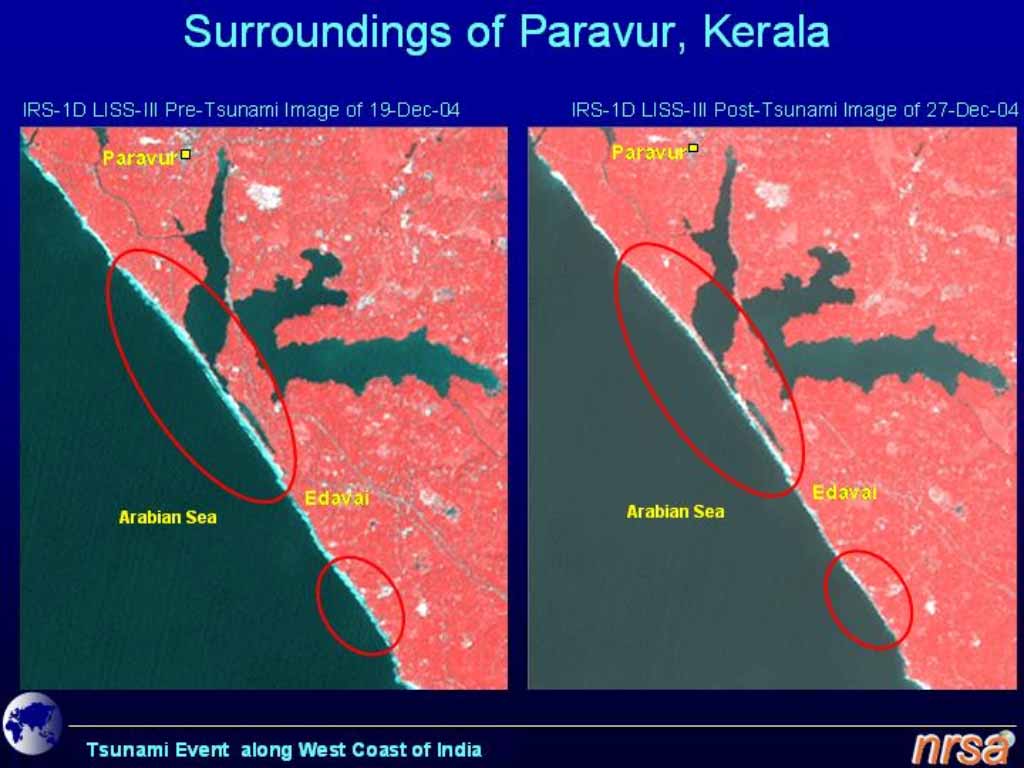
Before and after tsunami satellite images, Paravur, Kerala

Source: IRS-1D LISS data, 19/12/04 and 27/12/04
Acquired: 27/12/04

Copyright: Courtesy National Remote Sensing Agency, Govt. of India
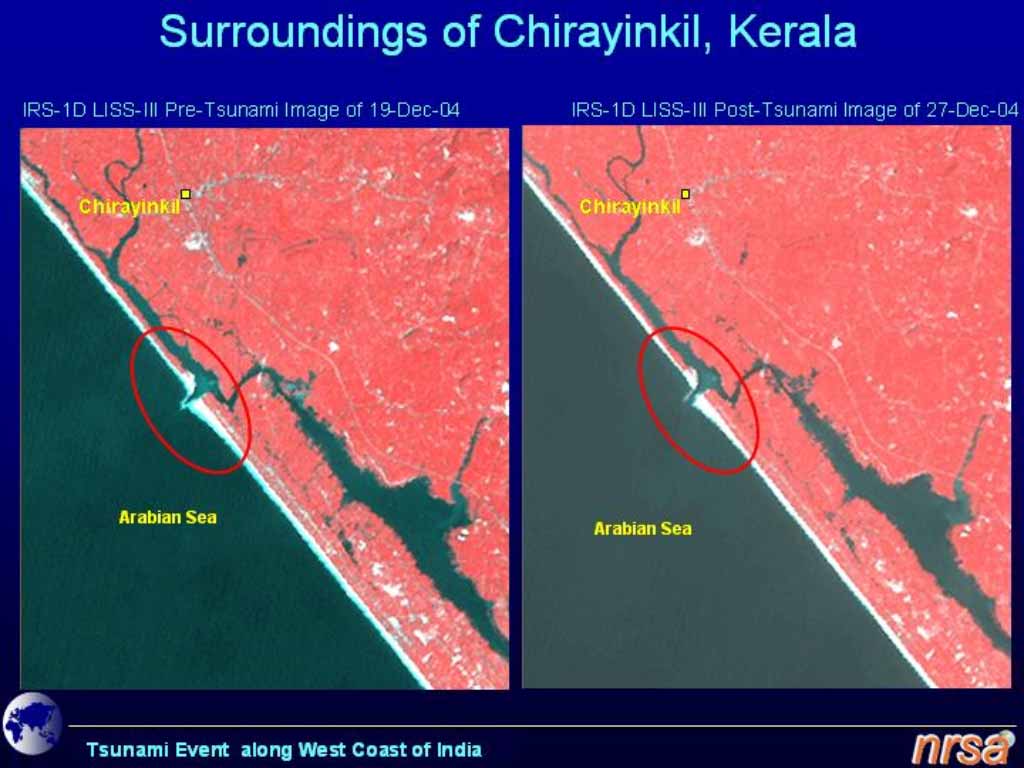
Before and after tsunami satellite images, Chirayinkil, Kerala

Source: IRS-1D LISS data, 19/12/04 and 27/12/04
Acquired: 27/12/04

Copyright: Courtesy National Remote Sensing Agency, Govt. of India
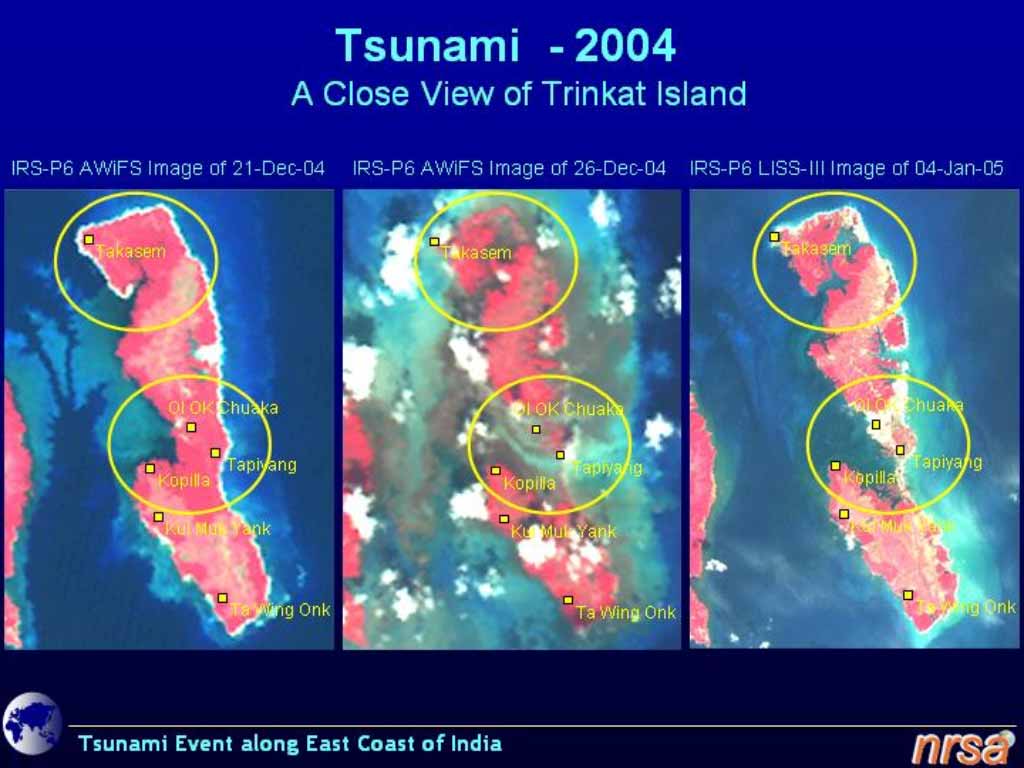
Before and after tsunami satellite images, Trinkat

Source: IRS-P6 AWiFS data, 21/12/04, 26/12/04, and IRS-P6 LISS-III data, 04/01/05
Acquired: 21/12/04, 26/12/04, 04/01/05

Copyright: Courtesy National Remote Sensing Agency, Govt. of India
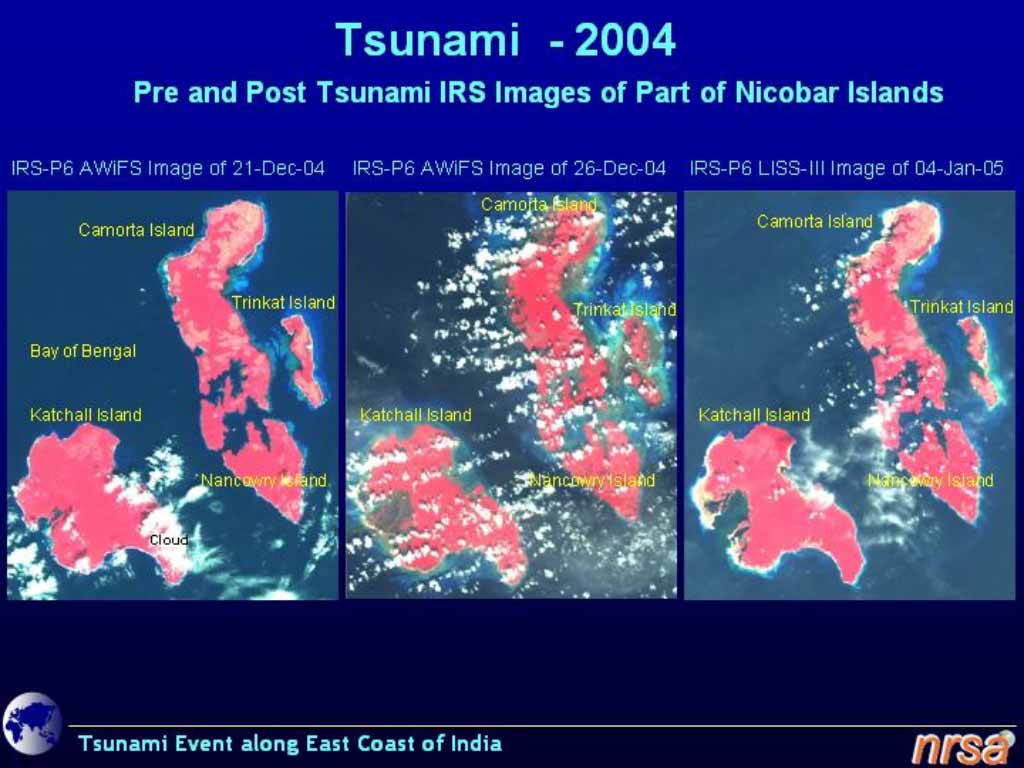
Before and after tsunami satellite images, Nicobar

Source: IRS-P6 AWiFS data, 21/12/04, 26/12/04, and IRS-P6 LISS-III data, 04/01/05
Acquired: 21/12/04, 26/12/04, 04/01/05

Copyright: Courtesy National Remote Sensing Agency, Govt. of India
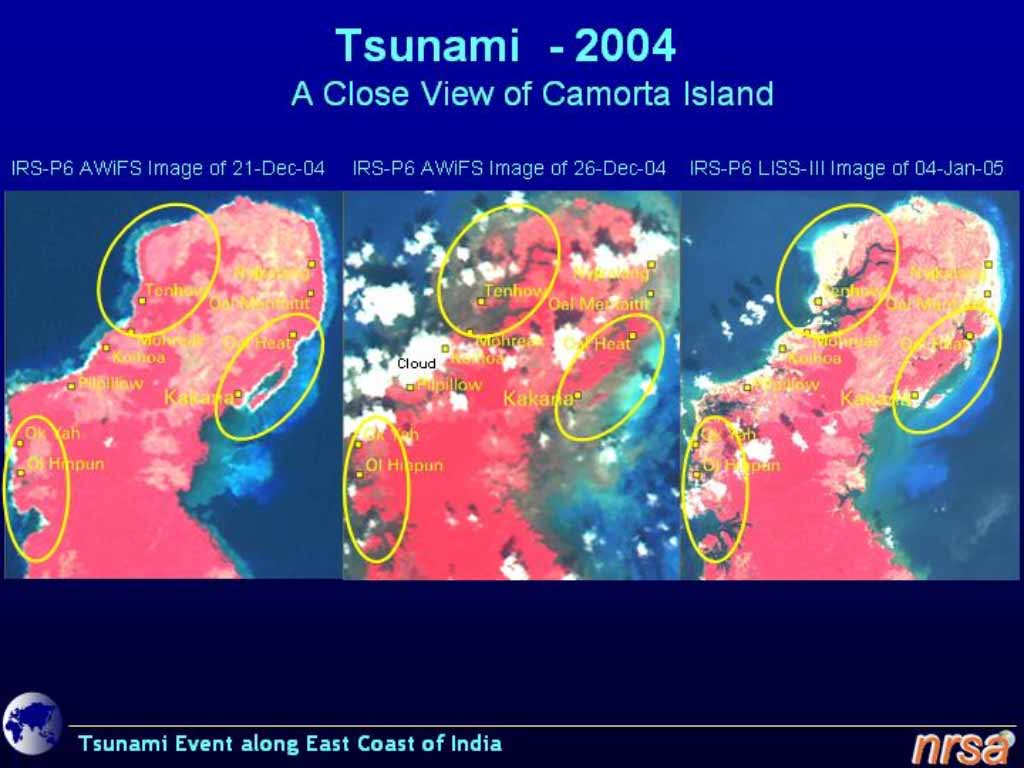
Before and after tsunami satellite images, Camorta

Source: IRS-P6 AWiFS data, 21/12/04, 26/12/04, and IRS-P6 LISS-III data, 04/01/05
Acquired: 21/12/04, 26/12/04, 04/01/05

Copyright: Courtesy National Remote Sensing Agency, Govt. of India
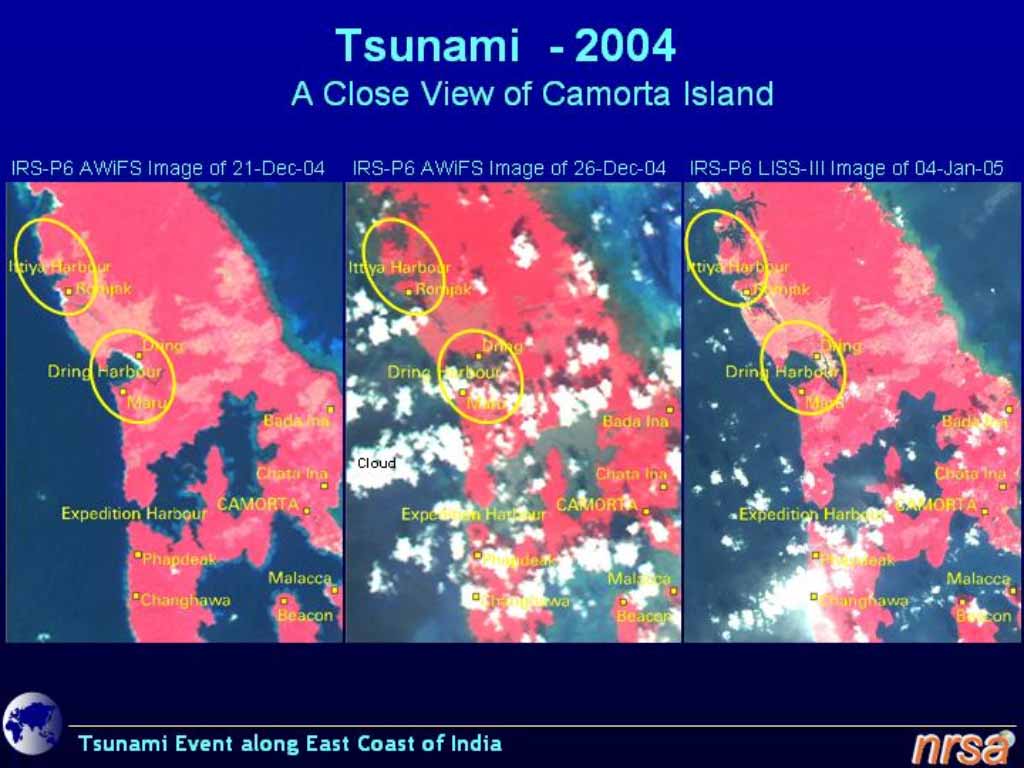
Before and after tsunami satellite images, Camorta

Source: IRS-P6 AWiFS data, 21/12/04, 26/12/04, and IRS-P6 LISS-III data, 04/01/05
Acquired: 21/12/04, 26/12/04, 04/01/05

Copyright: Courtesy National Remote Sensing Agency, Govt. of India
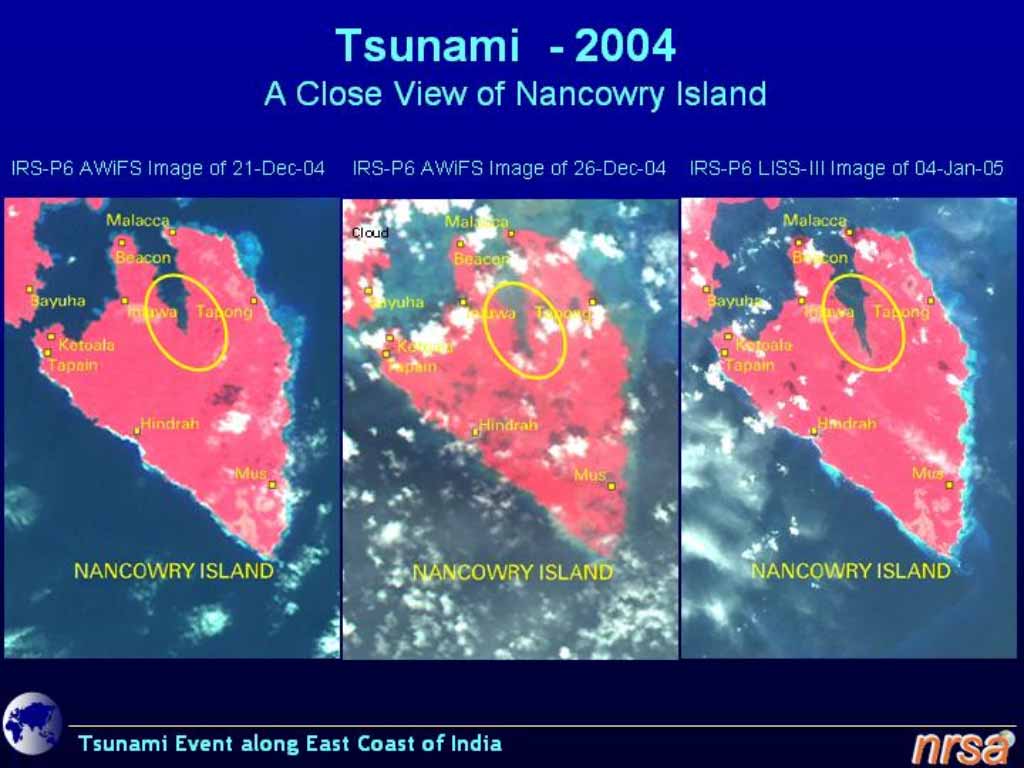
Before and after tsunami satellite images, Nancowry

Source: IRS-P6 AWiFS data, 21/12/04, 26/12/04, and IRS-P6 LISS-III data, 04/01/05
Acquired: 21/12/04, 26/12/04, 04/01/05

Copyright: Courtesy National Remote Sensing Agency, Govt. of India
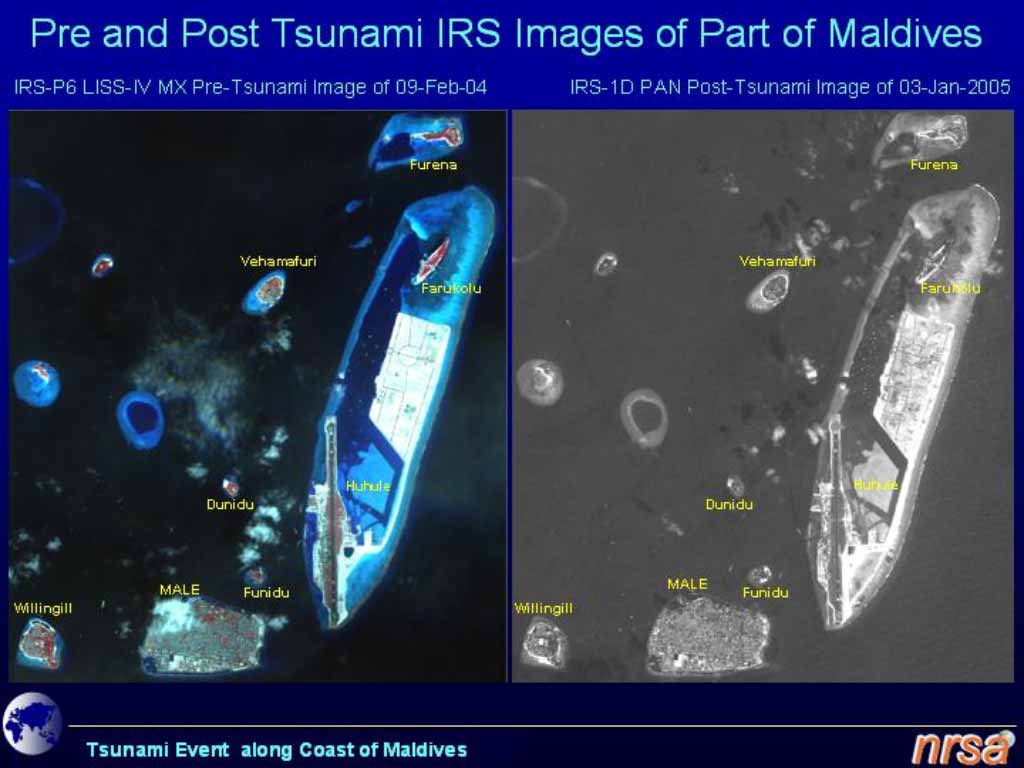
Before and after tsunami satellite images, Male, Maldives

Source: IRS-P6 LISS-IV MX data, 09/02/04, IRS 1D PAN, 03/01/05
Acquired: 03/01/05

Copyright: Courtesy National Remote Sensing Agency, Govt. of India
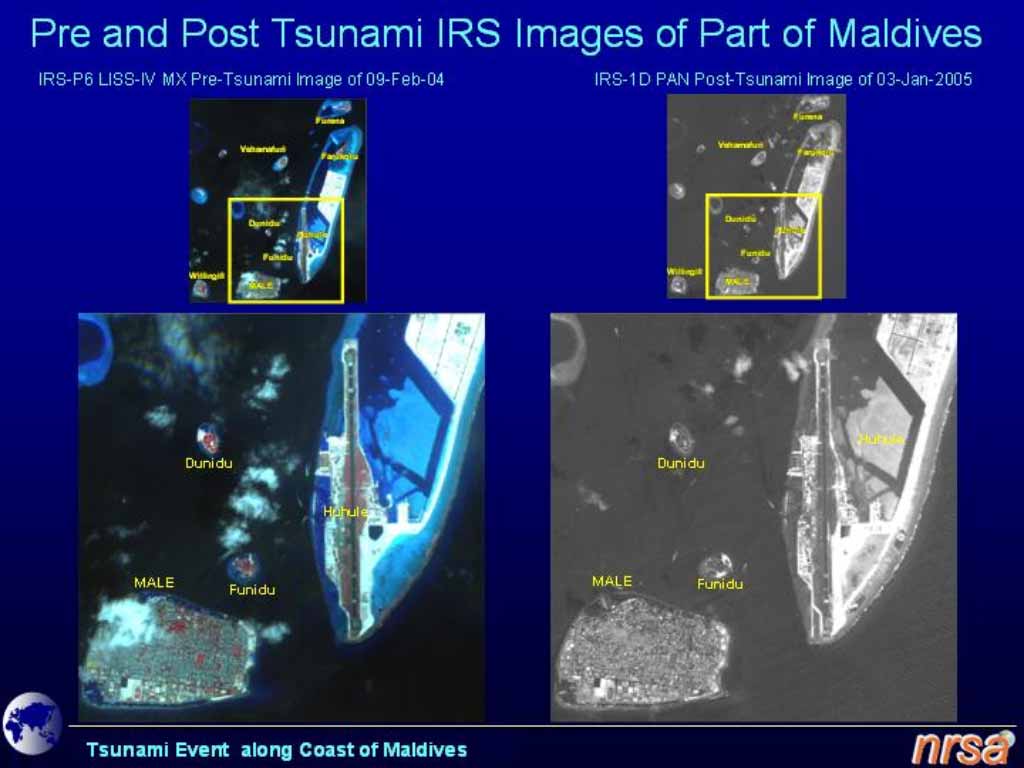
Before and after tsunami satellite images, Huhule, Maldives

Source: IRS-P6 LISS-IV MX data, 09/02/04, IRS 1D PAN, 03/01/05
Acquired: 03/01/05

Copyright: Courtesy National Remote Sensing Agency, Govt. of India
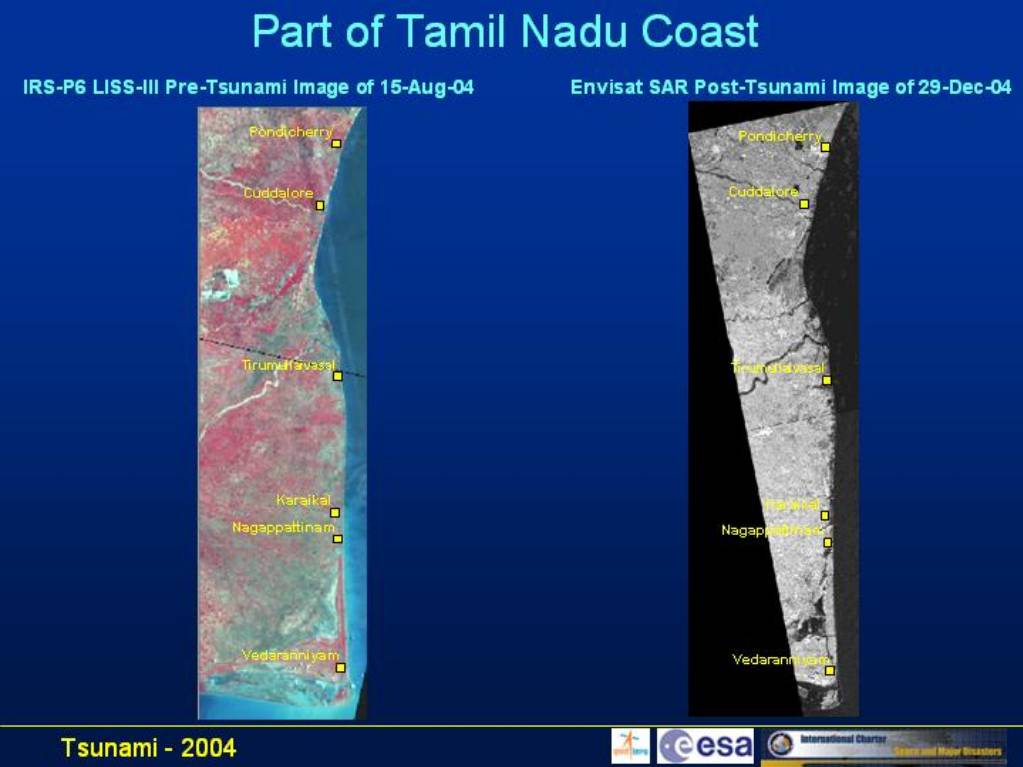
Before and after tsunami satellite images, Tamil Nadu Coast Tamil Nadu

Source: IRS-P6 LISS-III data, 15/08/04 and Envisat SAR data, 29/12/04
Acquired: 29/12/04

Copyright: Courtesy National Remote Sensing Agency, Govt. of India
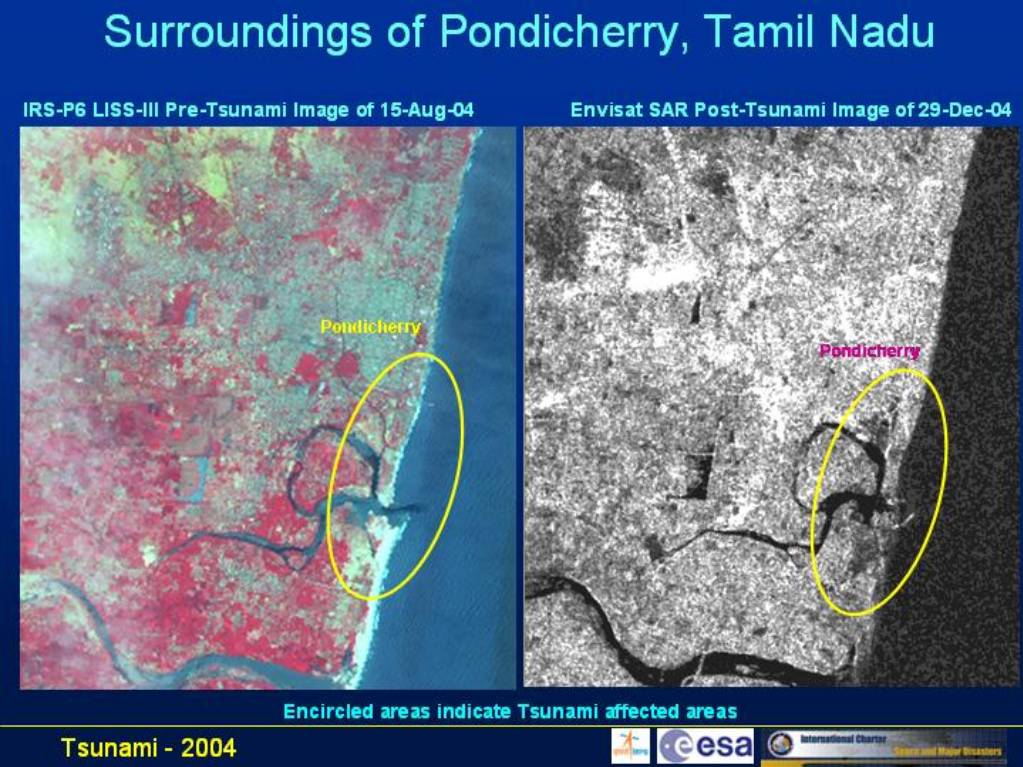
Before and after tsunami satellite images, Pondicherry Tamil Nadu

Source: IRS-P6 LISS-III data, 15/08/04 and Envisat SAR data, 29/12/04
Acquired: 29/12/04

Copyright: Courtesy National Remote Sensing Agency, Govt. of India
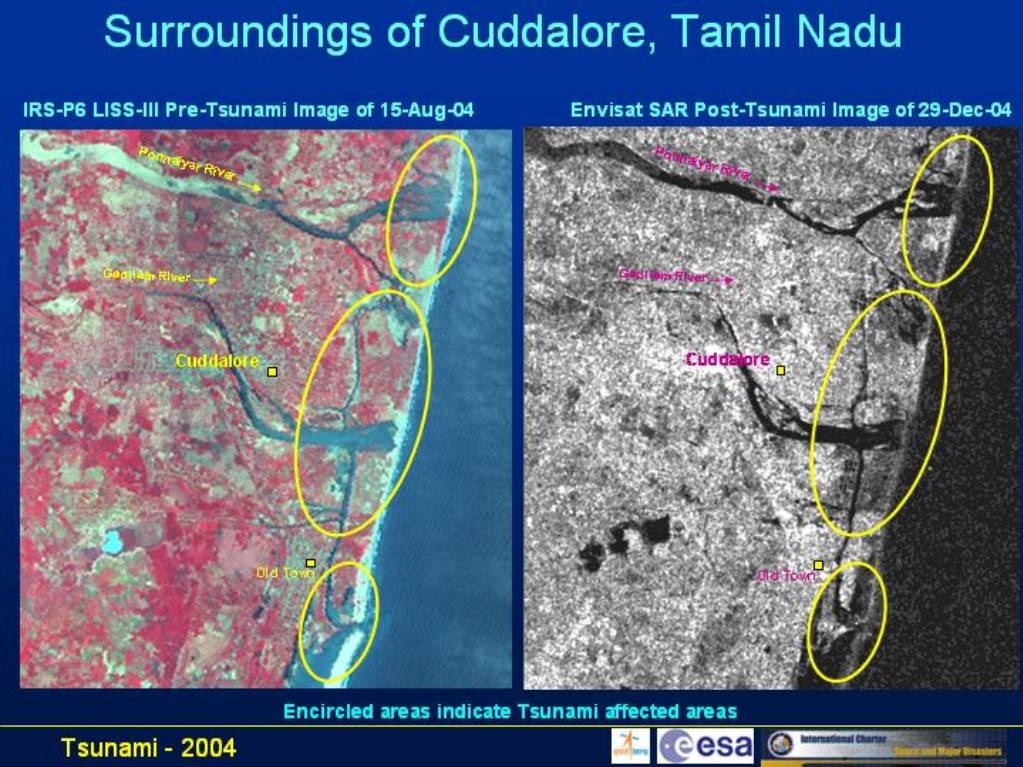
Before and after tsunami satellite images, Cuddalore Tamil Nadu

Source: IRS-P6 LISS-III data, 15/08/04 and Envisat SAR data, 29/12/04
Acquired: 29/12/04

Copyright: Courtesy National Remote Sensing Agency, Govt. of India
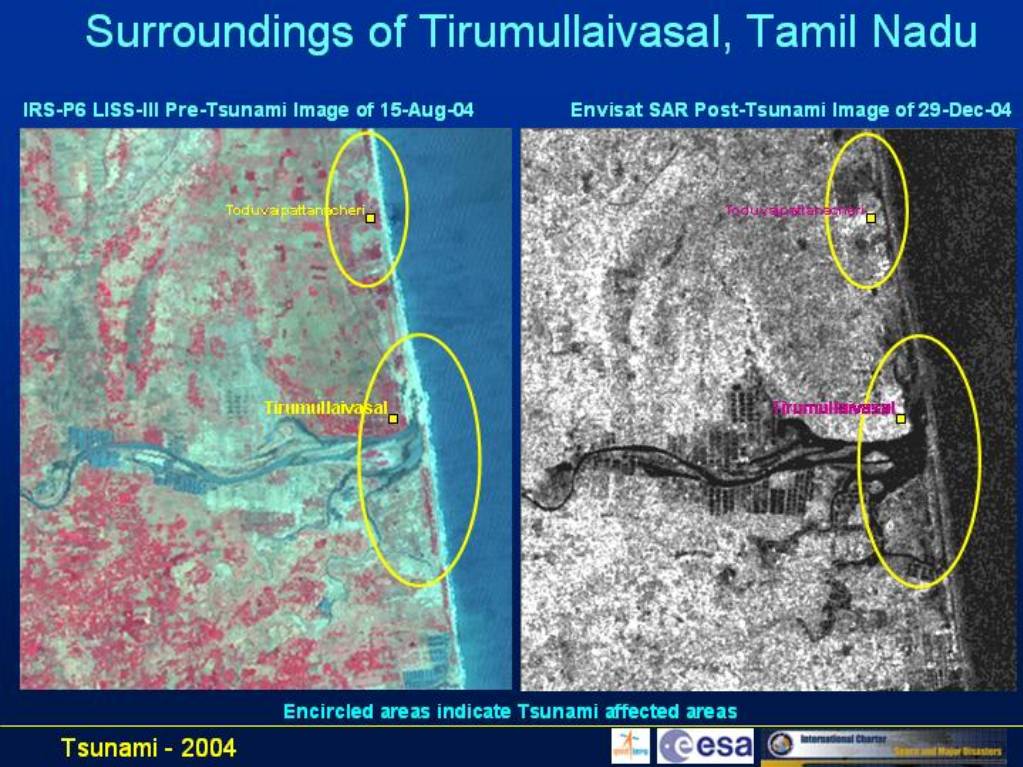
Before and after tsunami satellite images, Tirumullaivasal Tamil Nadu

Source: IRS-P6 LISS-III data, 15/08/04 and Envisat SAR data, 29/12/04
Acquired: 29/12/04

Copyright: Courtesy National Remote Sensing Agency, Govt. of India
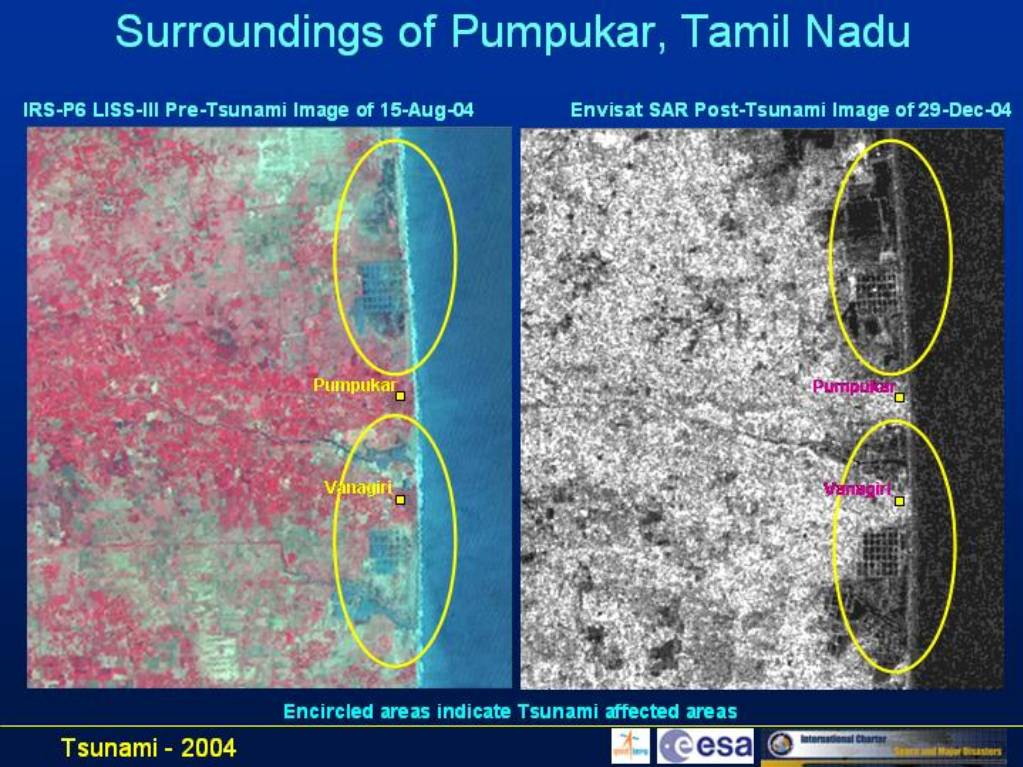
Before and after tsunami satellite images, Pumpukar Tamil Nadu

Source: IRS-P6 LISS-III data, 15/08/04 and Envisat SAR data, 29/12/04
Acquired: 29/12/04

Copyright: Courtesy National Remote Sensing Agency, Govt. of India
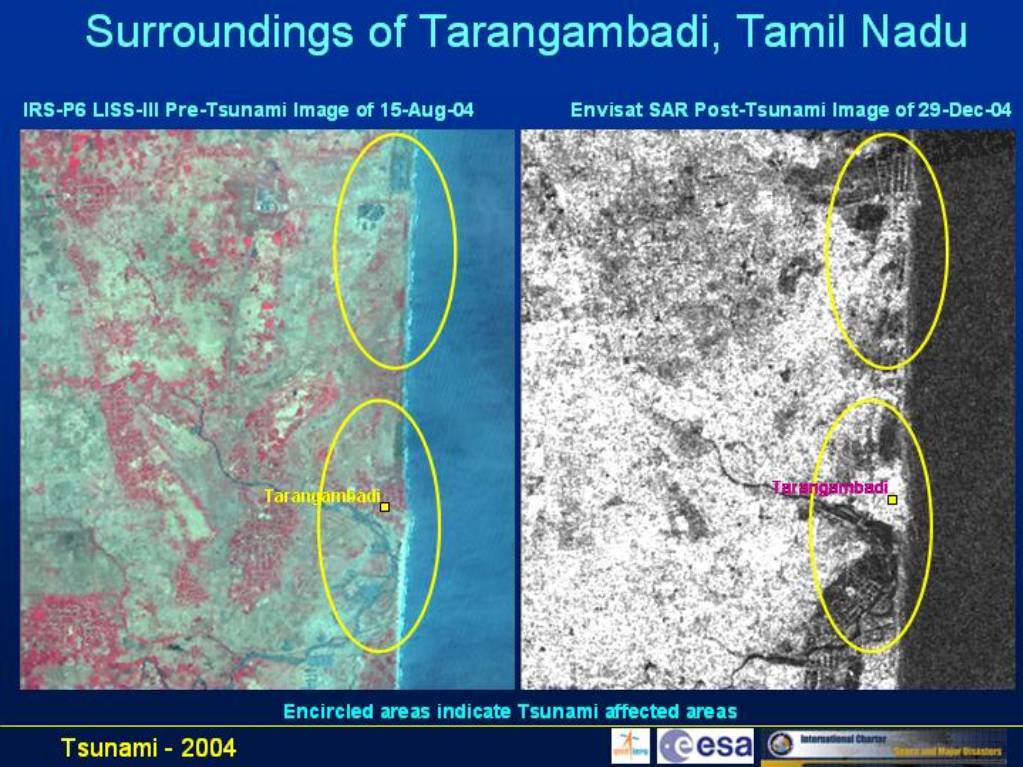
Before and after tsunami satellite images, Tarangambadi Tamil Nadu

Source: IRS-P6 LISS-III data, 15/08/04 and Envisat SAR data, 29/12/04
Acquired: 29/12/04

Copyright: Courtesy National Remote Sensing Agency, Govt. of India
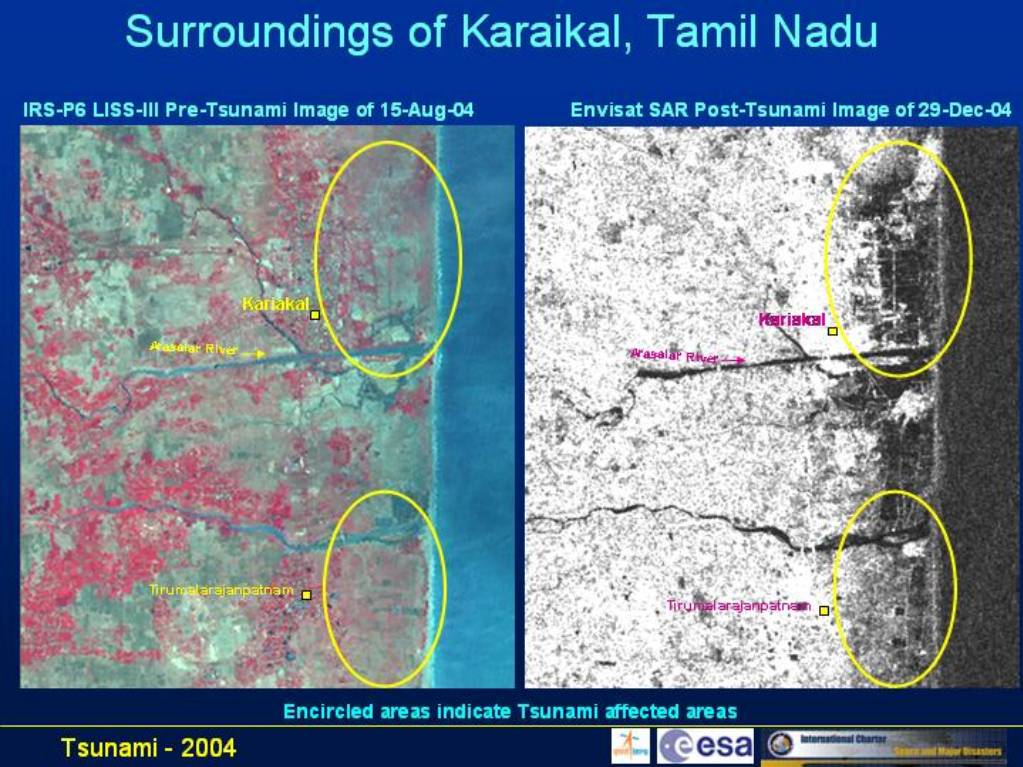
Before and after tsunami satellite images, Karaikal Tamil Nadu

Source: IRS-P6 LISS-III data, 15/08/04 and Envisat SAR data, 29/12/04
Acquired: 29/12/04

Copyright: Courtesy National Remote Sensing Agency, Govt. of India
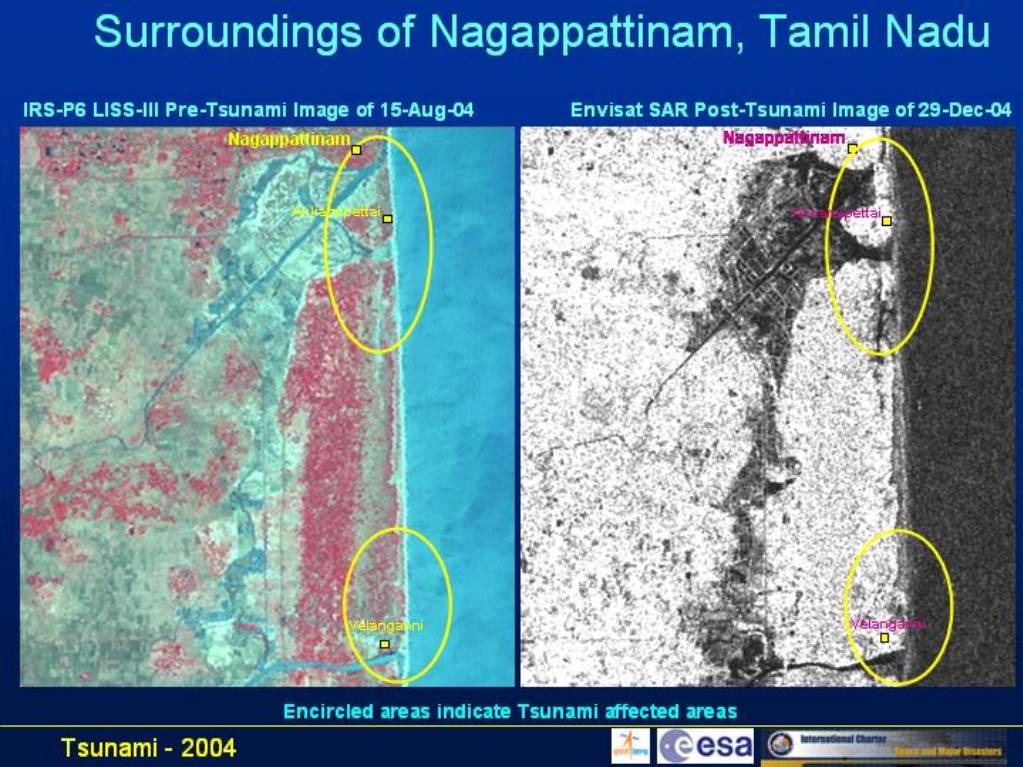
Before and after tsunami satellite images, Nagappattinam Tamil Nadu

Source: IRS-P6 LISS-III data, 15/08/04 and Envisat SAR data, 29/12/04
Acquired: 29/12/04

Copyright: Courtesy National Remote Sensing Agency, Govt. of India
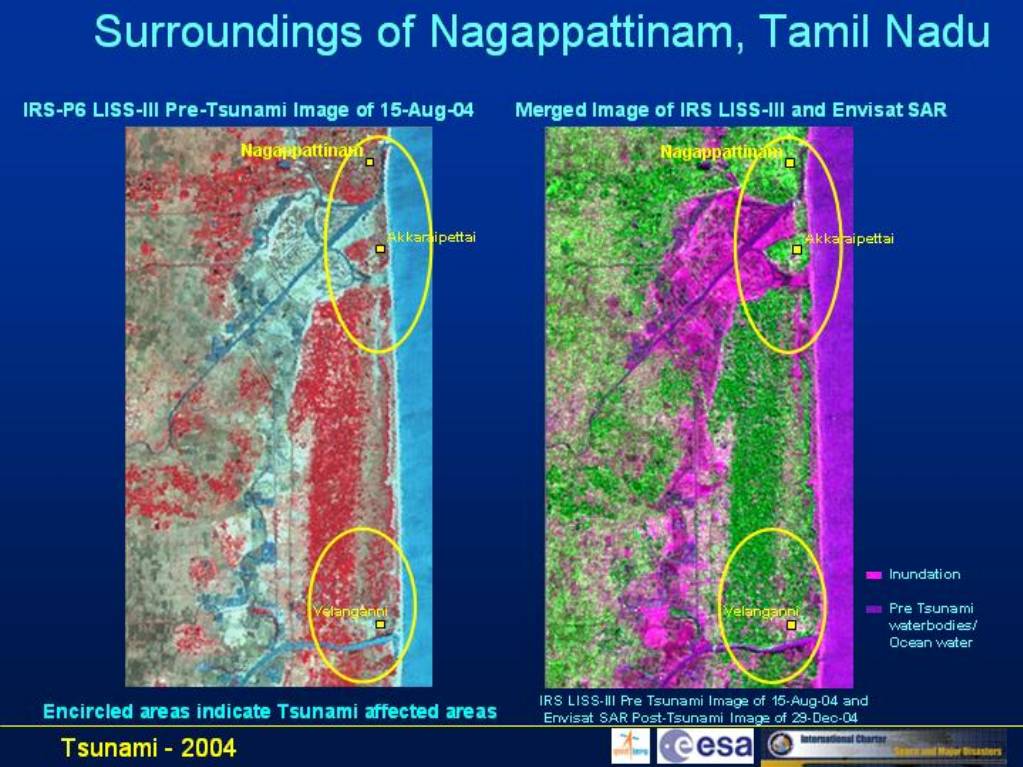
Before and after tsunami satellite images, Nagappattinam Surroundings Tamil Nadu

Source: IRS-P6 LISS-III data, 15/08/04 and merged image IRS LISS-III, 15/08/04 and Envisat SAR data, 29/12/04
Acquired: 29/12/04

Copyright: Courtesy National Remote Sensing Agency, Govt. of India
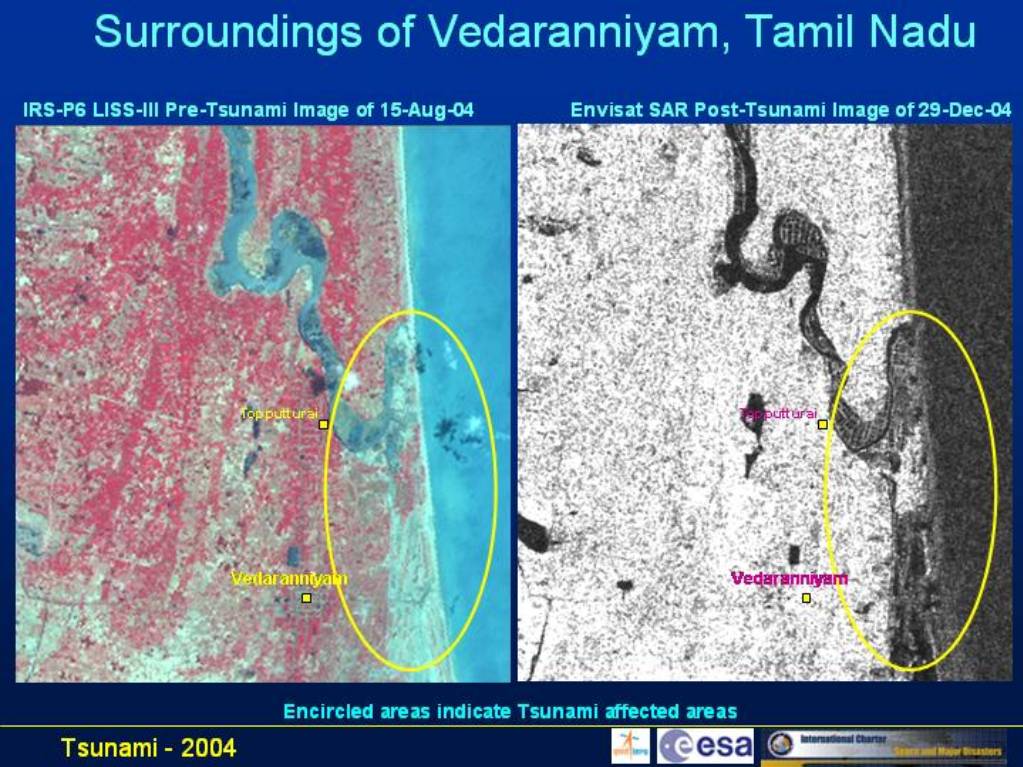
Before and after tsunami satellite images, Vedaranniyam Tamil Nadu

Source: IRS-P6 LISS-III data, 15/08/04 and Envisat SAR data, 29/12/04
Acquired: 29/12/04

Copyright: Courtesy National Remote Sensing Agency, Govt. of India
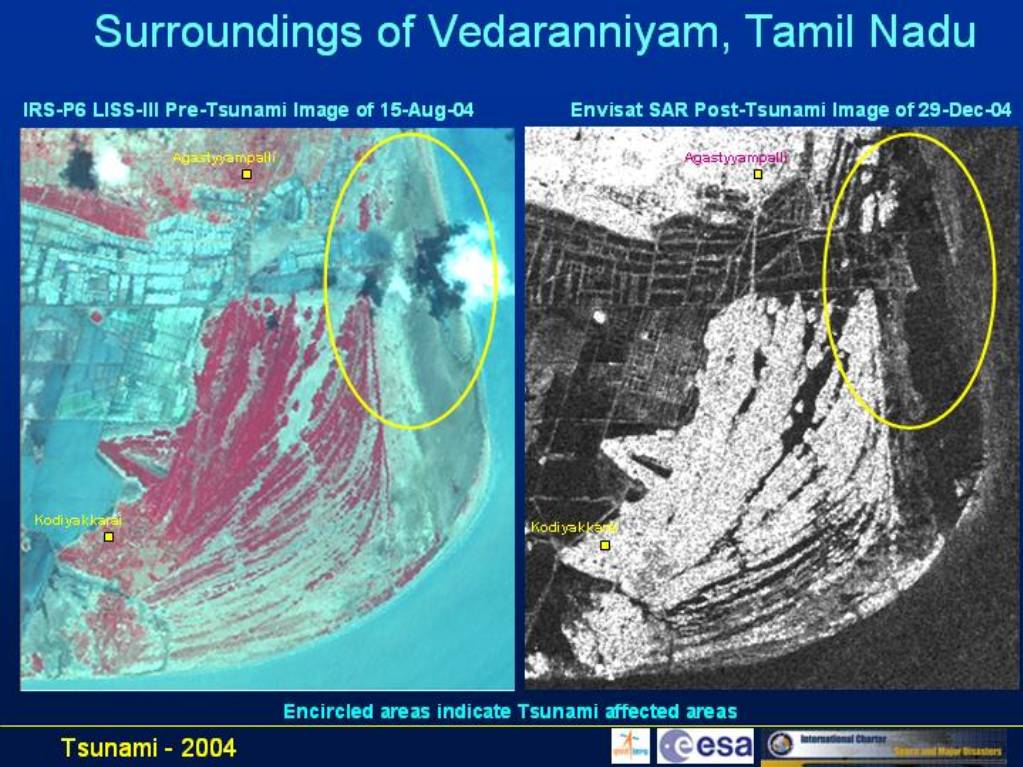
Before and after tsunami satellite images, Vedaranniyam Surroundings Tamil Nadu

Source: IRS-P6 LISS-III data, 15/08/04 and Envisat SAR data, 29/12/04
Acquired: 29/12/04

Copyright: Courtesy National Remote Sensing Agency, Govt. of India
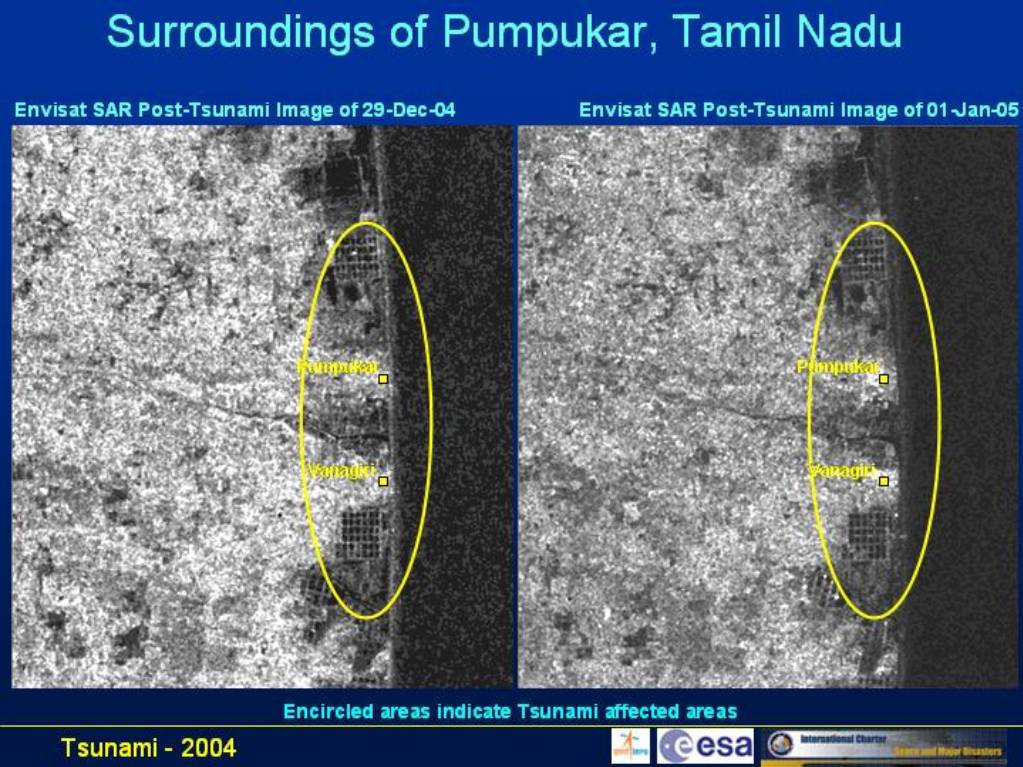
Before and after tsunami satellite images, Pumpukar Surroundings Tamil Nadu

Source: Envisat SAR data, 29/12/04 and 01/01/05
Acquired: 01/01/05

Copyright: Courtesy National Remote Sensing Agency, Govt. of India
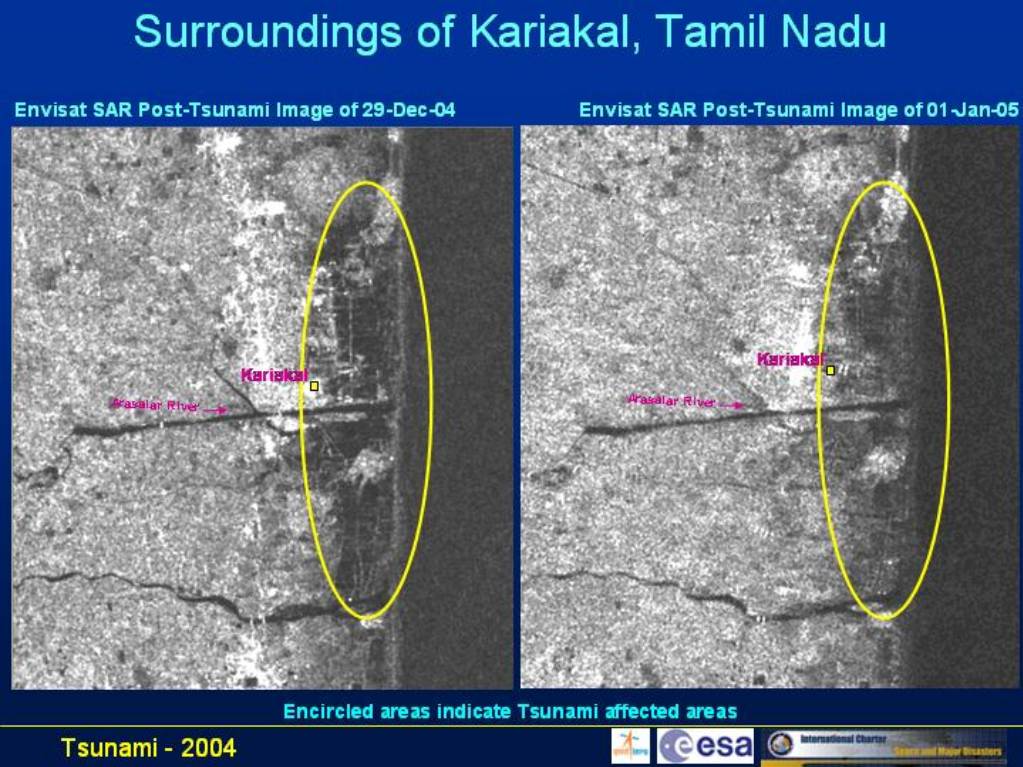
Before and after tsunami satellite images, Karaikal Surroundings Tamil Nadu

Source: Envisat SAR data, 29/12/04 and 01/01/05
Acquired: 01/01/05

Copyright: Courtesy National Remote Sensing Agency, Govt. of India
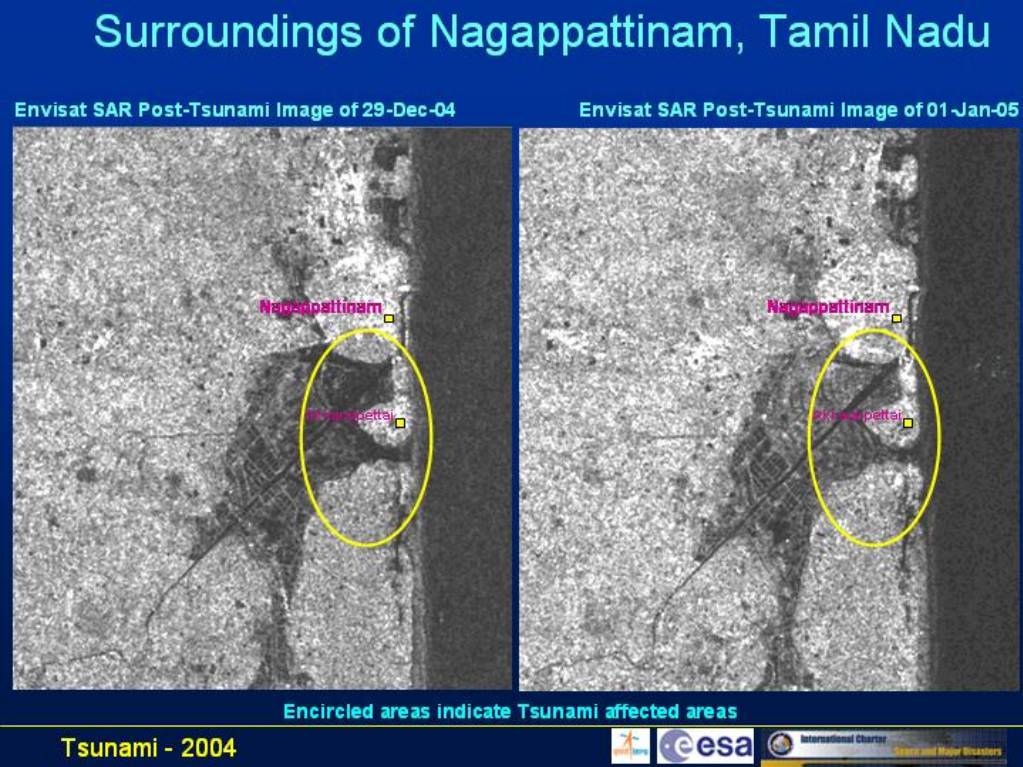
Before and after tsunami satellite images, Nagappattinam Surroundings Tamil Nadu

Source: Envisat SAR data, 29/12/04 and 01/01/05
Acquired: 01/01/05

Copyright: Courtesy National Remote Sensing Agency, Govt. of India
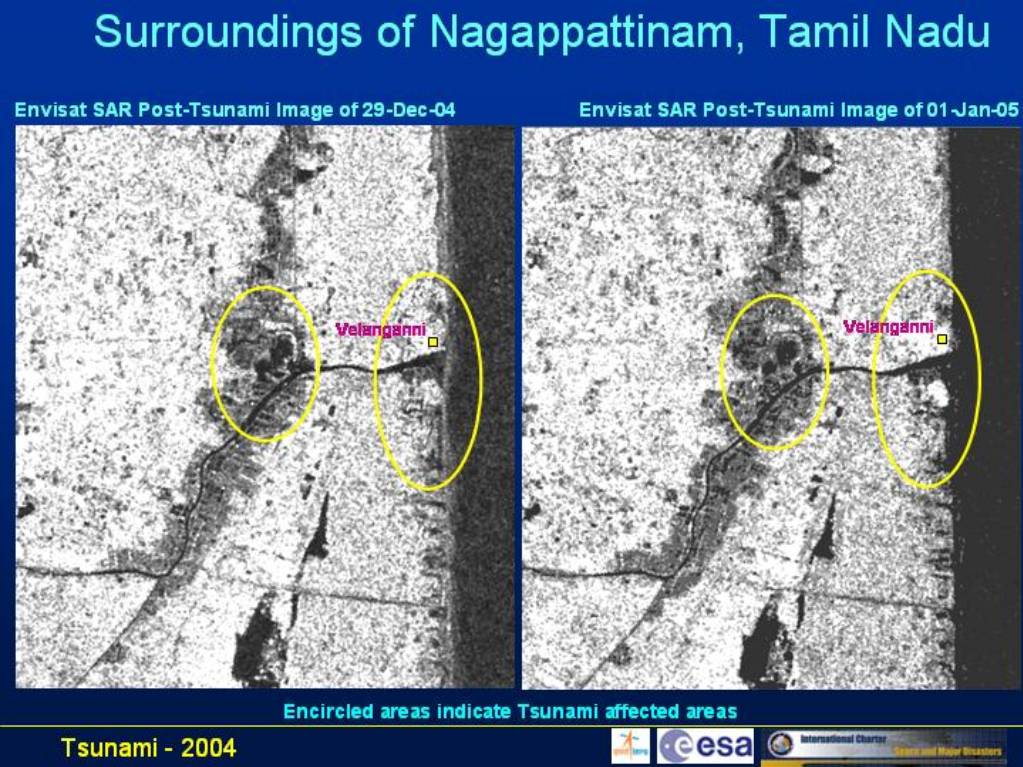
Before and after tsunami satellite images, Nagappattinam Surroundings Tamil Nadu

Source: Envisat SAR data, 29/12/04 and 01/01/05
Acquired: 01/01/05

Copyright: Courtesy National Remote Sensing Agency, Govt. of India
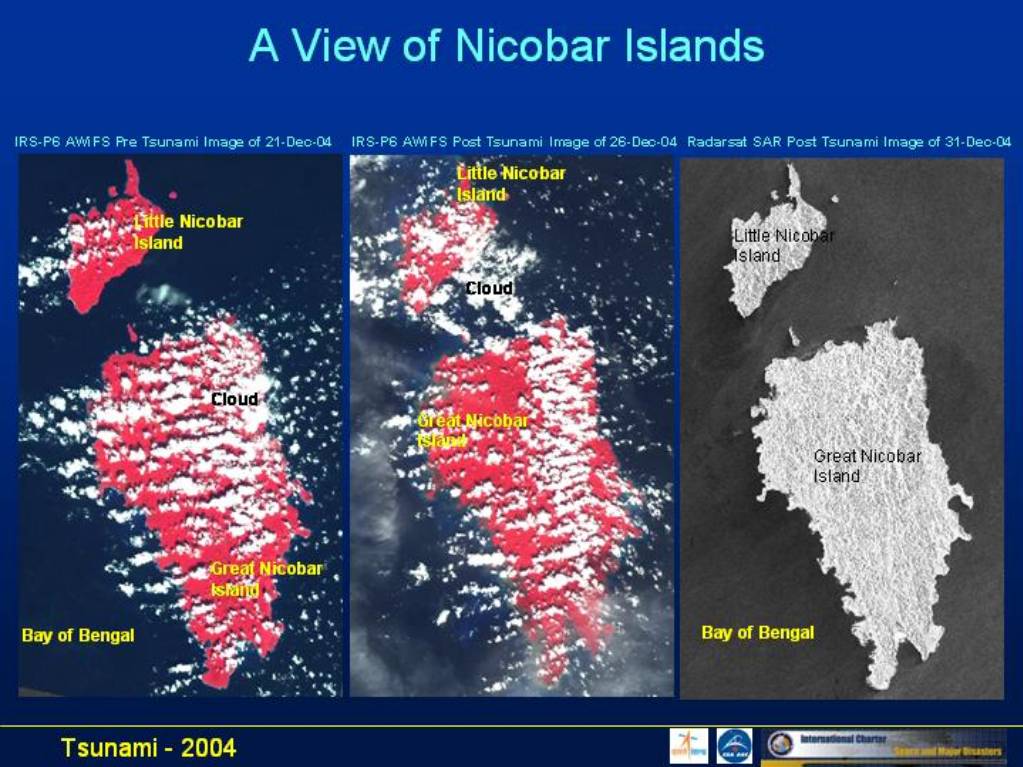
Before and after tsunami satellite images, View Of Nicobar Islands

Source: IRS-P6 AWiFS data, 21/12/04, 26/12/04, and Radarsat SAR data, 31/12/04
Acquired: 21/12/04, 26/12/04, 31/12/04

Copyright: Courtesy National Remote Sensing Agency, Govt. of India
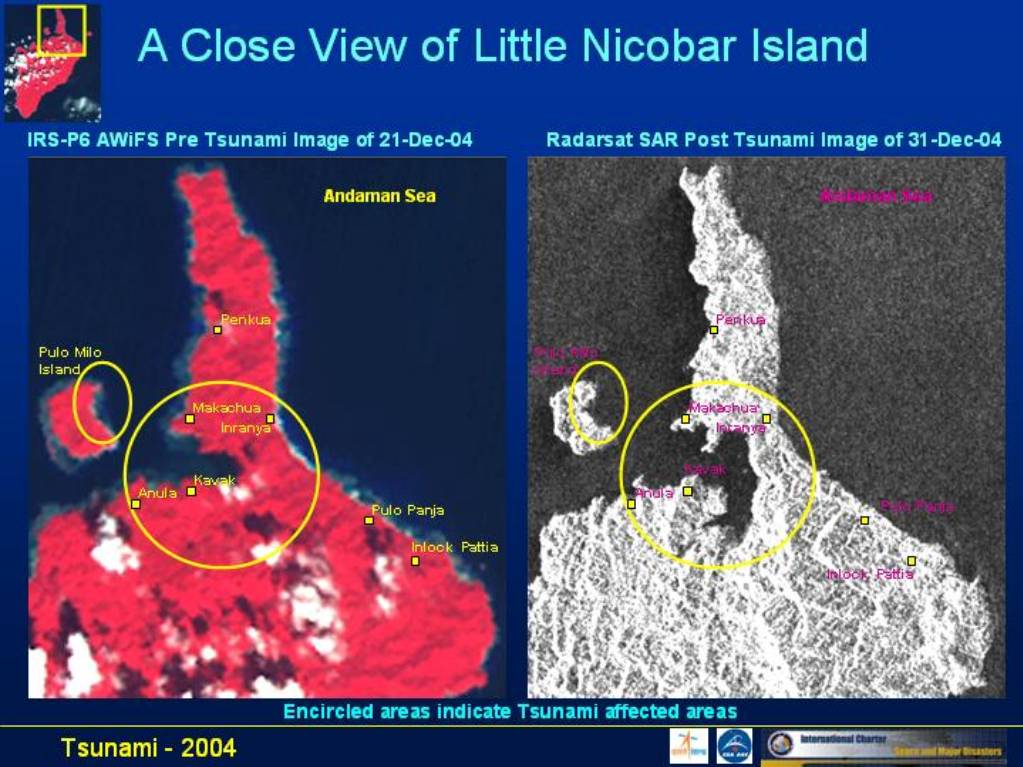
Before and after tsunami satellite images, Little Nicobar Pulo Milo Nicobar Islands

Source: IRS-P6 AWiFS data, 21/12/04, and Radarsat SAR data, 31/12/04
Acquired: 21/12/04, 31/12/04

Copyright: Courtesy National Remote Sensing Agency, Govt. of India
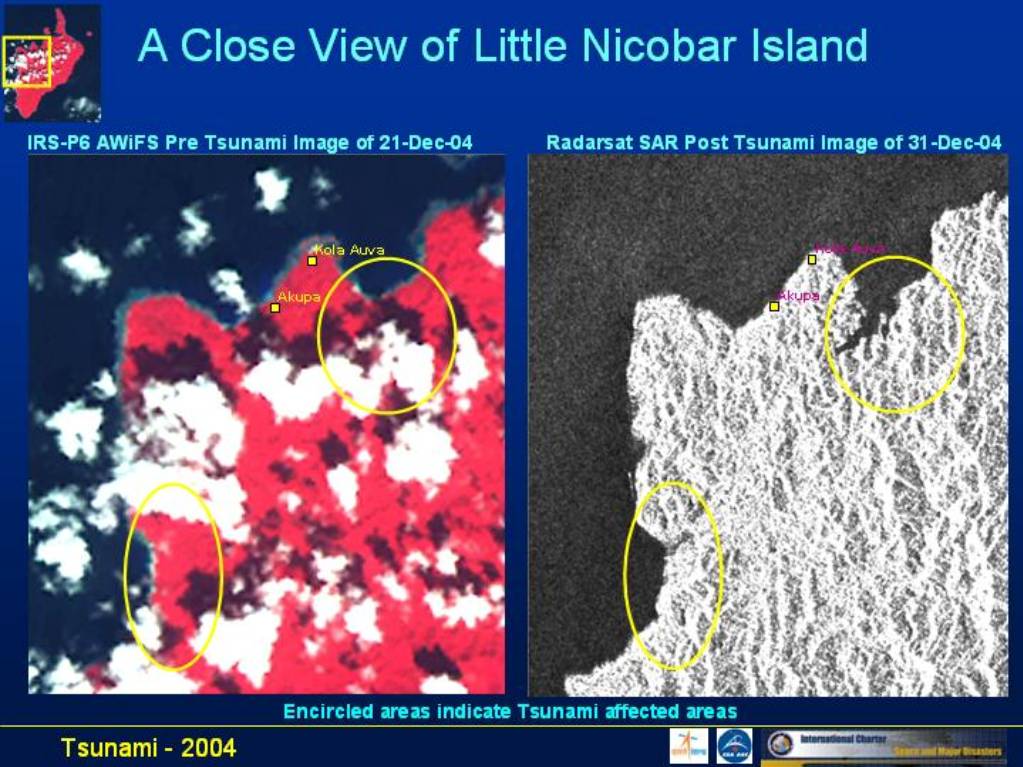
Before and after tsunami satellite images, Little Nicobar Kola Auva Nicobar Islands

Source: IRS-P6 AWiFS data, 21/12/04, and Radarsat SAR data, 31/12/04
Acquired: 21/12/04, 31/12/04

Copyright: Courtesy National Remote Sensing Agency, Govt. of India
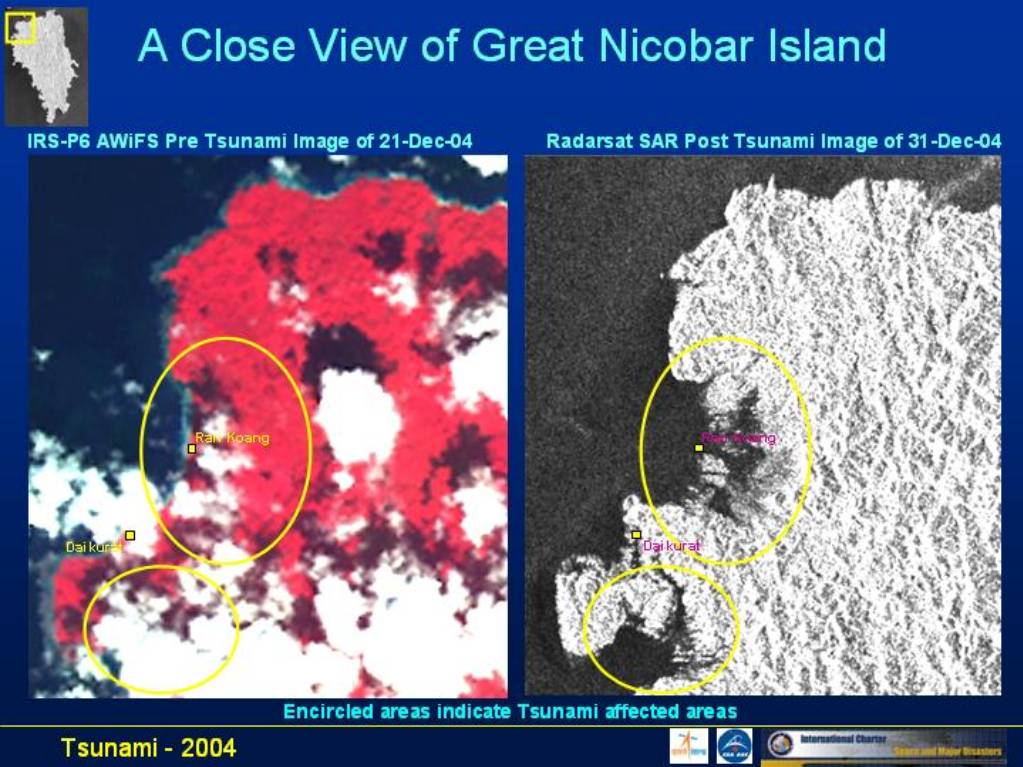
Before and after tsunami satellite images, Great Nicobar Nicobar Islands

Source: IRS-P6 AWiFS data, 21/12/04, and Radarsat SAR data, 31/12/04
Acquired: 21/12/04, 31/12/04

Copyright: Courtesy National Remote Sensing Agency, Govt. of India
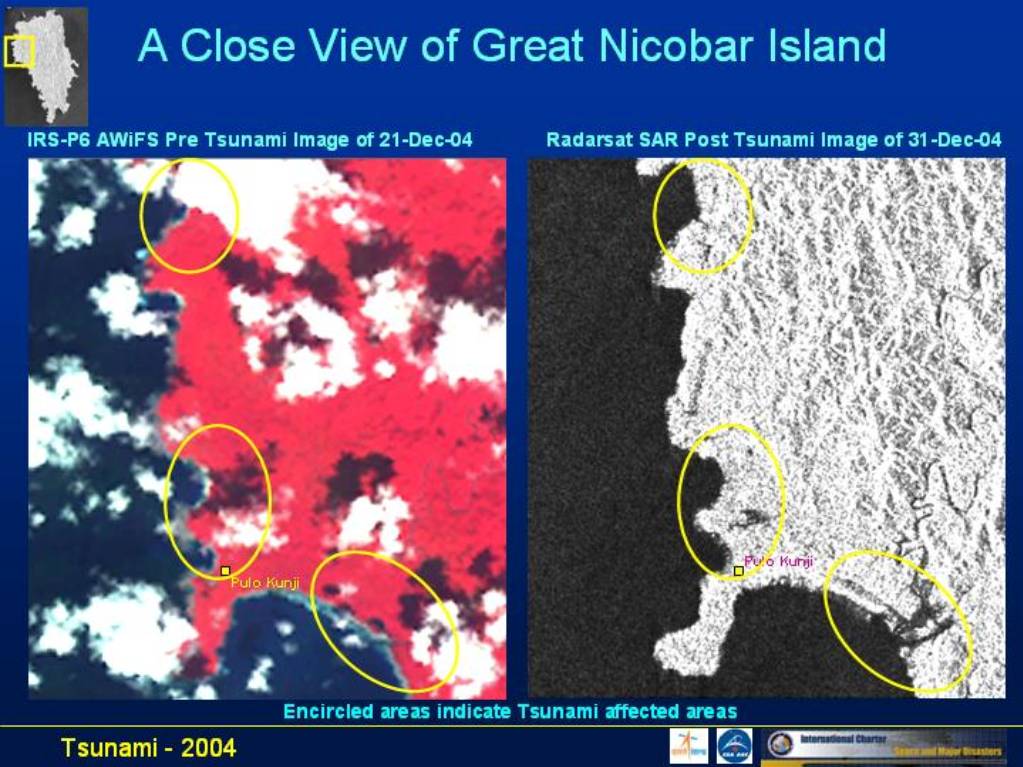
Before and after tsunami satellite images, Great Nicobar Pulo Kunji Nicobar Islands

Source: IRS-P6 AWiFS data, 21/12/04, and Radarsat SAR data, 31/12/04
Acquired: 21/12/04, 31/12/04

Copyright: Courtesy National Remote Sensing Agency, Govt. of India
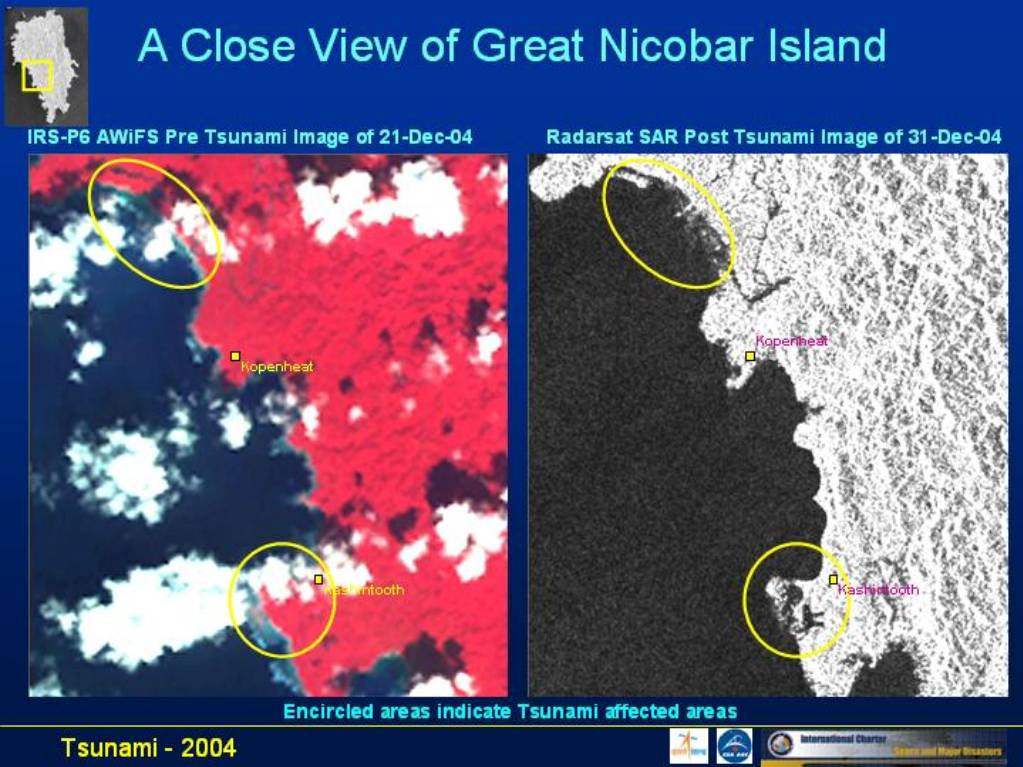
Before and after tsunami satellite images, Great Nicobar Kopenheat Nicobar Islands

Source: IRS-P6 AWiFS data, 21/12/04, and Radarsat SAR data, 31/12/04
Acquired: 21/12/04, 31/12/04

Copyright: Courtesy National Remote Sensing Agency, Govt. of India
Regional Topographic map, with affected areas, population density and digital elevation model

Source: UNJLC
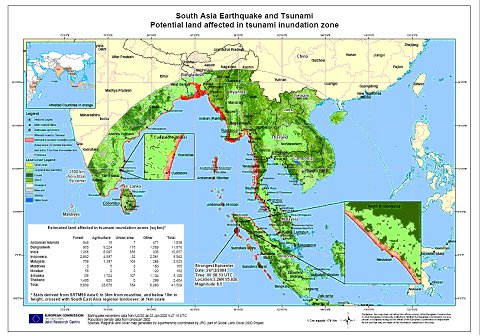
Potential land affected by Tsunami over the whole area.

Copyright: European Commission, Joint Research Institute. Regional land cover map generated by a partnership coordinated by JRC, part of Global Land Cover 2000 project.

Source: IRS-P6 AWiFs imagery 21/12/2004-26/12/2004, before and after tsunami
Copyright: Courtesy National Remote Sensing Agency, Govt. of India
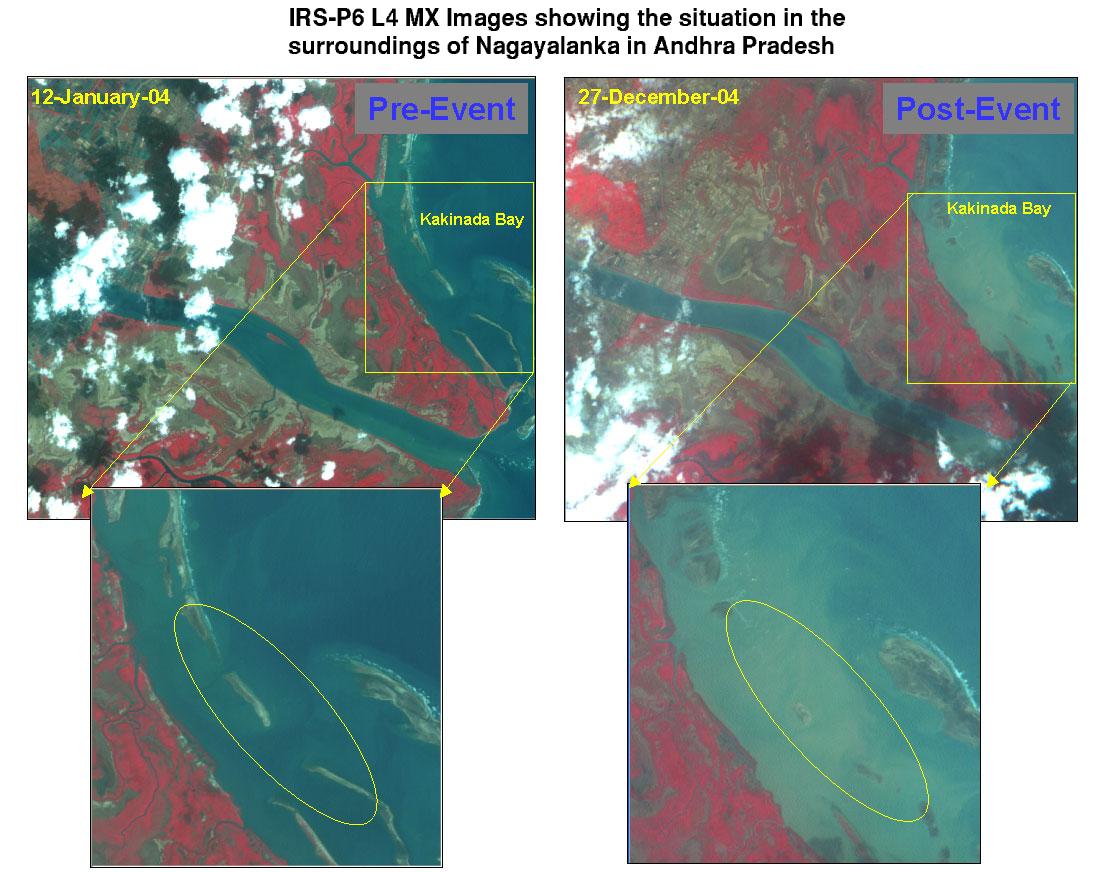

Source: IRS-P6 L4 MX imagery 12/01/2004-27/12/2004, before and after tsunami
Copyright: Courtesy National Remote Sensing Agency, Govt. of India
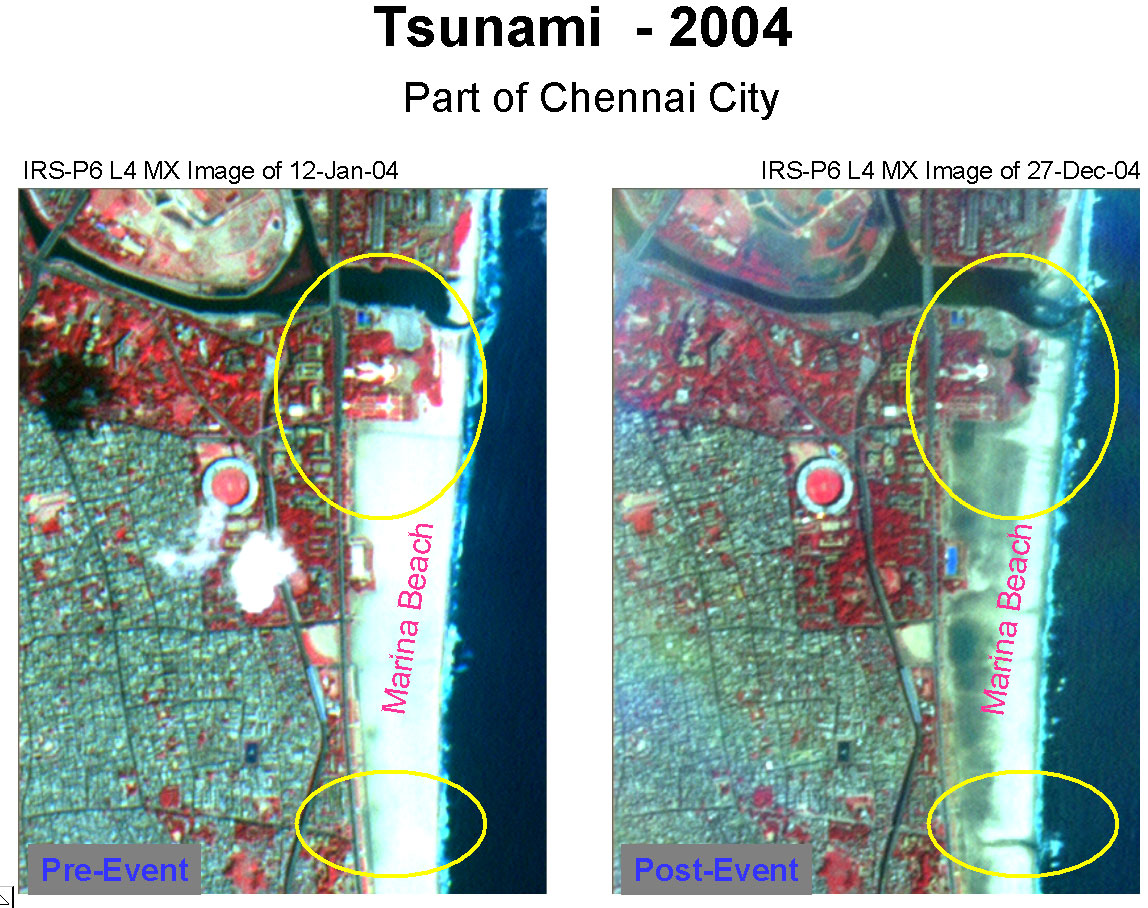

Source: IRS-P6 L4 MX imagery 12/01/2004-27/12/2004, before and after tsunami
Copyright: Courtesy National Remote Sensing Agency, Govt. of India
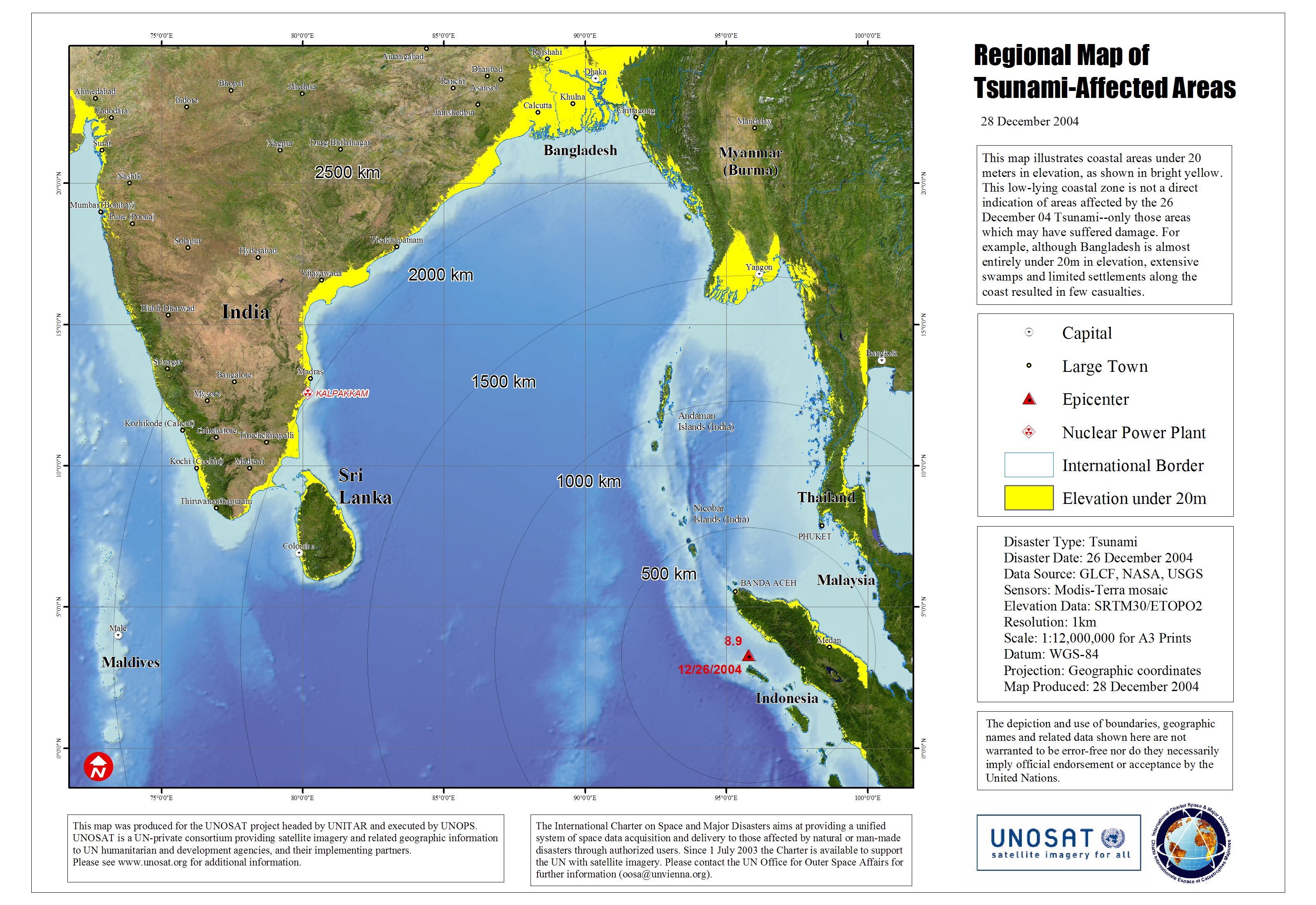
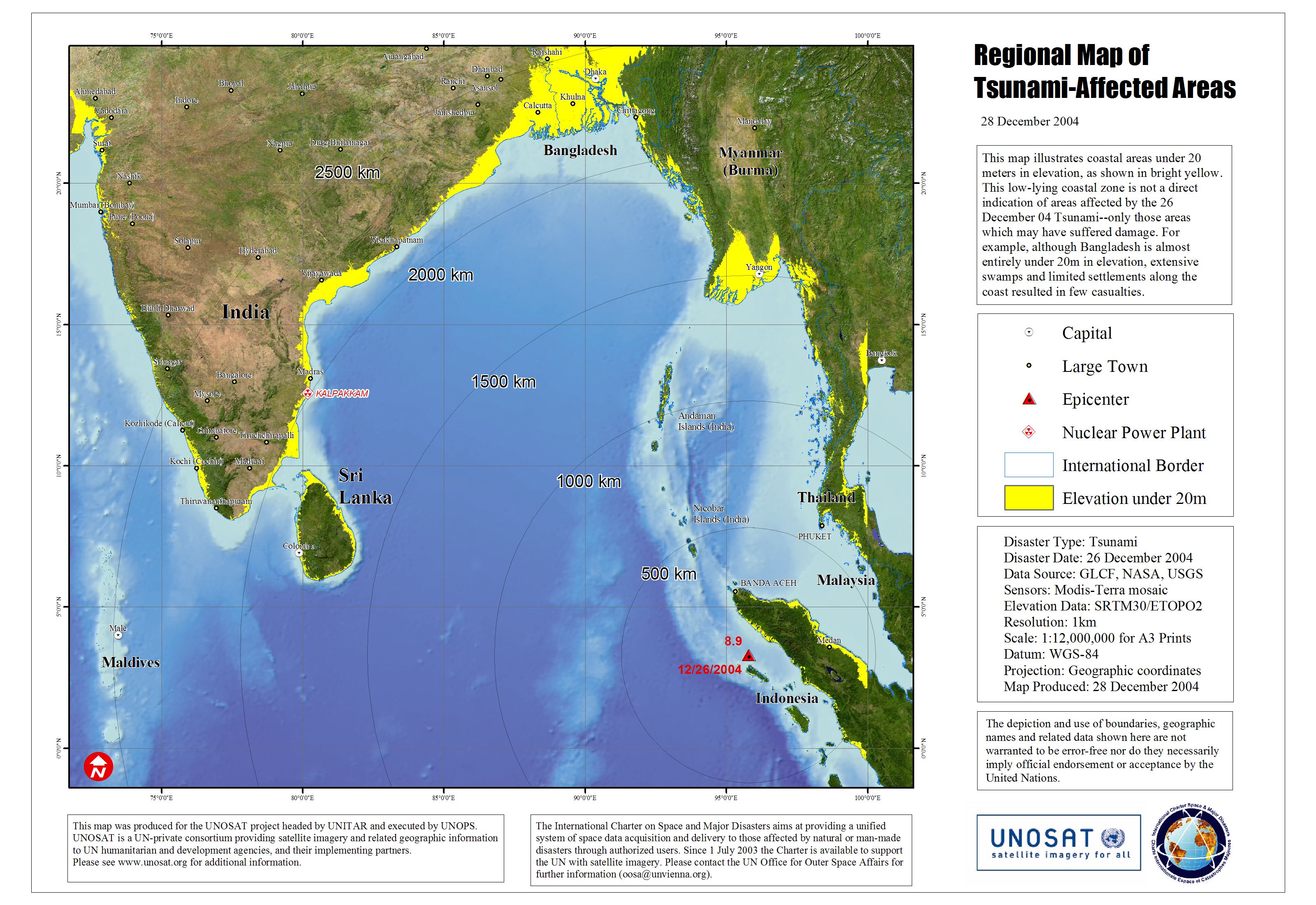
Regional map of tsunami-affected areas, scale: 1:12,000,000

Source: GLCF, NASA, USGS. MODIS-Terra Mosaic SRTM (3 arc seconds). Shows coastal areas under 20 meters elevation. Map produced 28/12/2004 by UNOSAT.
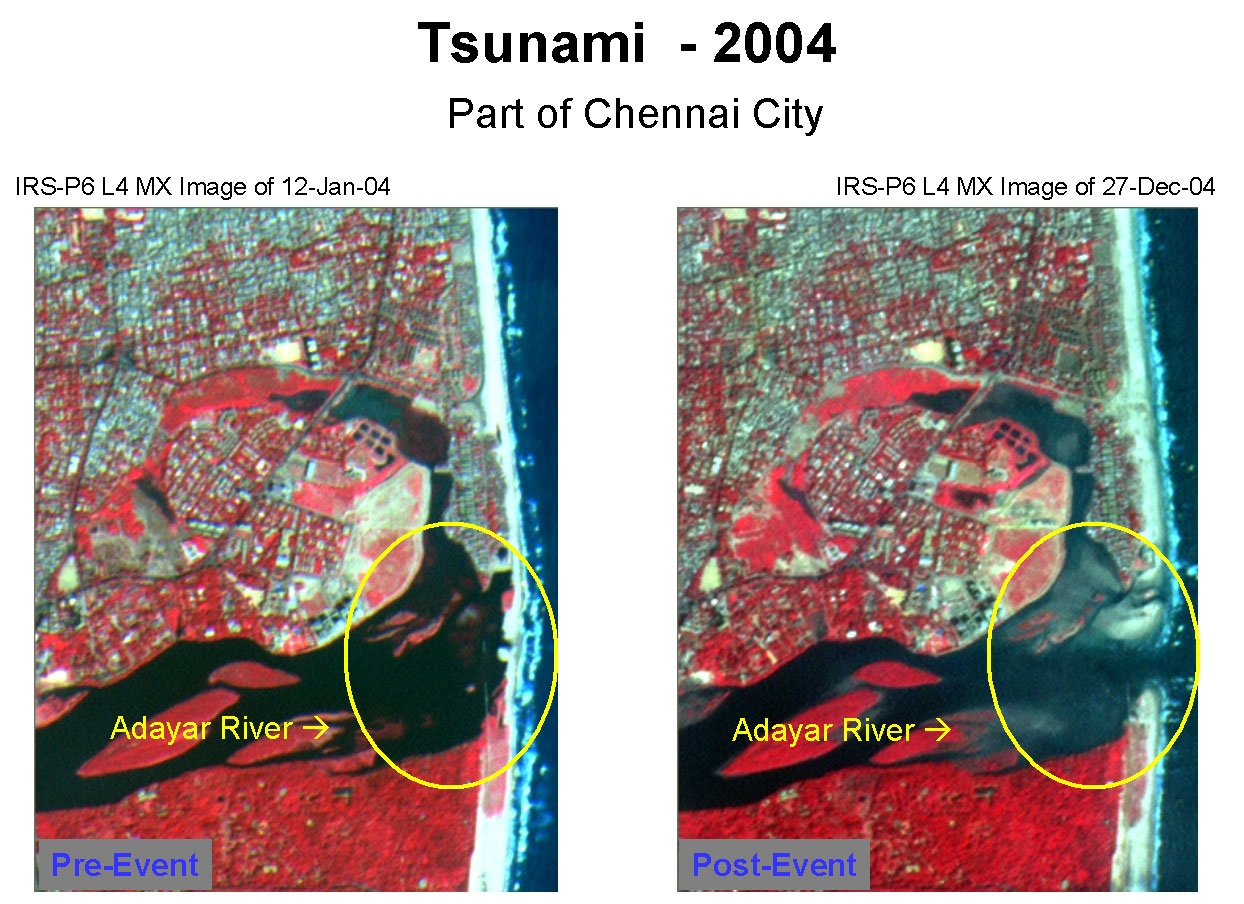
Other info: Elevation data: SRTM (3 arc seconds). Shows coastal areas under 20 meters elevation. Map produced 28/12/2004 by UNOSAT.


Source: IRS-P6 L4 MX imagery 12/01/2004-27/12/2004, before and after tsunami
Copyright: Courtesy National Remote Sensing Agency, Govt. of India
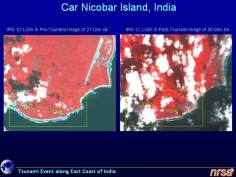

Source: IRS-1D LISS-III imagery, 21/12/2004, IRS-1C LISS-III imagery, 30/12/2004, Car Nicobar Island
Copyright: Courtesy National Remote Sensing Agency, Govt. of India.
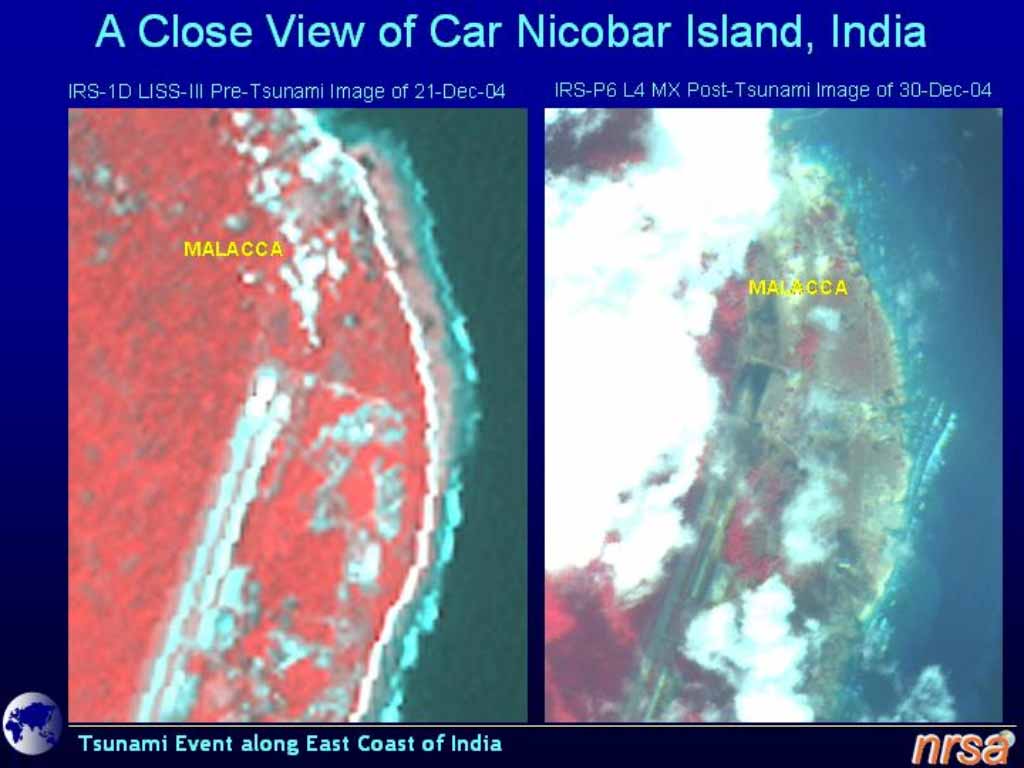

Source: IRS-1D LISS-III imagery, 21/12/2004, IRS-1C LISS-III imagery, 30/12/2004, Car Nicobar Island
Copyright: Courtesy National Remote Sensing Agency, Govt. of India.
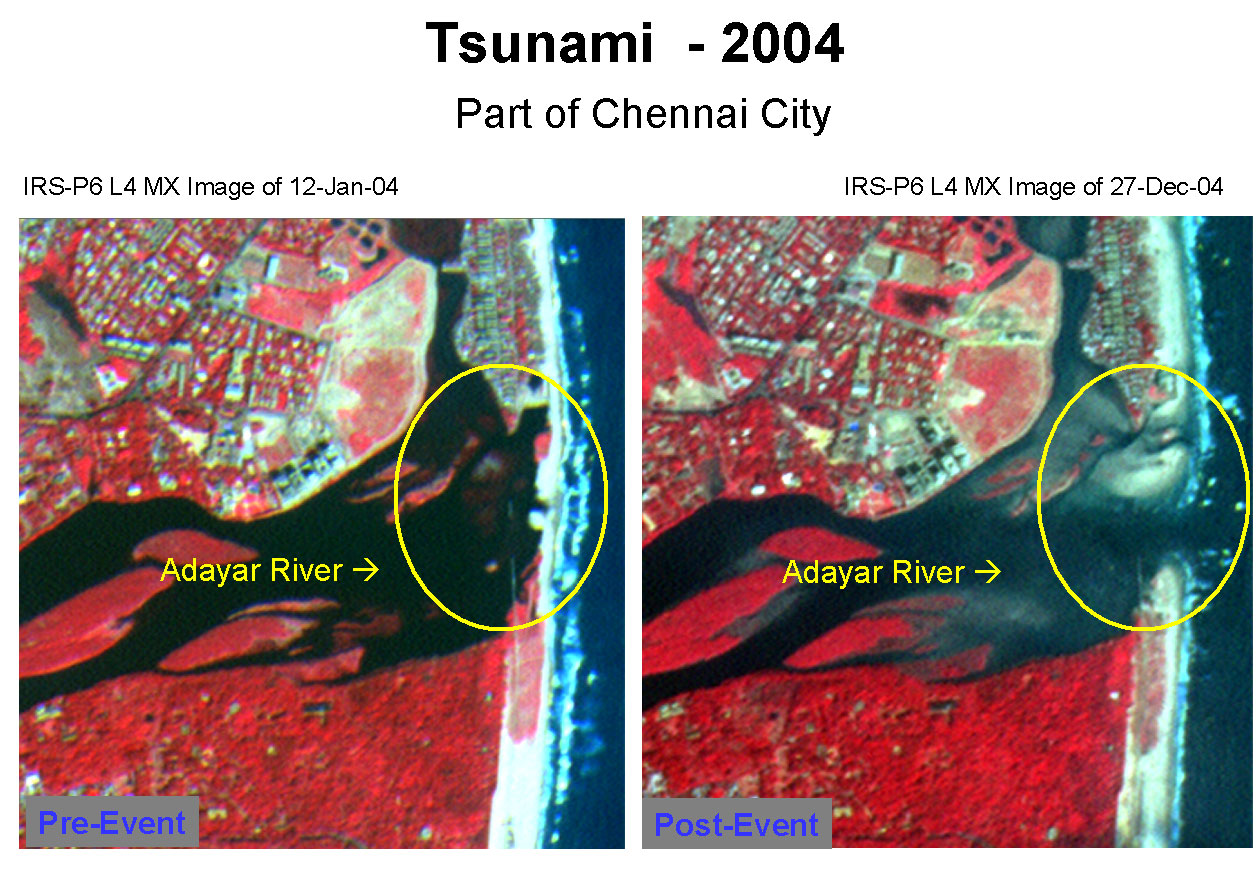

Source: IRS-P6 L4 MX imagery 12/01/2004-27/12/2004, before and after tsunami
Copyright: Courtesy National Remote Sensing Agency, Govt. of India
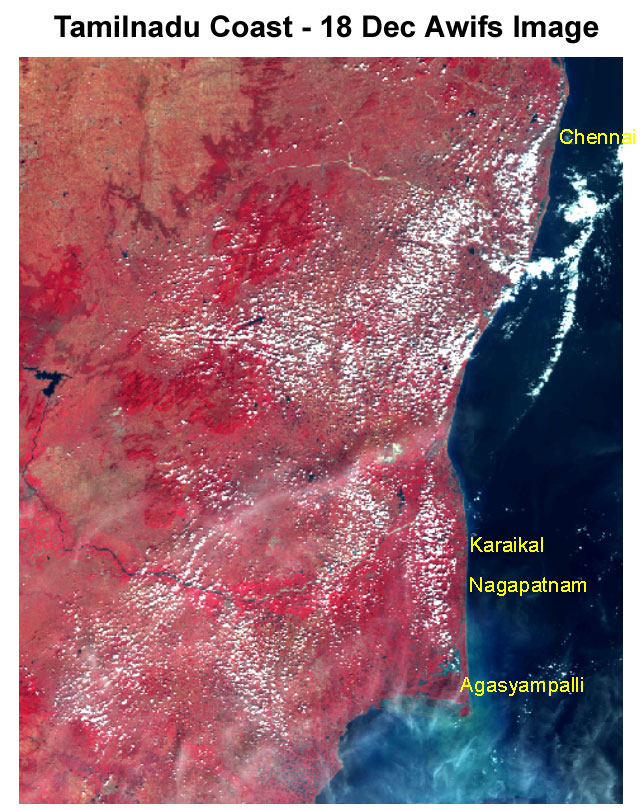

Source: IRS-P6 AWiFs imagery 18/12/2004
Copyright: Courtesy National Remote Sensing Agency, Govt. of India
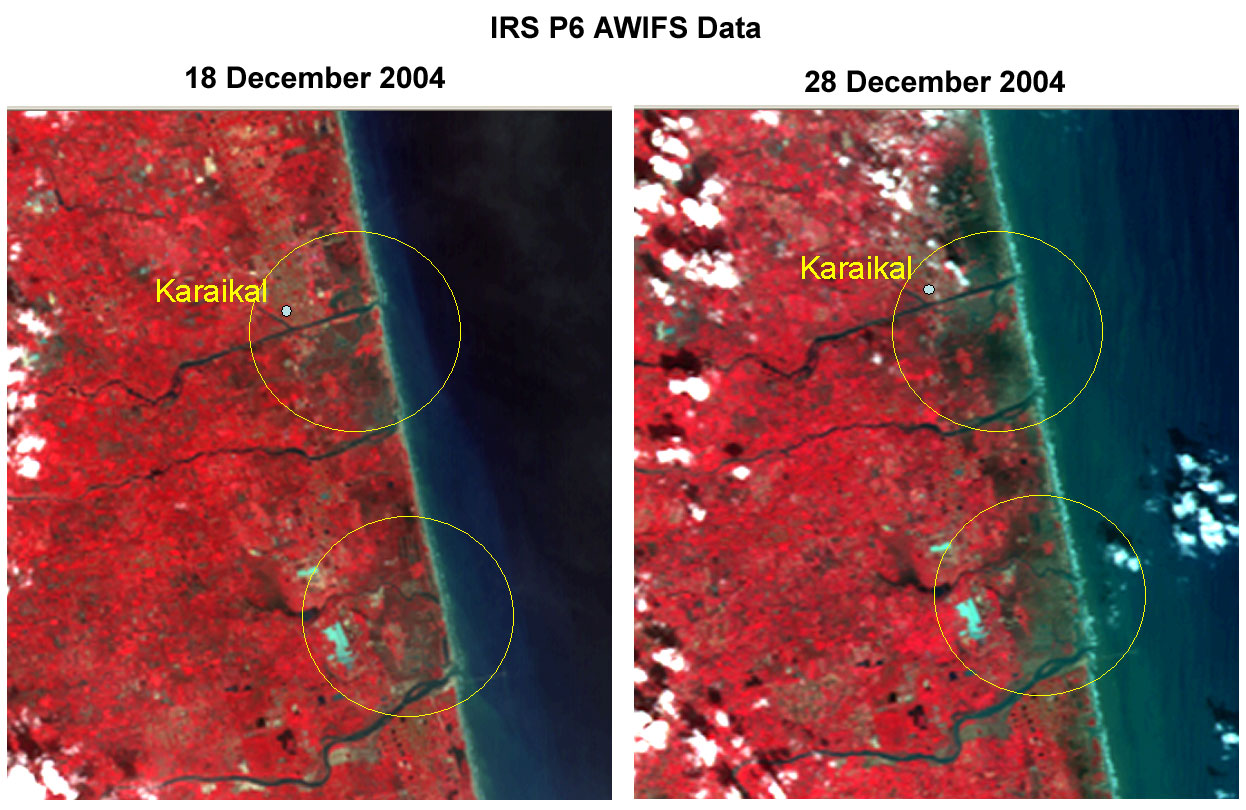

Source: IRS-P6 AWiFs imagery 18/12/2004-28/12/2004, before and after
Copyright: Courtesy National Remote Sensing Agency, Govt. of India
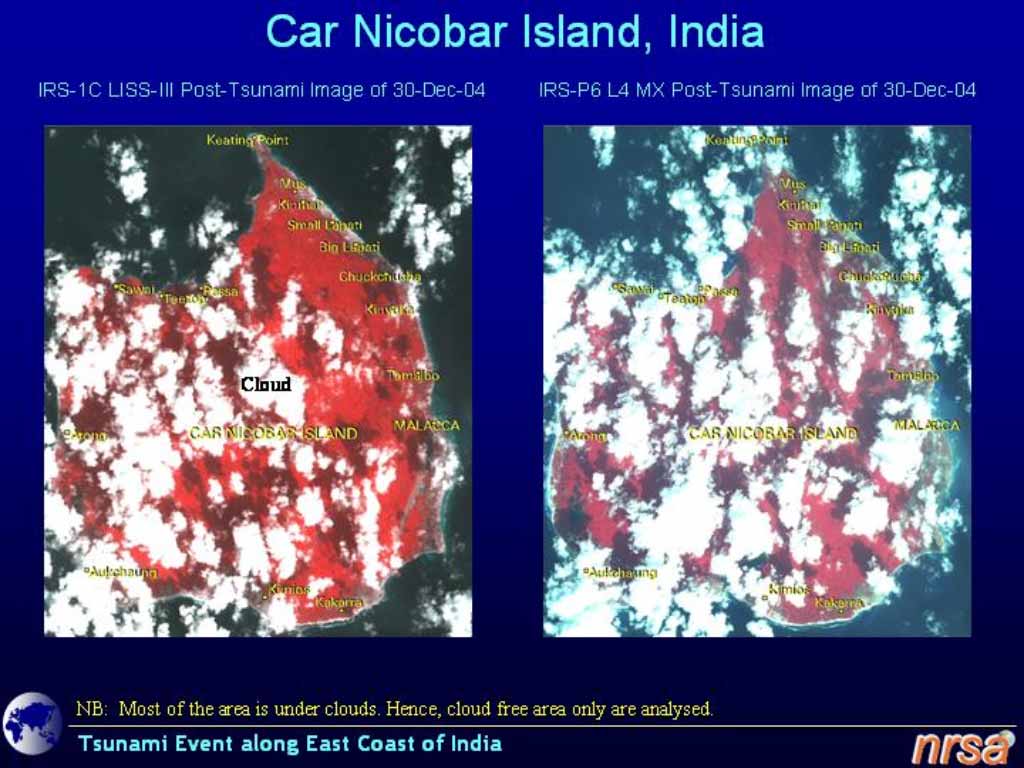

Source: IRS-1D LISS-III imagery, 21/12/2004, IRS-1C LISS-III imagery, 30/12/2004, Car Nicobar Island
Copyright: Courtesy National Remote Sensing Agency, Govt. of India.
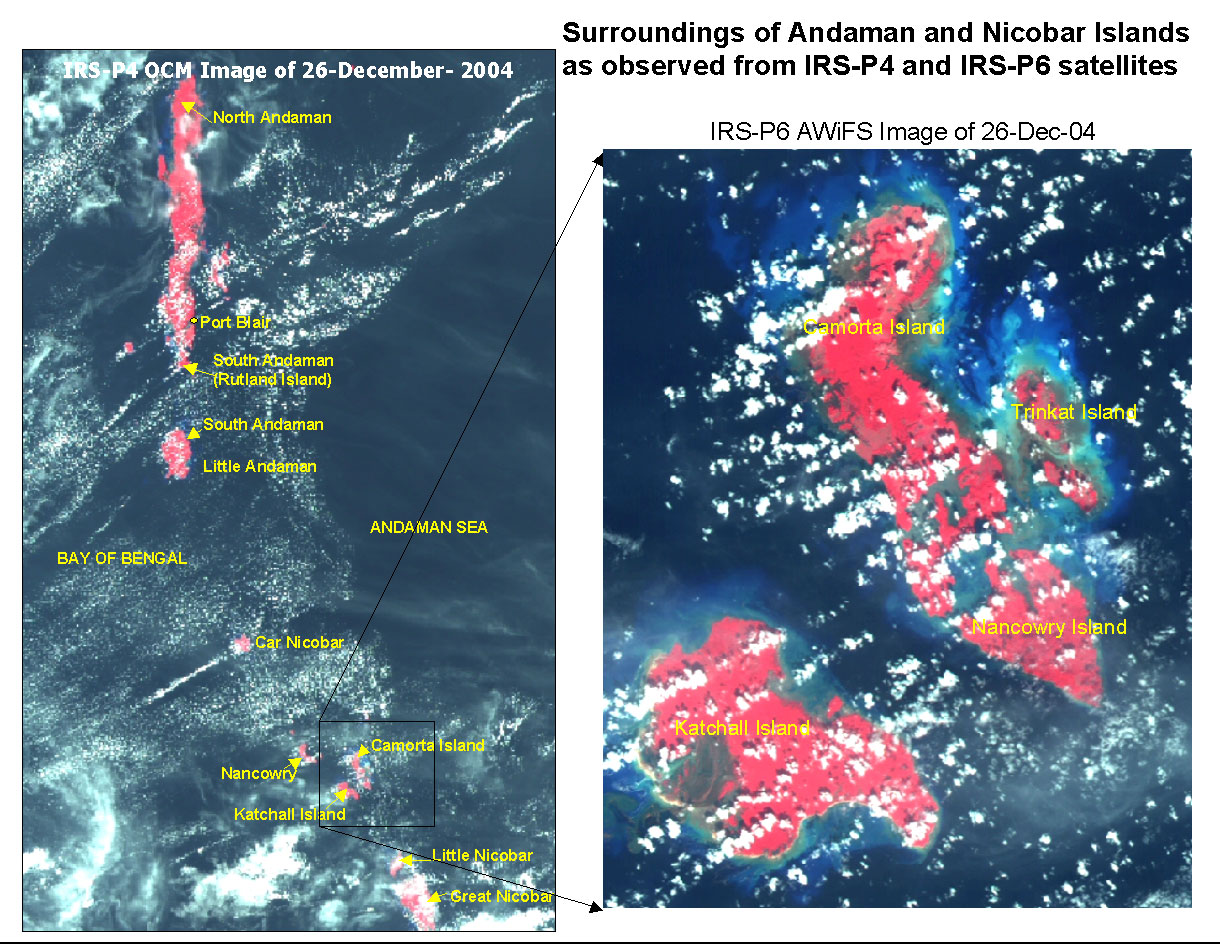

Source: IRS-P4 OCM, IRS-P6 AWiFs imagery 26/12/2004
Copyright: Courtesy National Remote Sensing Agency, Govt. of India
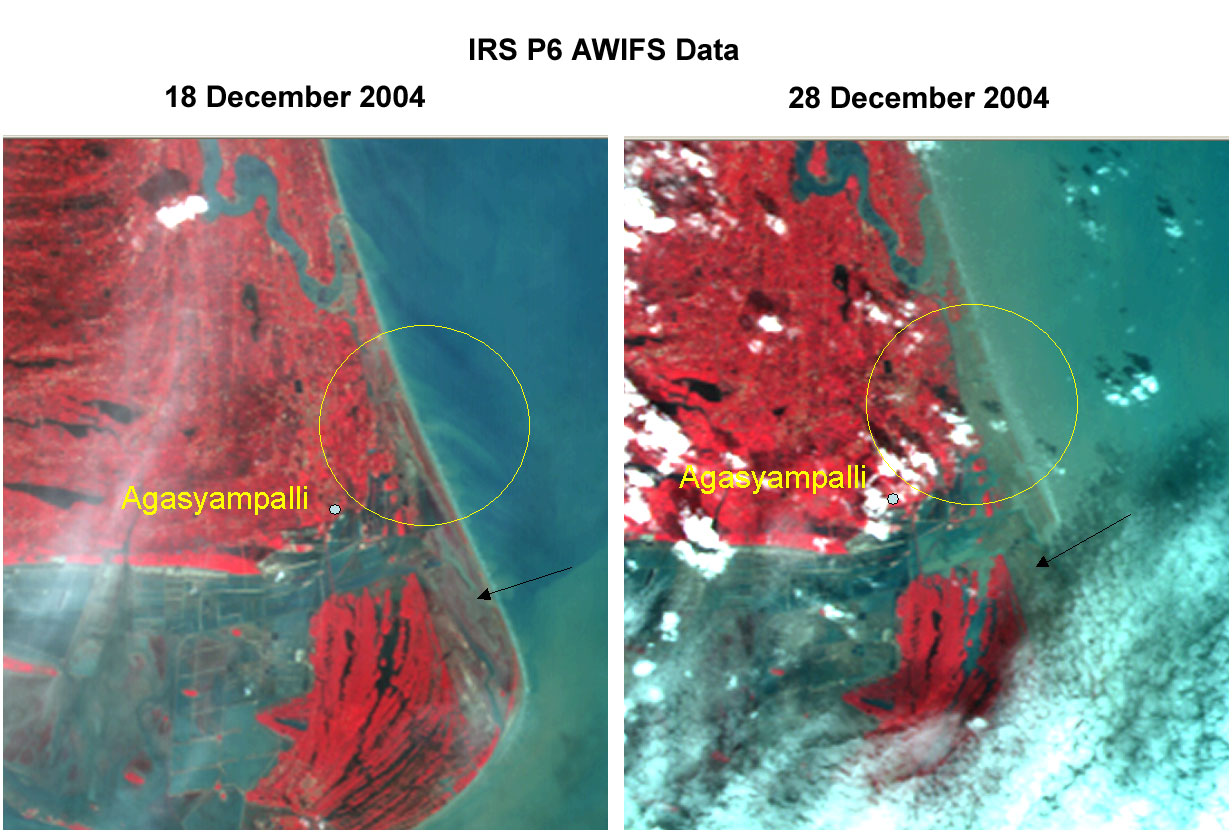

Source: IRS-P6 AWiFs imagery 18/12/2004-28/12/2004, before and after
Copyright: Courtesy National Remote Sensing Agency, Govt. of India
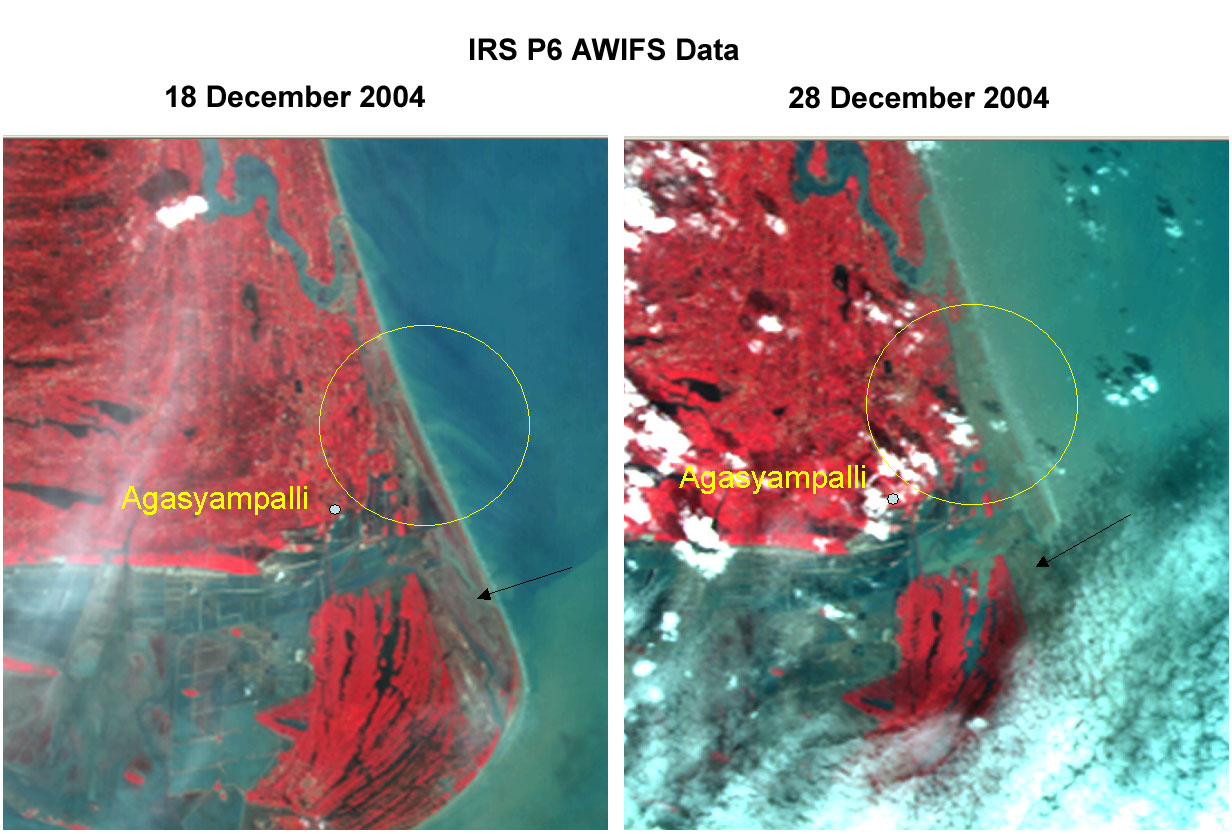

Source: IRS-P6 AWiFs imagery 18/12/2004-28/12/2004, before and after
Copyright: Courtesy National Remote Sensing Agency, Govt. of India
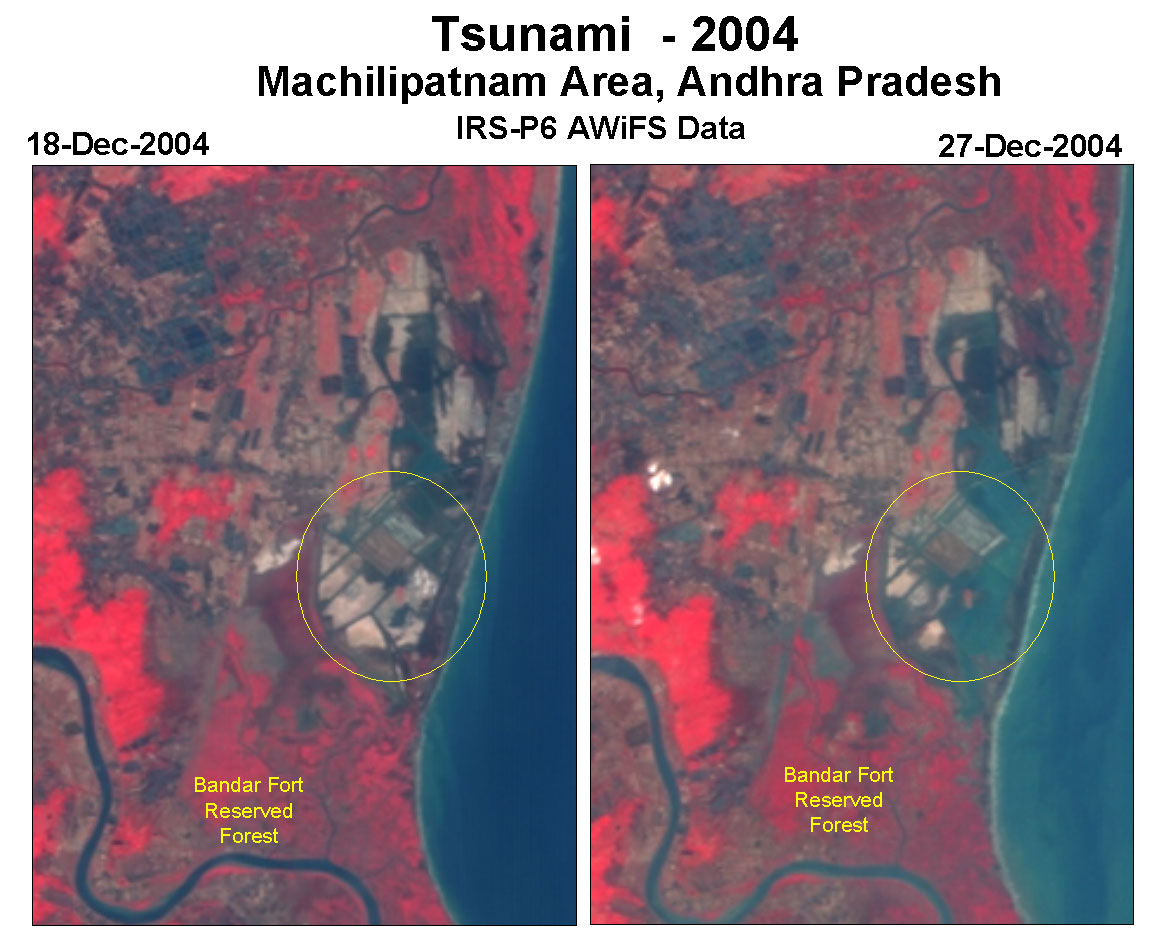

Source: IRS-P6 AWiFs imagery 18/12/2004-27/12/2004, before and after
Copyright: Courtesy National Remote Sensing Agency, Govt. of India
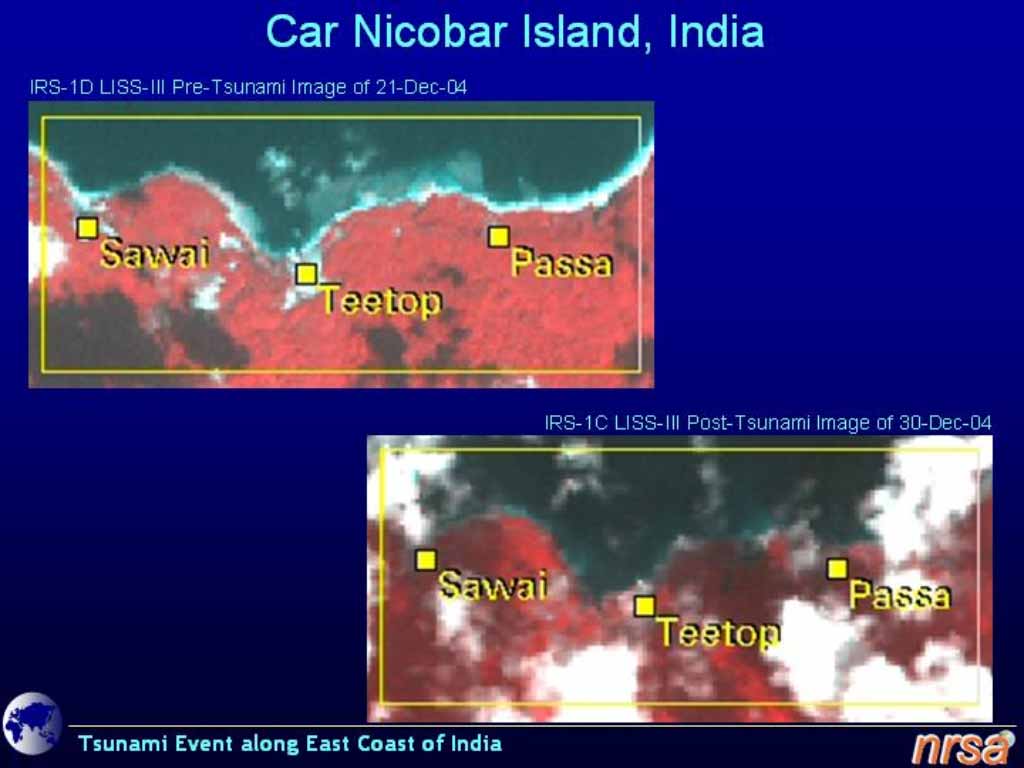

Source: IRS-1D LISS-III imagery, 21/12/2004, IRS-1C LISS-III imagery, 30/12/2004, Car Nicobar Island
Copyright: Courtesy National Remote Sensing Agency, Govt. of India.
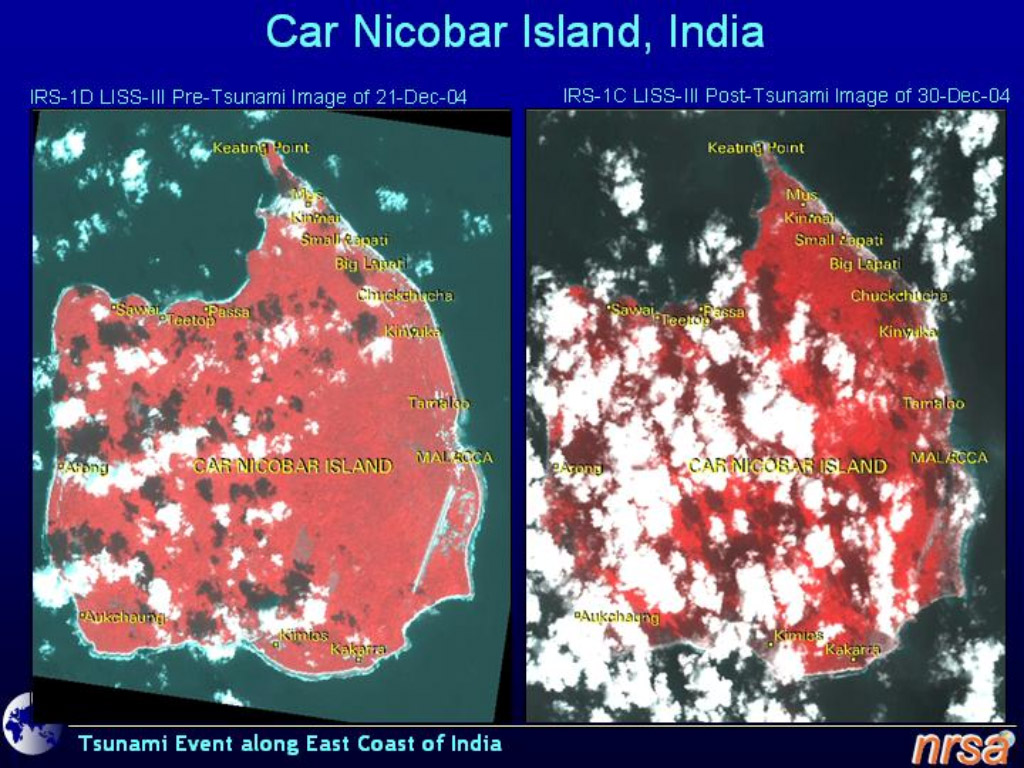

Source: IRS-1D LISS-III imagery, 21/12/2004, IRS-1C LISS-III imagery, 30/12/2004, Car Nicobar Island
Copyright: Courtesy National Remote Sensing Agency, Govt. of India.
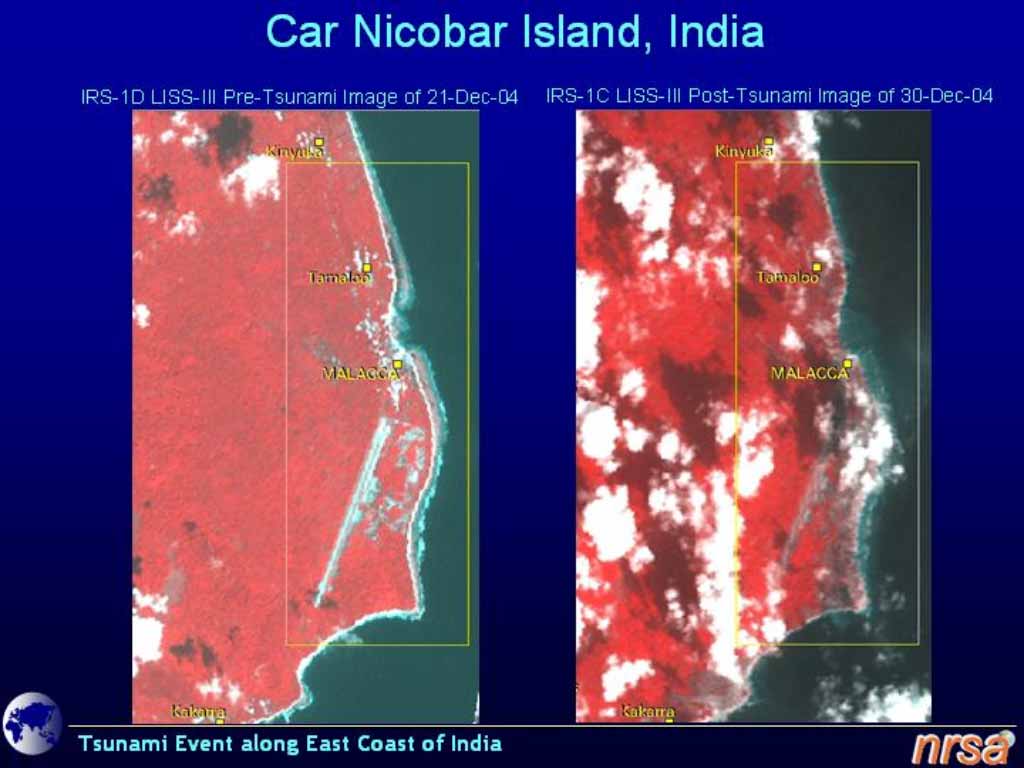

Source: IRS-1D LISS-III imagery, 21/12/2004, IRS-1C LISS-III imagery, 30/12/2004, Car Nicobar Island
Copyright: Courtesy National Remote Sensing Agency, Govt. of India.
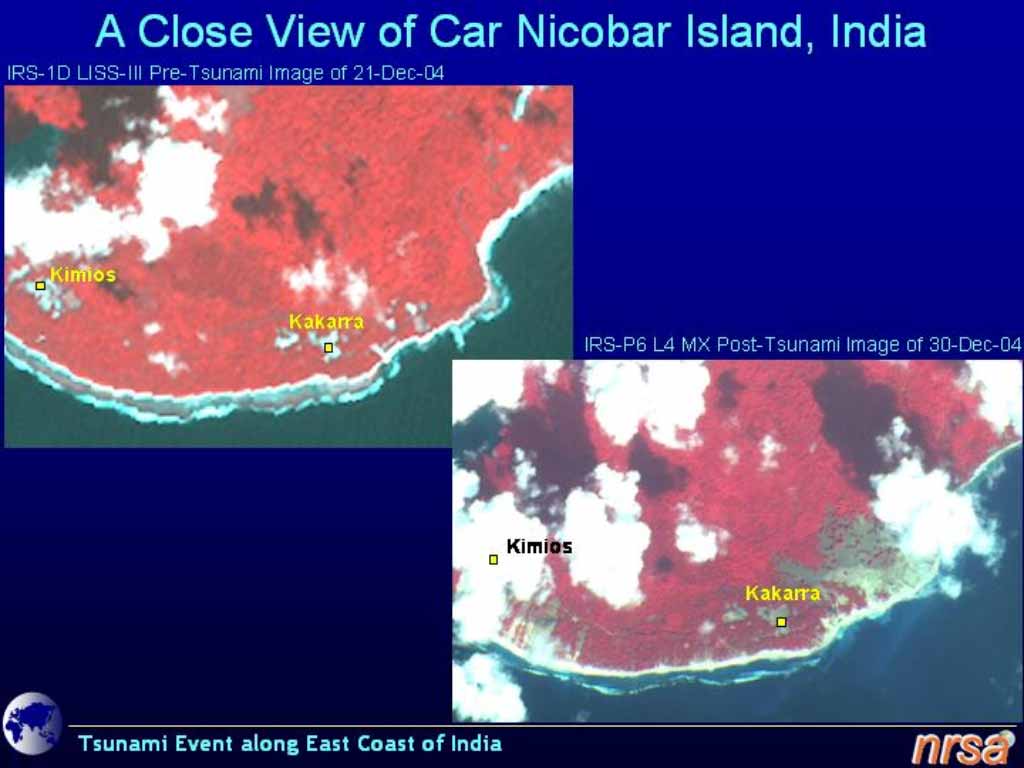

Source: IRS-1D LISS-III imagery, 21/12/2004, IRS-1C LISS-III imagery, 30/12/2004, Car Nicobar Island
Copyright: Courtesy National Remote Sensing Agency, Govt. of India.
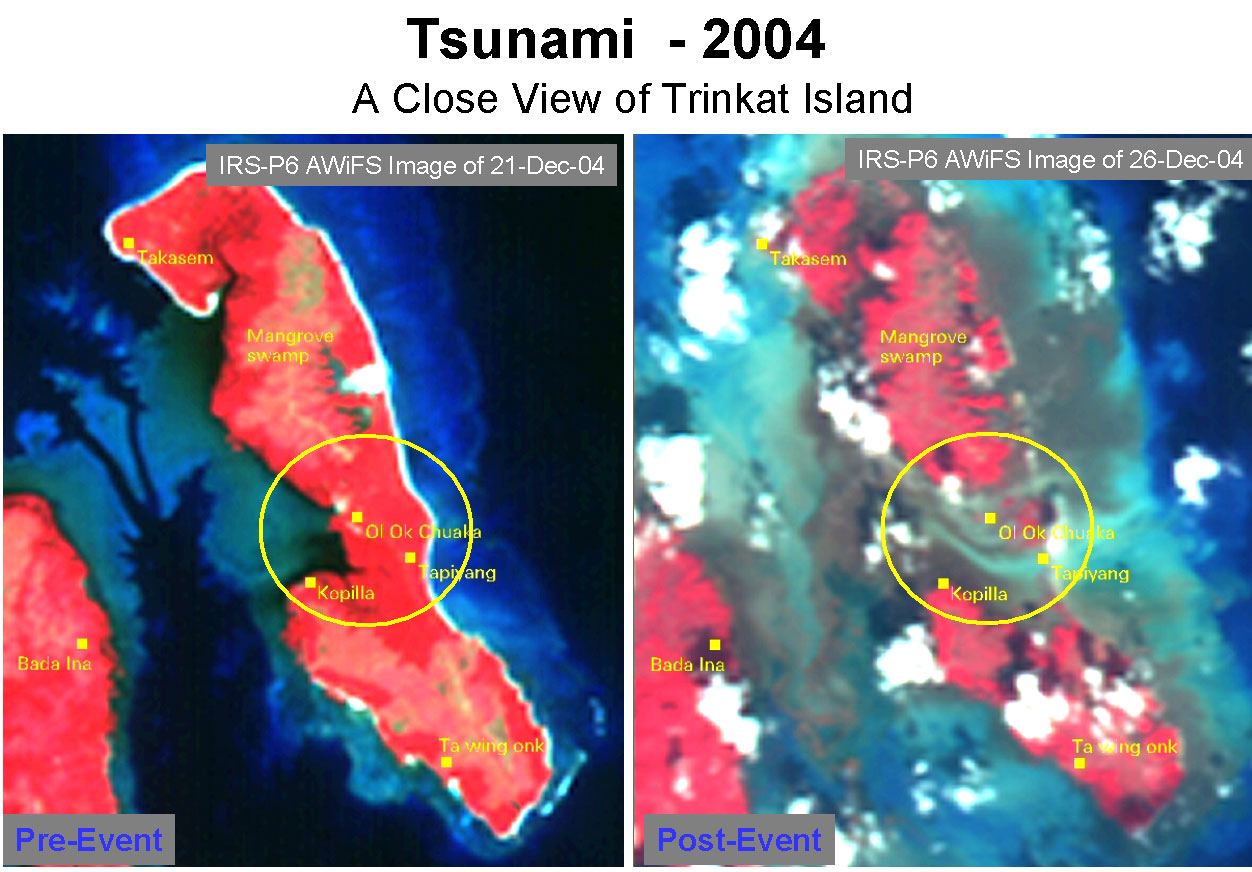

Source: IRS-P6 AWiFs imagery 21/12/2004-26/12/2004, before and after tsunami
Copyright: Courtesy National Remote Sensing Agency, Govt. of India
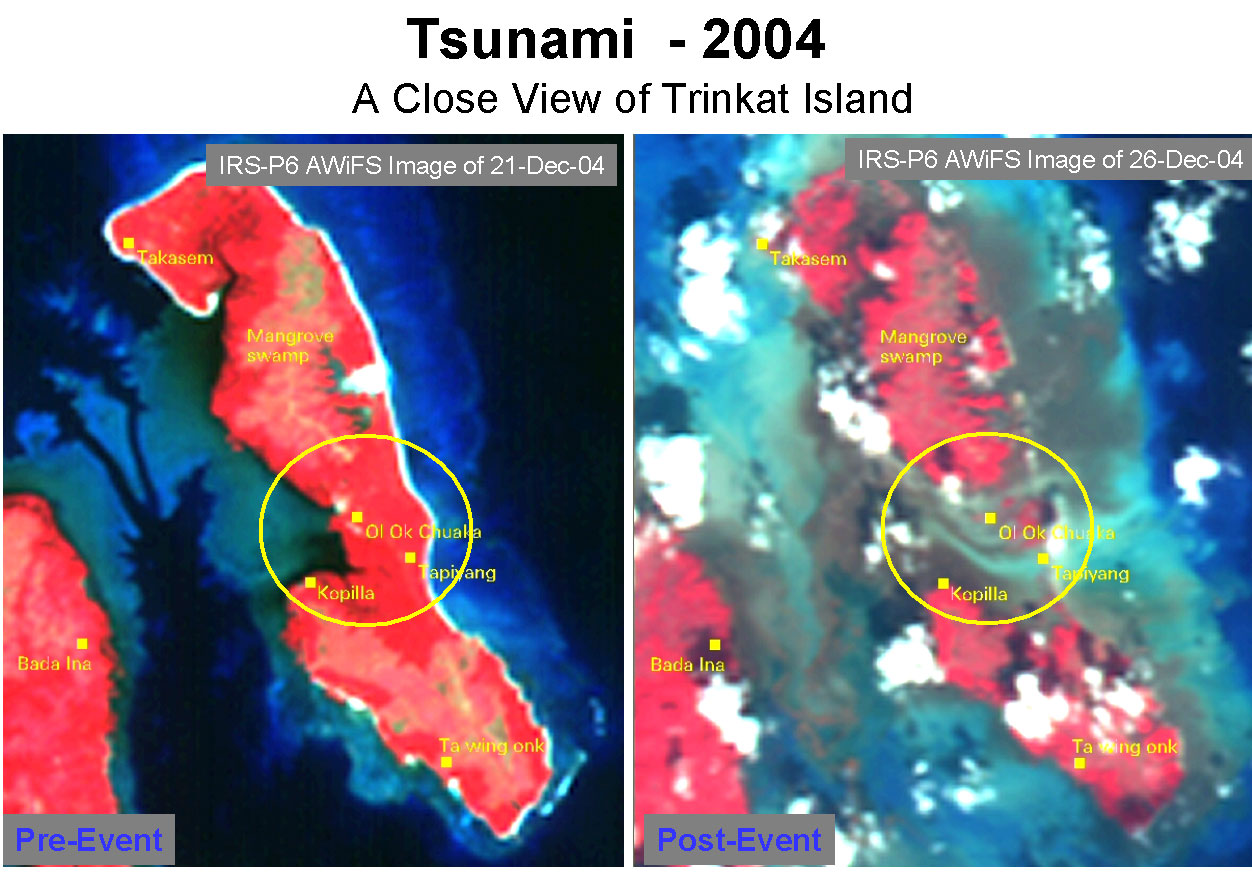

Source: IRS-P6 AWiFs imagery 21/12/2004-26/12/2004, before and after tsunami
Copyright: Courtesy National Remote Sensing Agency, Govt. of India.
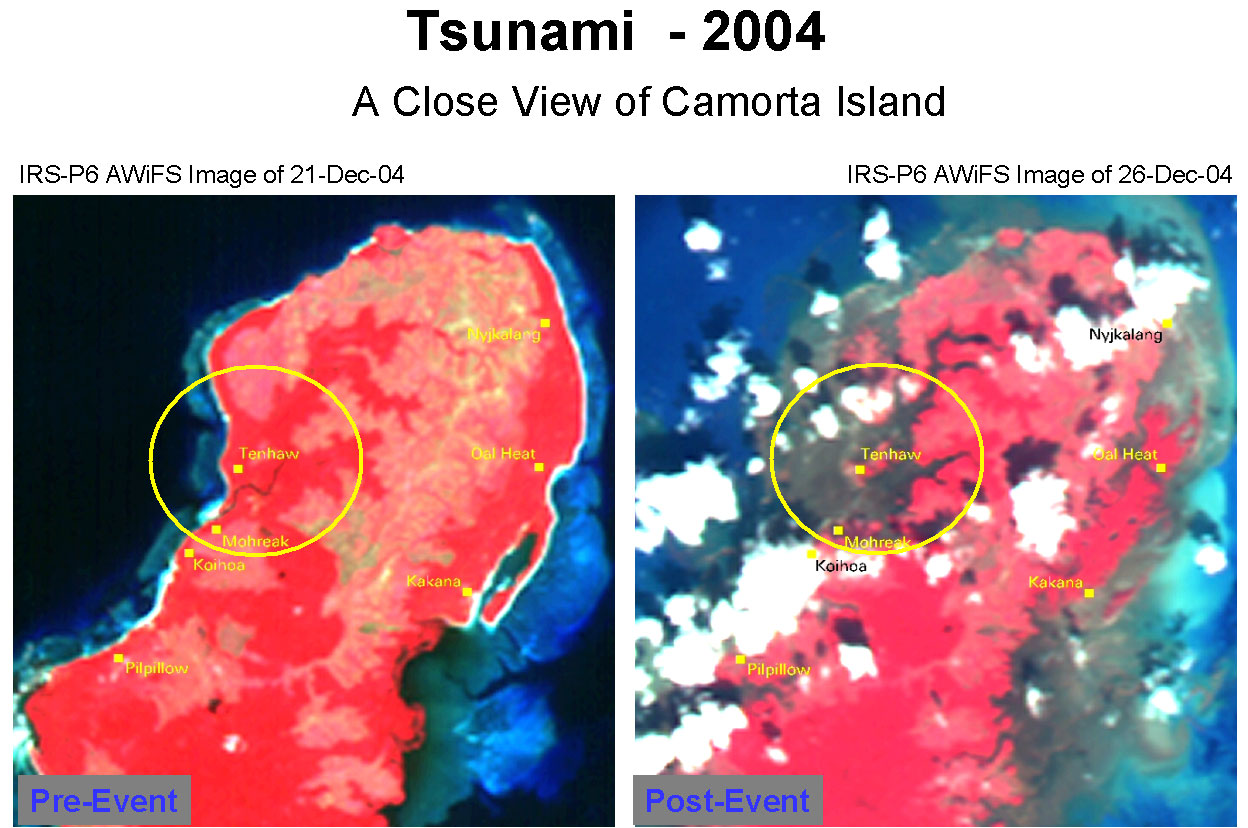

Source: IRS-P6 AWiFs imagery 21/12/2004-26/12/2004, before and after tsunami
Copyright: Courtesy National Remote Sensing Agency, Govt. of India
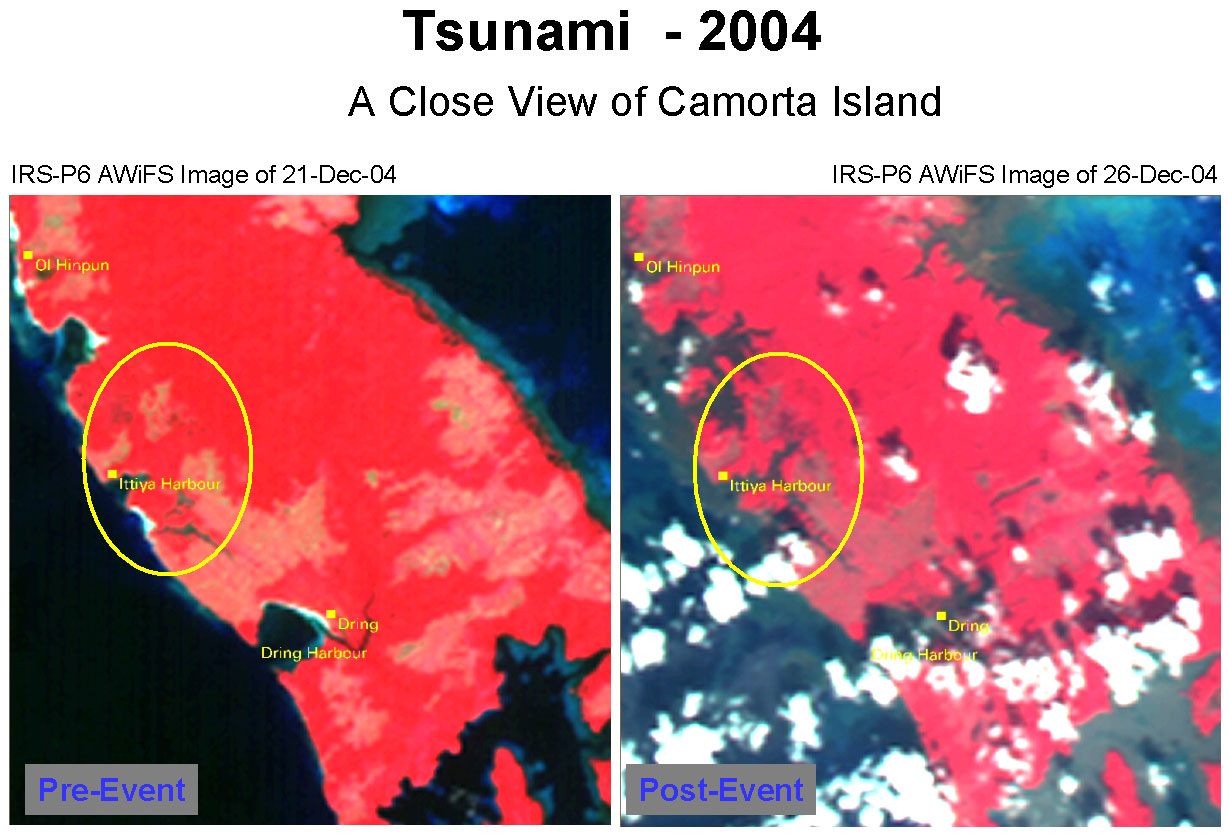

Source: IRS-P6 AWiFs imagery 21/12/2004-26/12/2004, before and after tsunami
Copyright: Courtesy National Remote Sensing Agency, Govt. of India

Other sites providing satellite imagery on the Asian disaster:
CRISP http://www.crisp.nus.edu.sg/tsunami/tsunami.html
SERTIT http://sertit.u-strasbg.fr/RMS/action.php?id=11642885

###########

Tsunami, Sri Lanka

 https://www.disasterscharter.org/web/guest/-/tsunami-sri-la-30

Sunday, 26 December 2004

Type of Event:
Tsunami, Earthquake
Location of Event:
Sri Lanka
Date of Charter Activation:
26/12/2004
Charter Requestor:
French Civil Protection Agency
Project Management:

Description of the event

Following a 9.0 magnitude earthquake off the coast of Sumatra, a massive tsunami struck Sri Lanka on 26th December 2004, killing over 30,000 people.
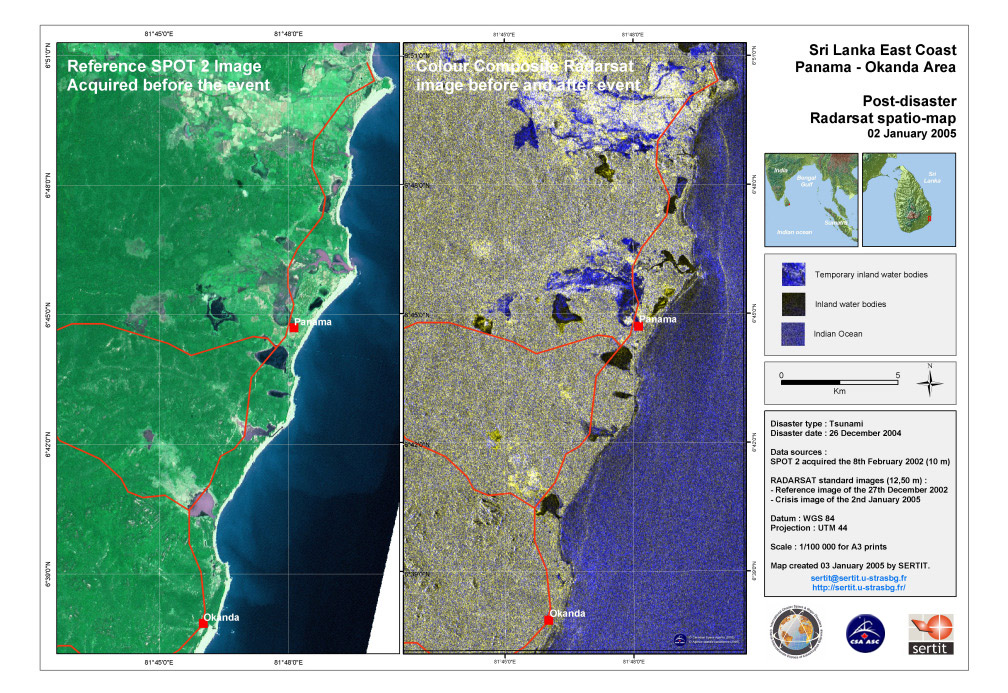
Satellite map of Sri Lanka, Radarsat Composite, Panama Okanda.

Source: SPOT 2, resolution: 10 m ( 08/02/2002)
Radarsat, resolution 12.5 m (02/01/2005 and 27/12/2002)
Acquired: 02/01/2005

Copyright: Map produced 03/01/2005 by SERTIT.

Other info: --
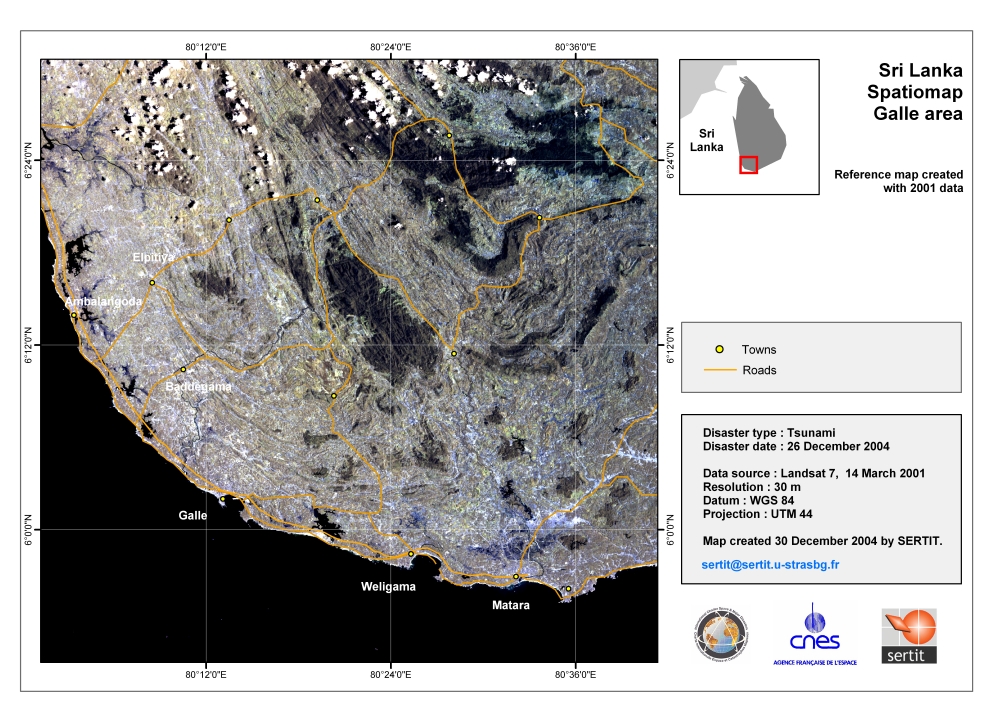
Satellite map of Sri Lanka, Galle area

Source: Landsat 7, 30 m resolution.
Acquired: 14/03/2001

Copyright: Map produced 30/12/2004 by SERTIT.

Other info: --
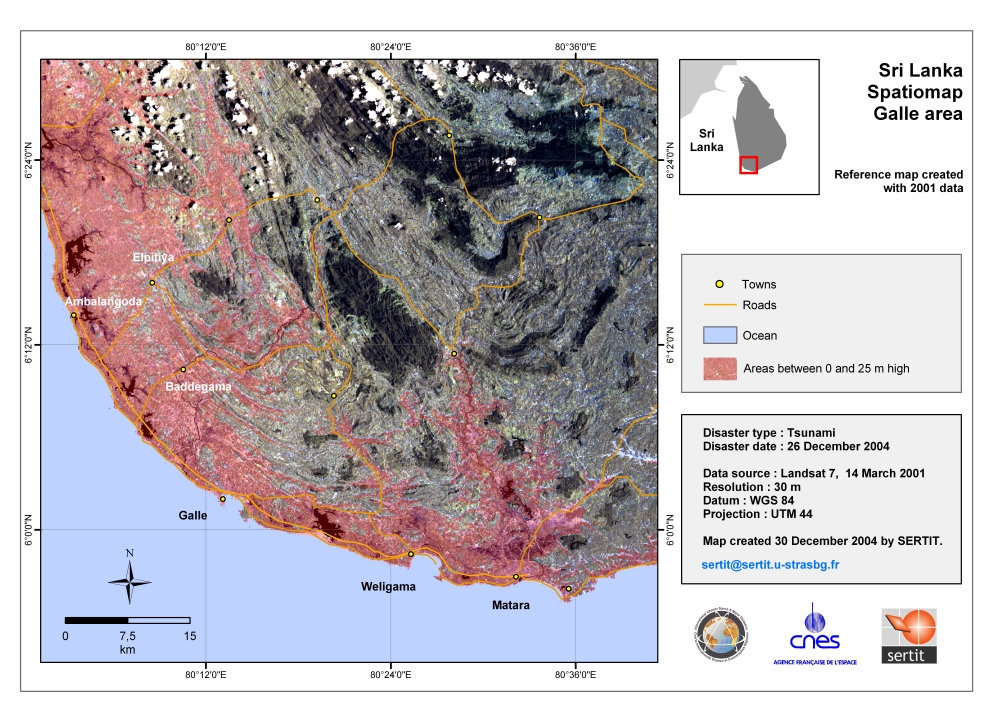
Satellite map of Sri Lanka, Galle area.

Source: Landsat 7, 30 m resolution.
Acquired: 14/03/2001

Copyright: Map produced 30/12/2004 by SERTIT.

Other info: --
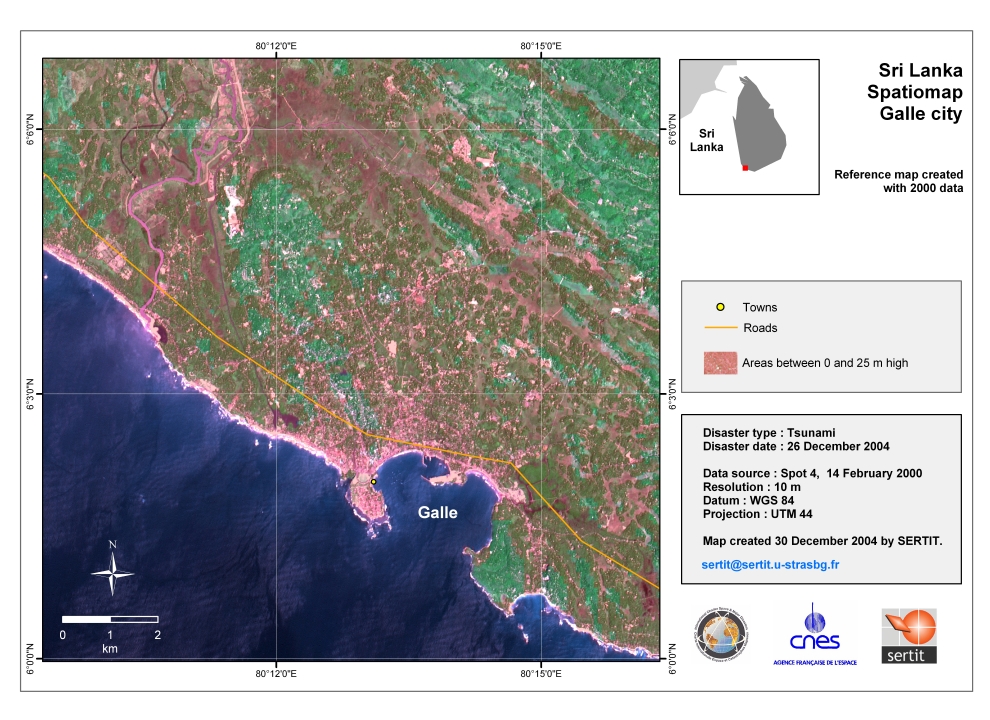
Satellite map of Sri Lanka, Galle area

Source: SPOT 4, 10 m resolution.
Acquired: 14/02/2000

Copyright: Map produced 31/12/2004 by SERTIT.

Other info: --
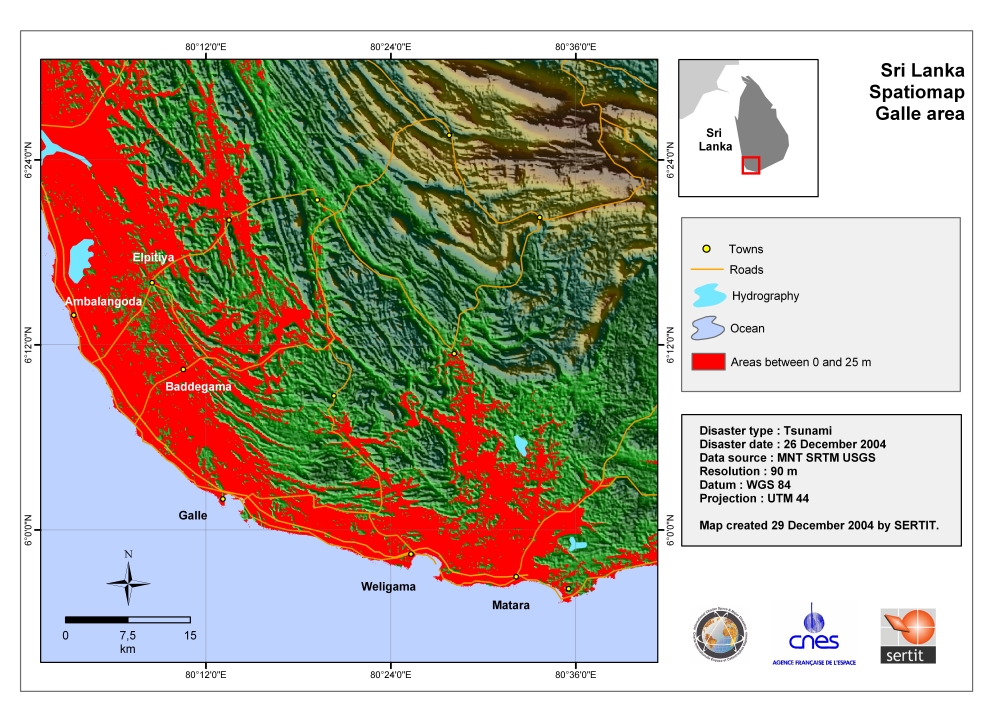
Satellite map of Sri Lanka, lowlands of Galle area 90m resolution.

Source: MNT USGS SRTM (3 arcseconds).
Acquired: --

Copyright: Map produced 30/12/2004 by SERTIT.

Other info: --
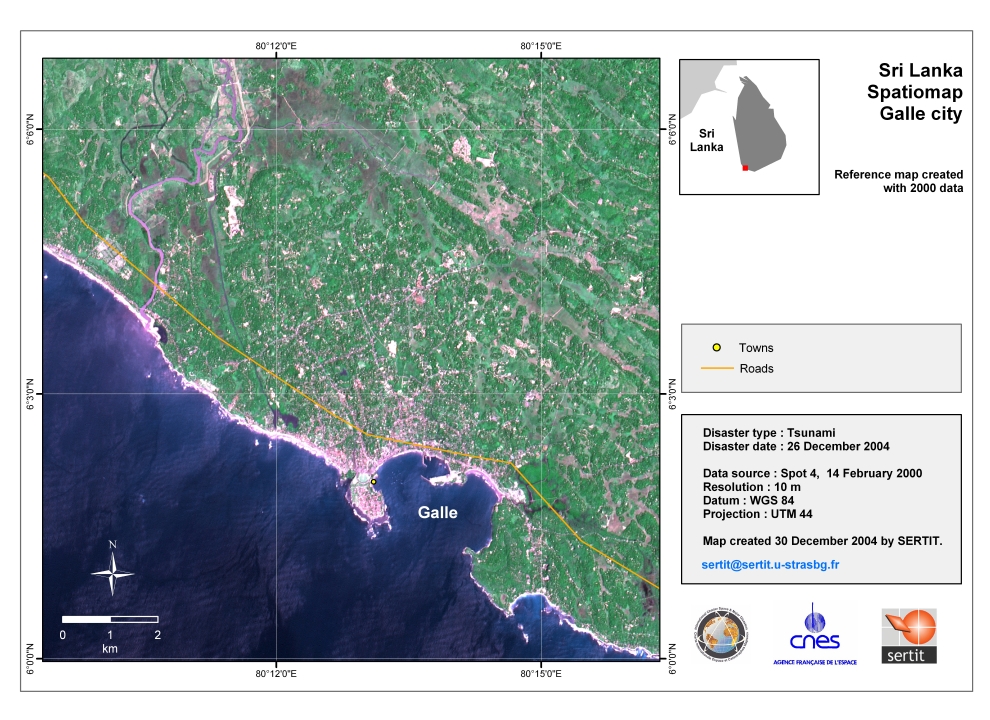
Satellite map of Sri Lanka, Galle area

Source: SPOT 4, 10 m resolution.
Acquired: 14/02/2000

Copyright: Map produced 30/12/2004 by SERTIT.

Other info: --
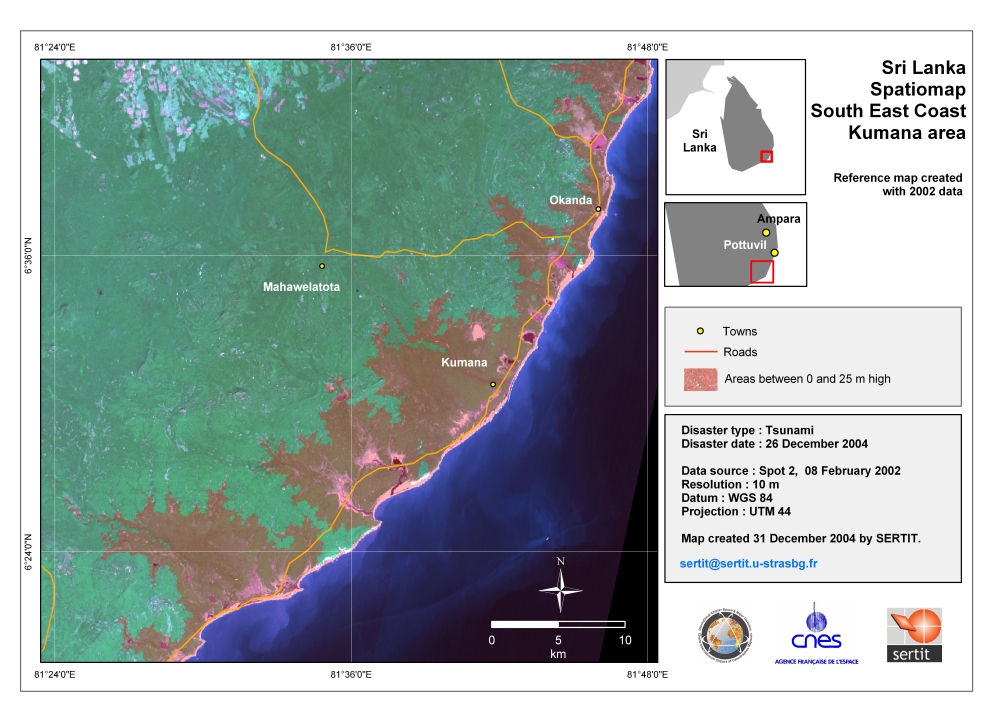
Satellite map of Sri Lanka, Kumana area

Source: SPOT 2, 10 m resolution.
Acquired: 08/02/2002

Copyright: Map produced 31/12/2004 by SERTIT.

Other info: --
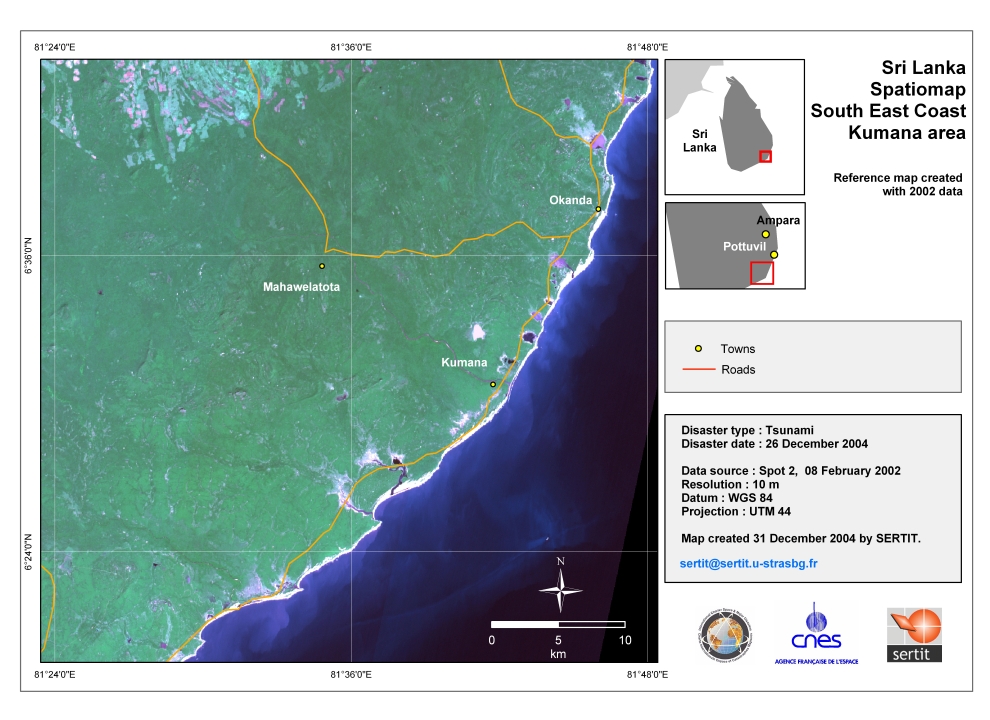
Satellite map of Sri Lanka, Kumana area, reference map 10 m resolution.

Source: SPOT 2
Acquired: 08/02/2002.

Copyright: Map produced 31/12/2004 by SERTIT.

Other info: --
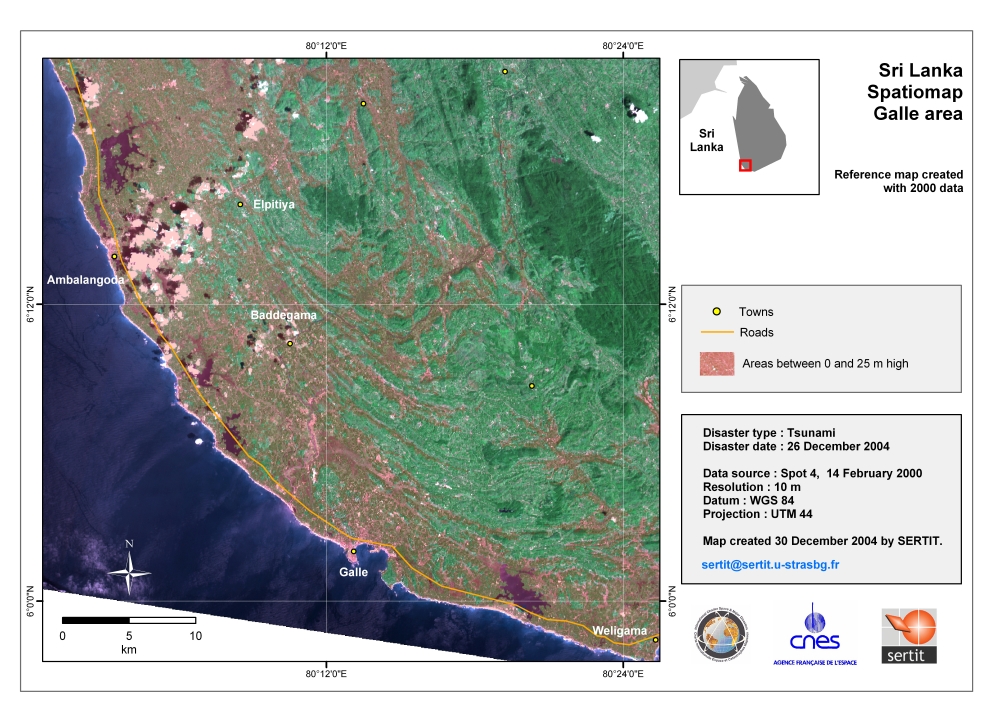
Satellite map of Sri Lanka, Galle area

Source: SPOT 4, 10 m resolution.
Acquired: 11/02/2000

Copyright: Map produced 30/12/2004 by SERTIT.

Other info: --
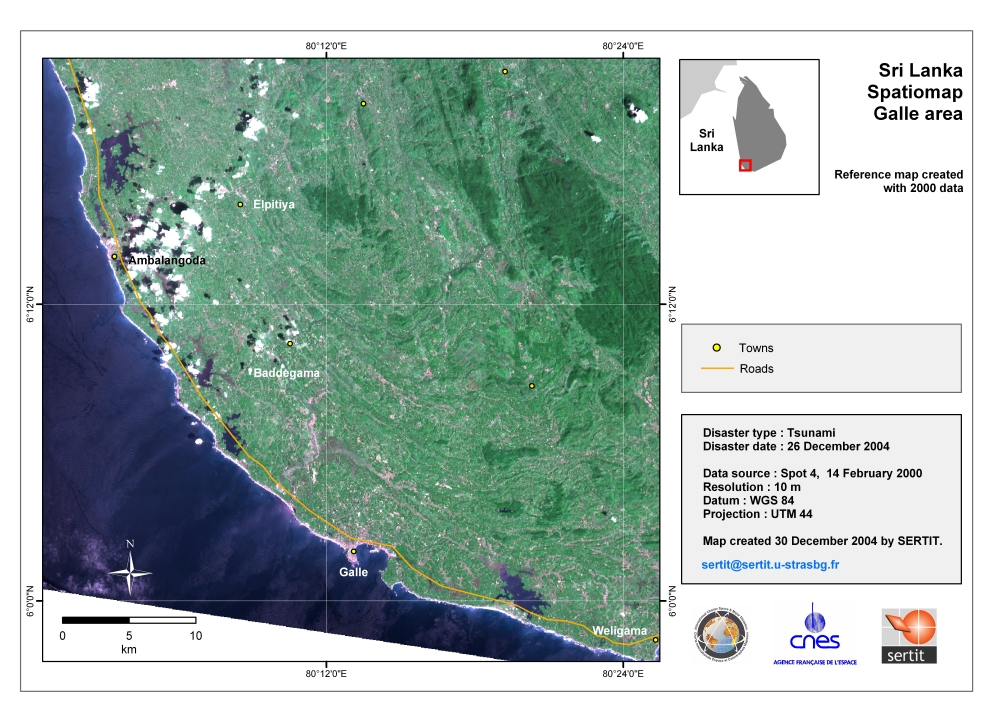
Satellite map of Sri Lanka, Galle area .

Source: SPOT 4, 10 m resolution
Acquired: 14/02/2000

Copyright: Map produced 30/12/2004 by SERTIT.

Other info: --
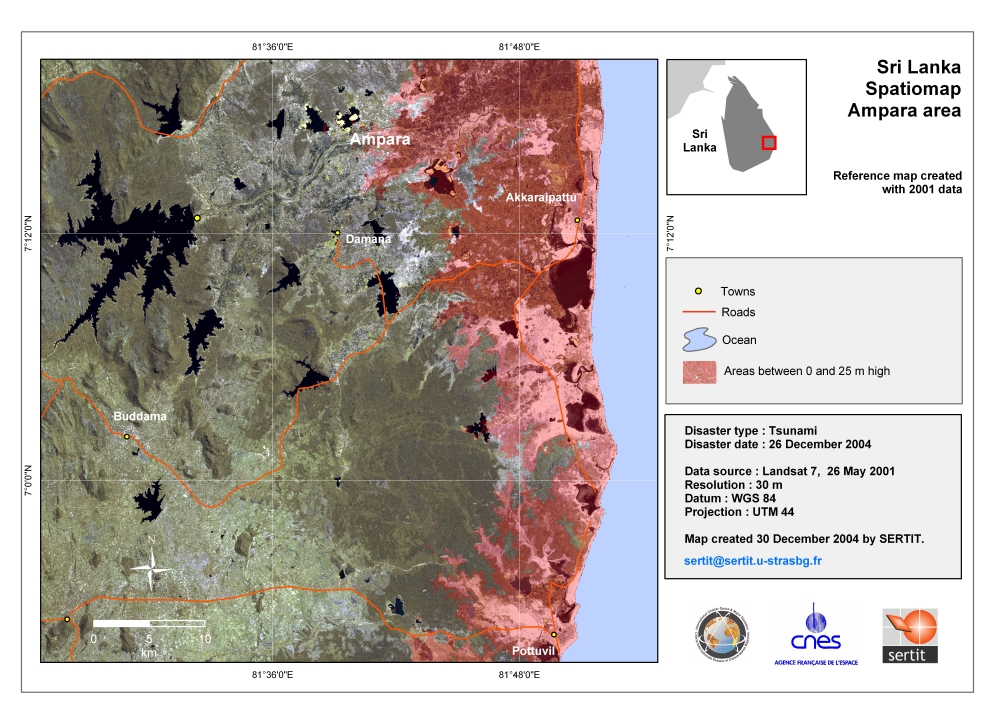
Satellite map of Sri Lanka, Ampara area

Source: Landsat 7, 30 m resolution.
Acquired: 26/05/2001

Copyright: Map produced 30/12/2004 by SERTIT.

Other info: --
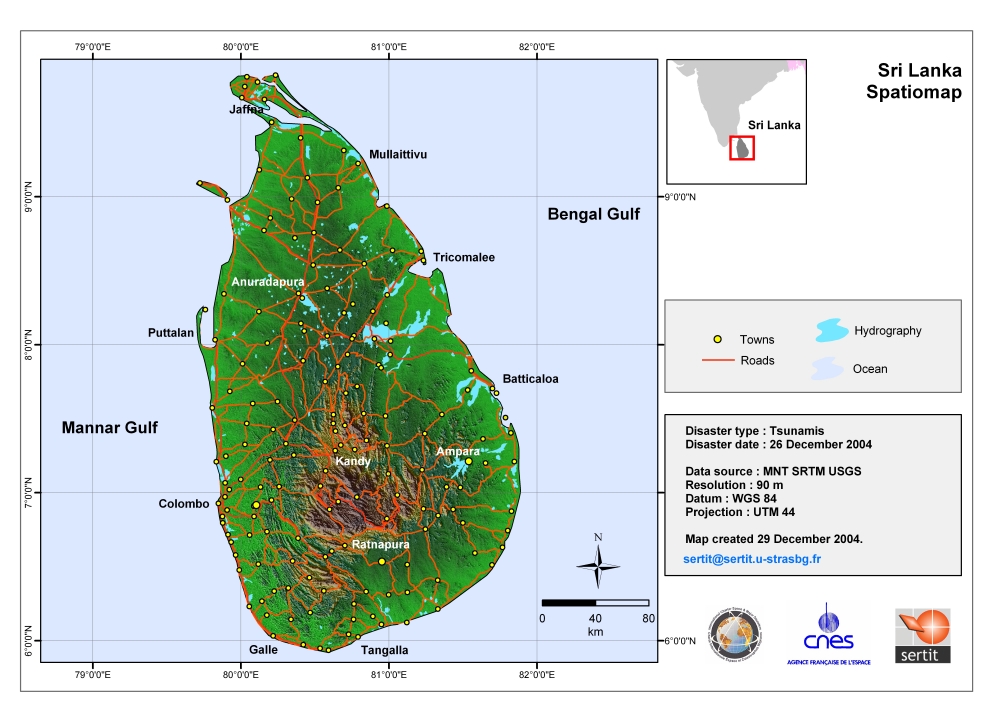
Satellite map of Sri Lanka 90m resolution.

Source: MNT USGS SRTM (3 arc seconds).
Acquired: --

Copyright: Map produced 29/12/2004 by SERTIT.

Other info: --
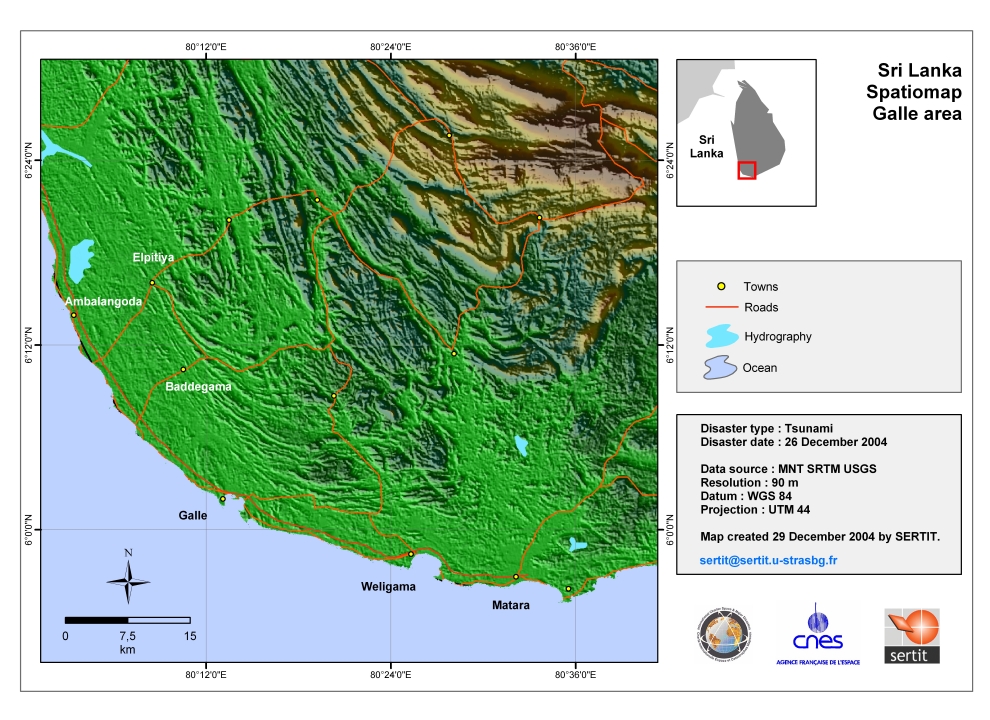
Satellite map of Sri Lanka, Galle area 90m resolution.

Source: MNT USGS SRTM (3 arcseconds).
Acquired: --

Copyright: Map produced 29/12/2004 by SERTIT.

Other info: --
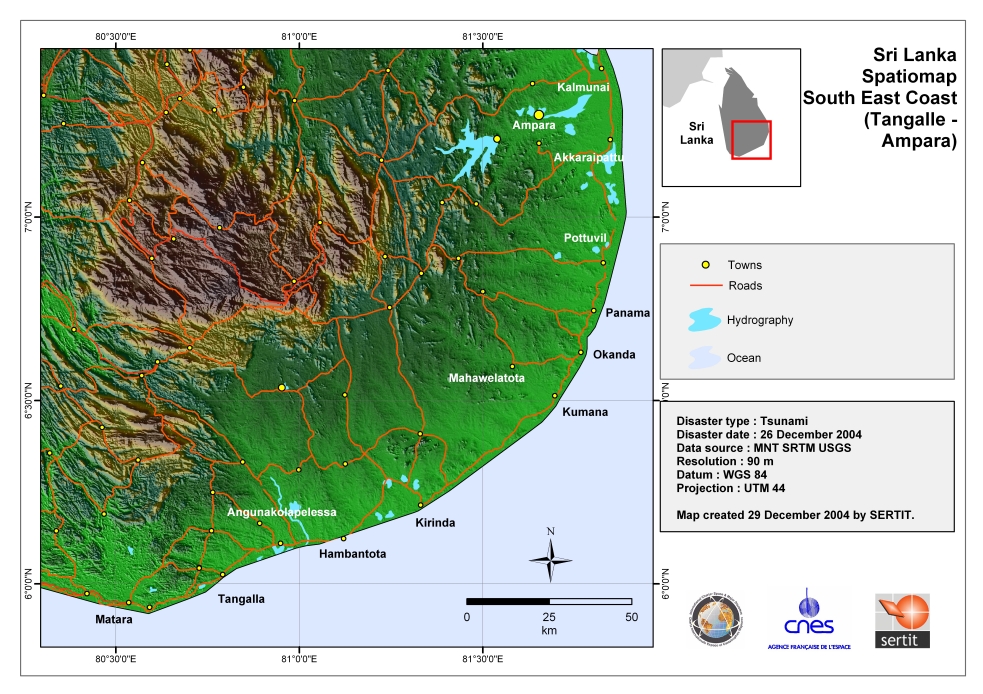
Satellite map of Sri Lanka, Tangalle-Ampara area 90m resolution.

Source: MNT USGS SRTM (3 arcseconds).
Acquired: --

Copyright: Map produced 30/12/2004 by SERTIT.

Other info: --
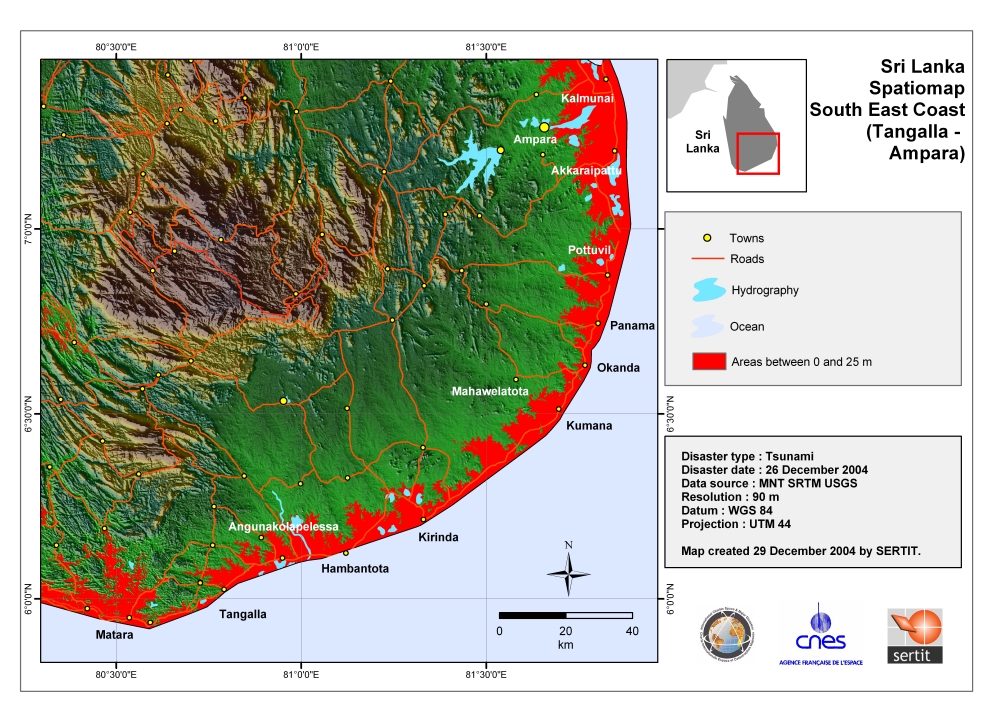
Satellite map of Sri Lanka, lowlands of Tangalle-Ampara area 90m resolution.

Source: MNT USGS SRTM (3 arcseconds).
Acquired: --

Copyright: Map produced 30/12/2004 by SERTIT.

Other info: --
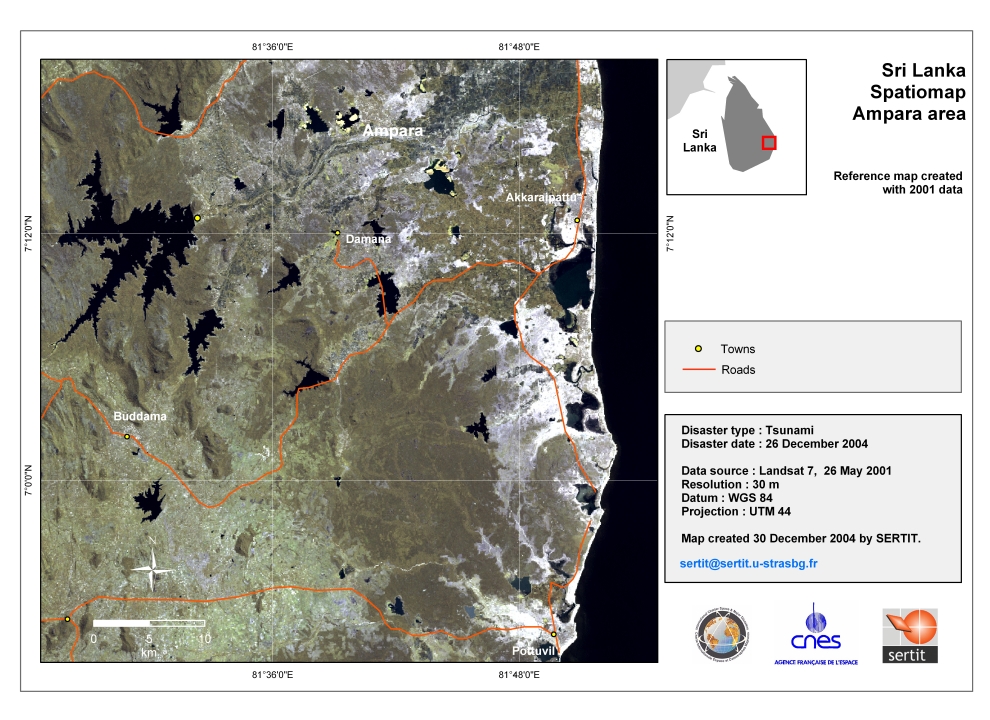
Satellite map of Sri Lanka, Ampara area.

Source: Landsat 7, 26/05/2001, 30 m resolution.
Acquired: --

Copyright: Map produced 30/12/2004 by SERTIT.

Other info: --
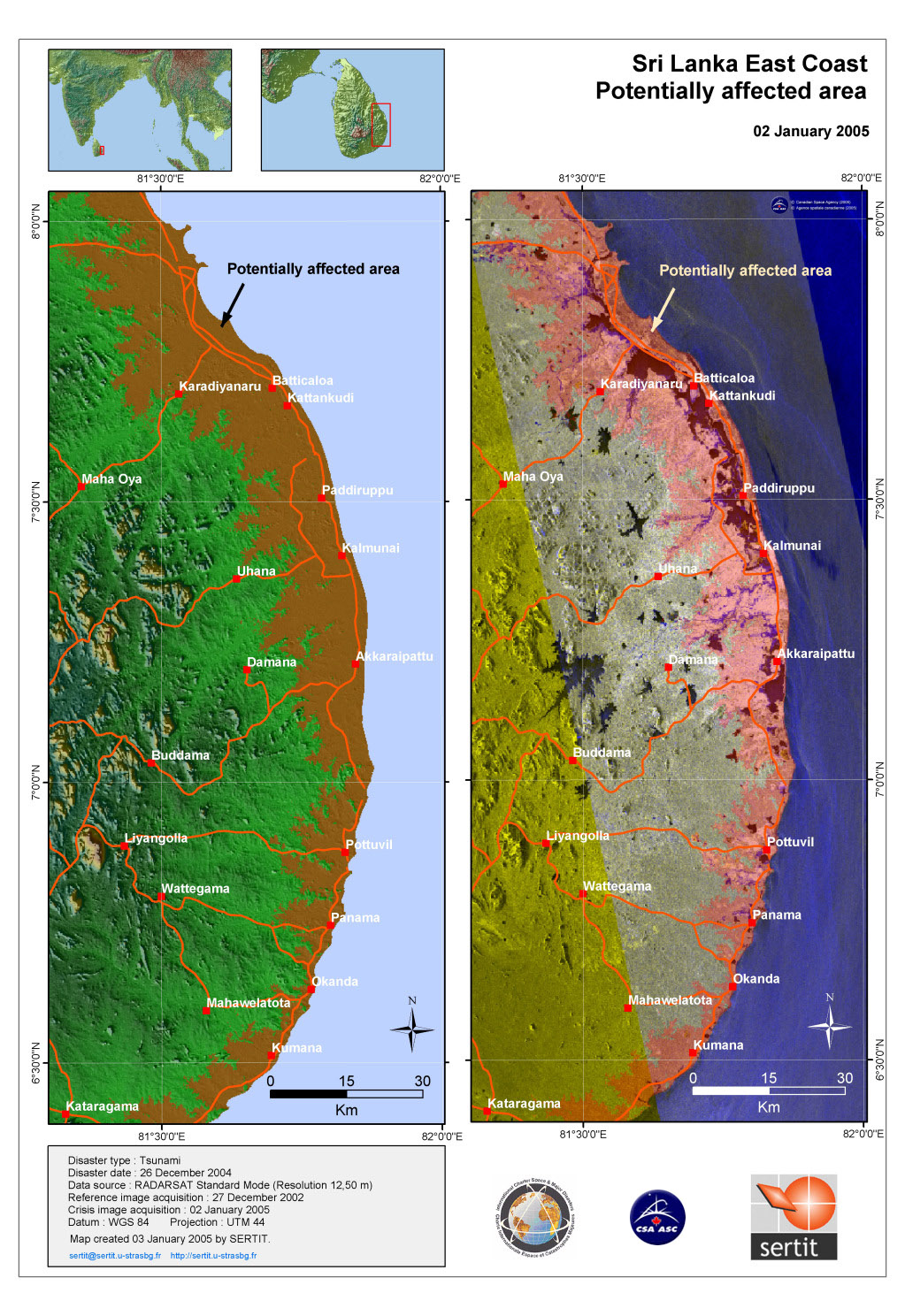
Satellite map of Sri Lanka, Potentially Affected Area, east coast.

Source: Radarsat, 02/01/2005. Resolution: 12.5 m.
Acquired: --

Copyright: Map produced 03/01/2005 by SERTIT.

Other info: --
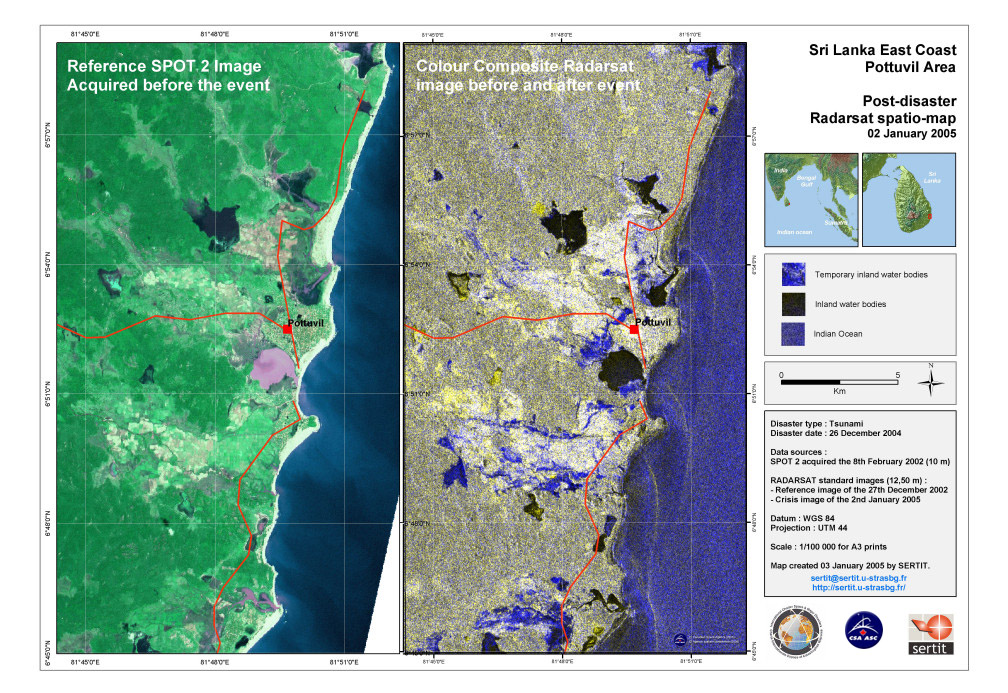
Satellite map of Sri Lanka, Radarsat Composite, Pottuvi.

Source: SPOT 2, 27/12/2002 and Radarsat, 02/01/2005. Resolution: 12.5 m. SPOT 2, 08/02/2002. Resolution: 10 m.
Acquired: --

Copyright: Map produced 03/01/2005 by SERTIT.

Other info: --
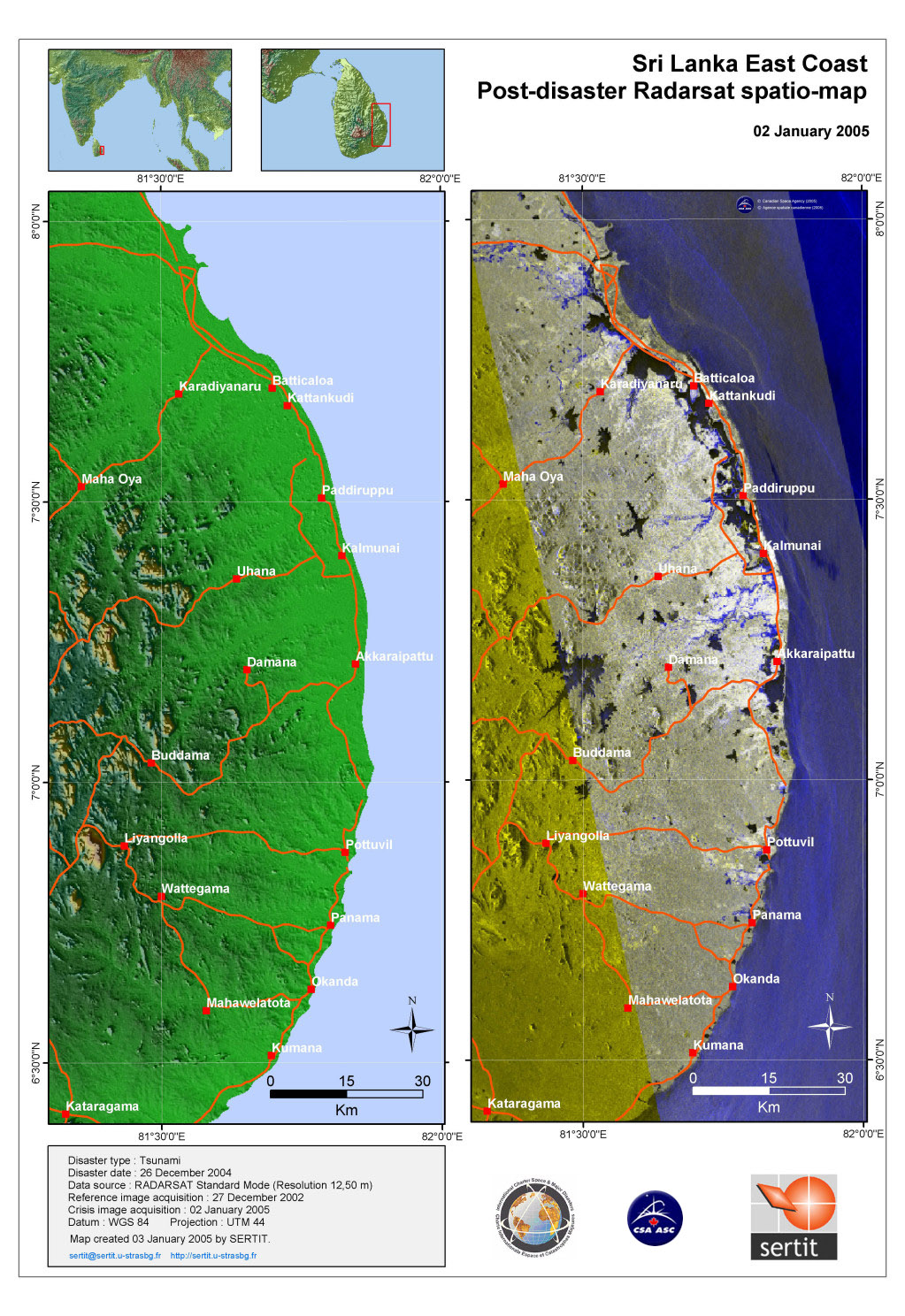
Satellite map of Sri Lanka, Postdisaster Radarsat East coast.

Source: Radarsat, 02/01/2005. Resolution: 12.5 m.
Acquired: --

Copyright: Map produced 03/01/2005 by SERTIT.

Other info: --
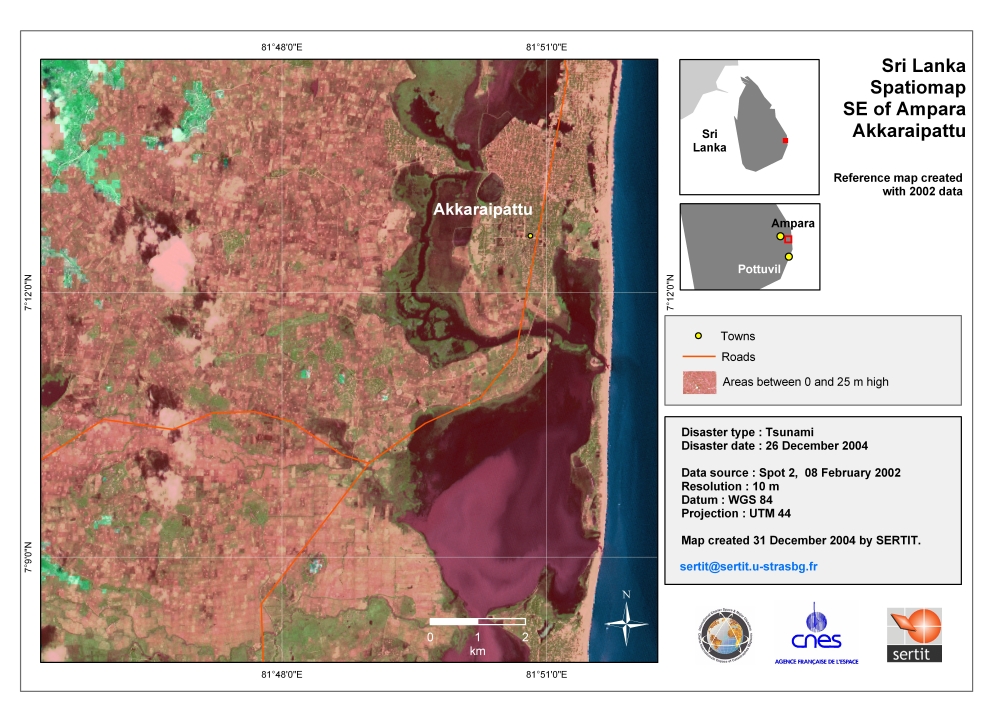
Satellite map of Sri Lanka, Akkaraipattu

Source: SPOT 2, 10 m resolution.
Acquired: 08/02/2002

Copyright: Map produced 31/12/2004 by SERTIT.

Other info: --
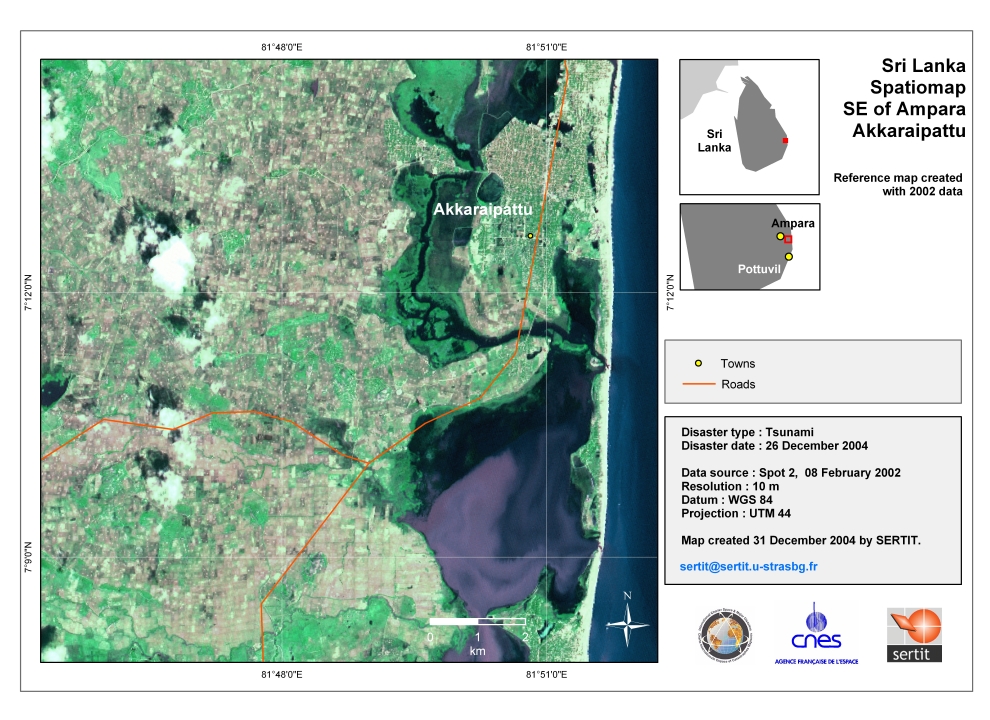
Satellite map of Sri Lanka, Akkaraipattu

Source: SPOT 2, 10 m resolution.
Acquired: 08/02/2002

Copyright: Map produced 31/12/2004 by SERTIT.

Other info: --
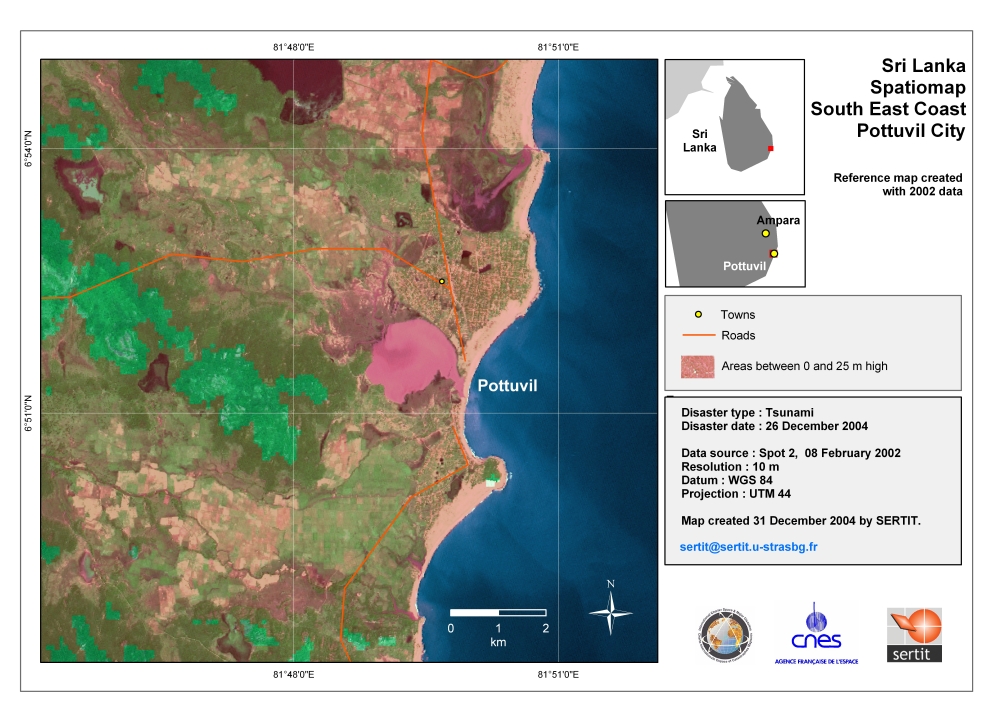
Satellite map of Sri Lanka, Ampara - Pottuvil city, reference map 10 m resolution.

Source: SPOT 2
Acquired: 08/02/2002

Copyright: Map produced 31/12/2004 by SERTIT.

Other info: --
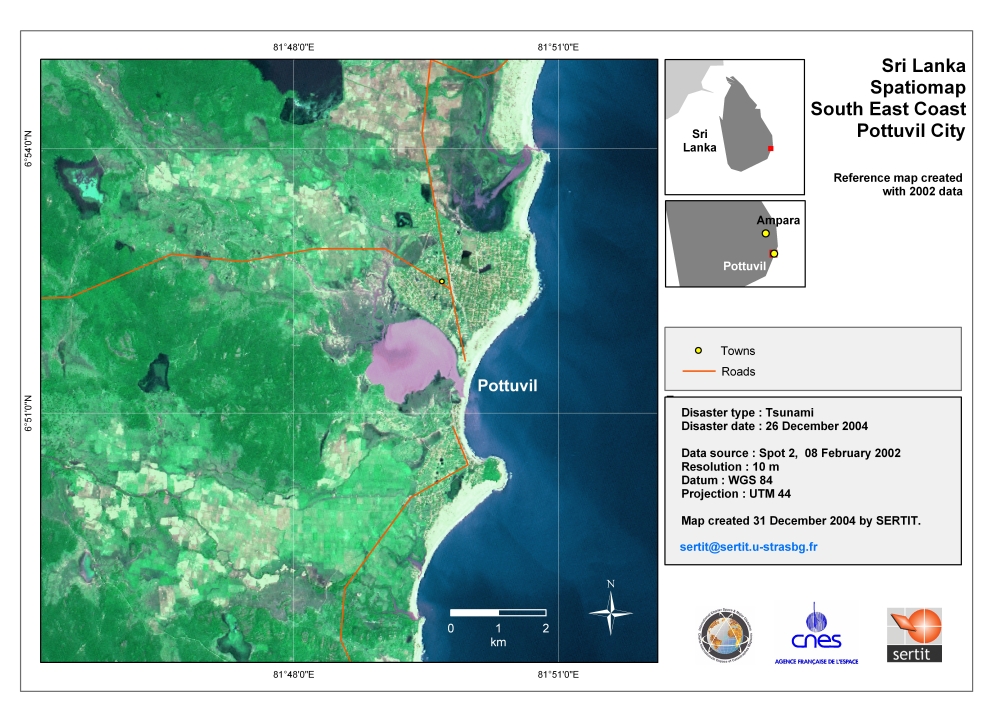
Satellite map of Sri Lanka, Ampara - Pottuvil city

Source: SPOT 2, 10 m resolution.
Acquired: 08/02/2002

Copyright: Map produced 31/12/2004 by SERTIT.

Other info: --
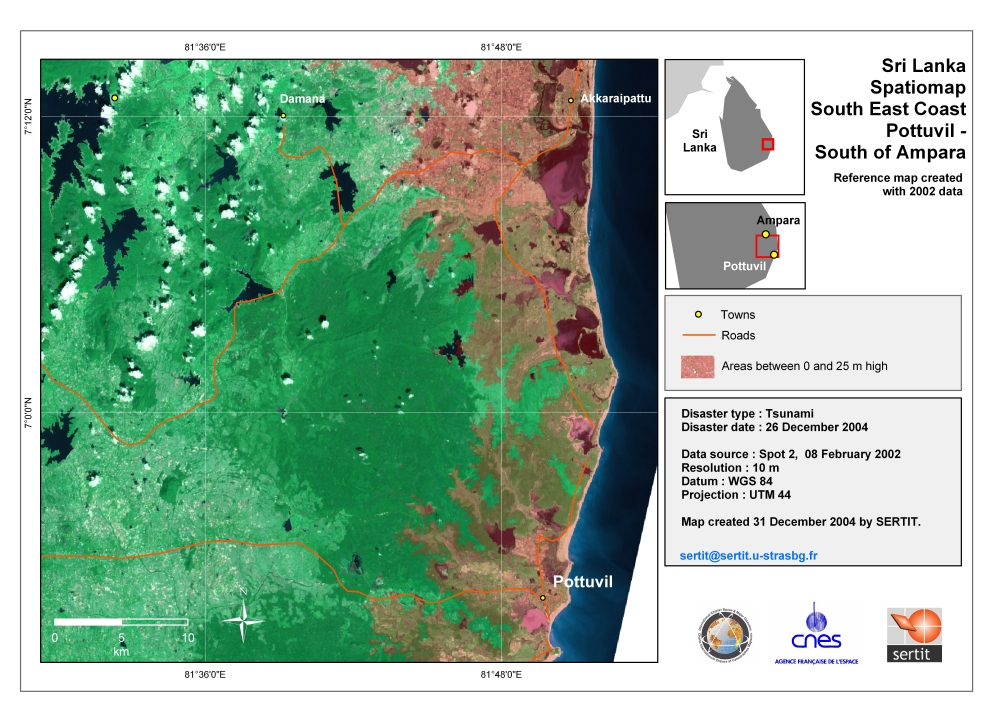
Satellite map of Sri Lanka, Ampara - Pottuvil area

Source: SPOT 2, 10 m resolution.
Acquired: 08/02/2002

Copyright: Map produced 31/12/2004 by SERTIT.

Other info: --
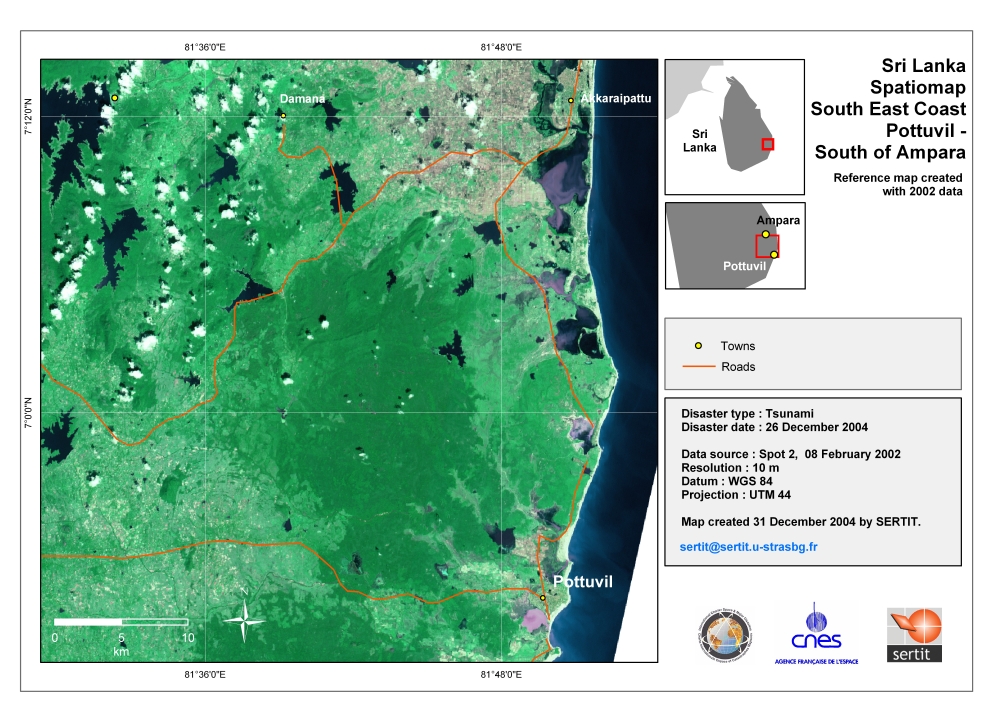
Satellite map of Sri Lanka, Ampara - Pottuvil area

Source: SPOT 2, 10 m resolution.
Acquired: 08/02/2002

Copyright: Map produced 31/12/2004 by SERTIT.

Other info: --
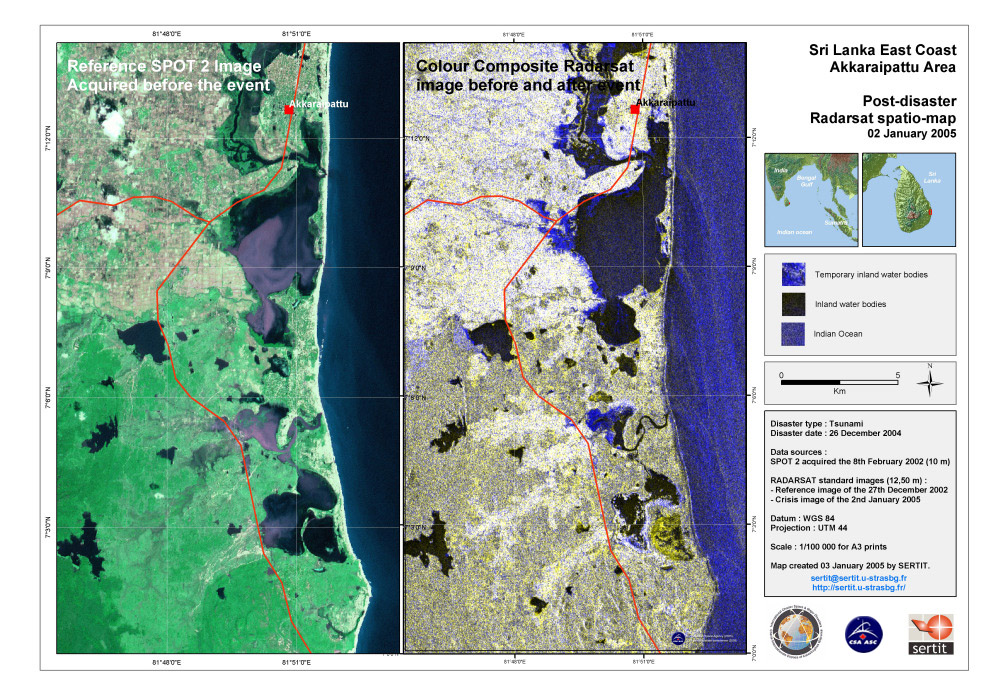
Satellite map of Sri Lanka, Radarsat Composite, Akkaraipattu.

Source: SPOT 2, 27/12/2002 and Radarsat, 02/01/2005. Resolution: 12.5 m.
SPOT 2, 08/02/2002. Resolution: 10 m.
Acquired: 02/01/2005

Copyright: Map produced 03/01/2005 by SERTIT.

Other info: --
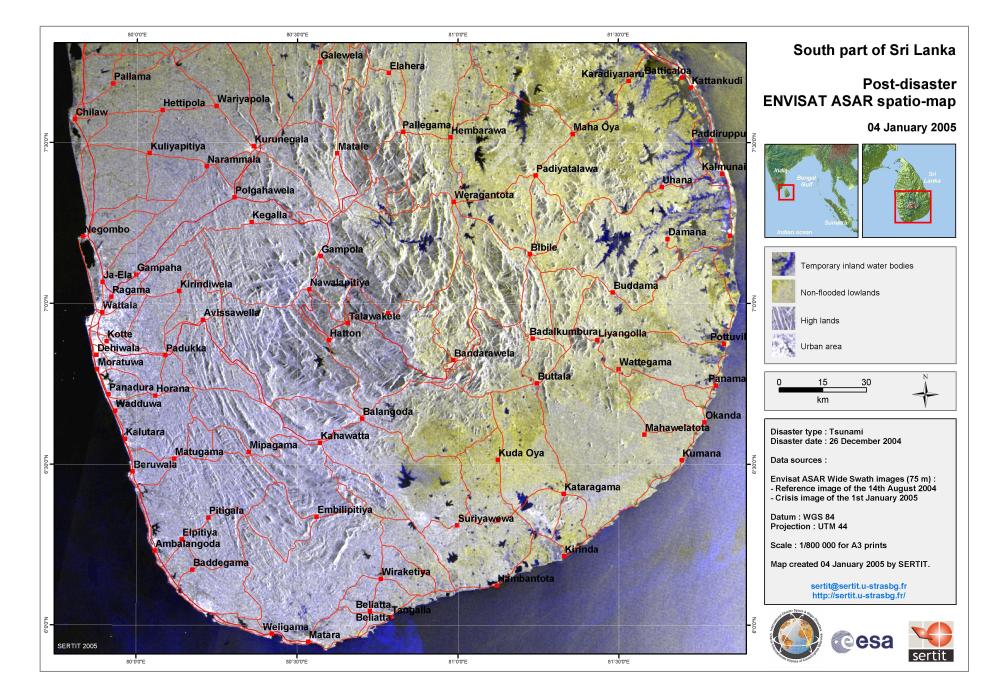
Satellite map of Sri Lanka.

Source: Post-disaster ENVISAT ASAR data.
Acquired: --

Copyright: Map produced 04/01/2005 by SERTIT.

Other info: --
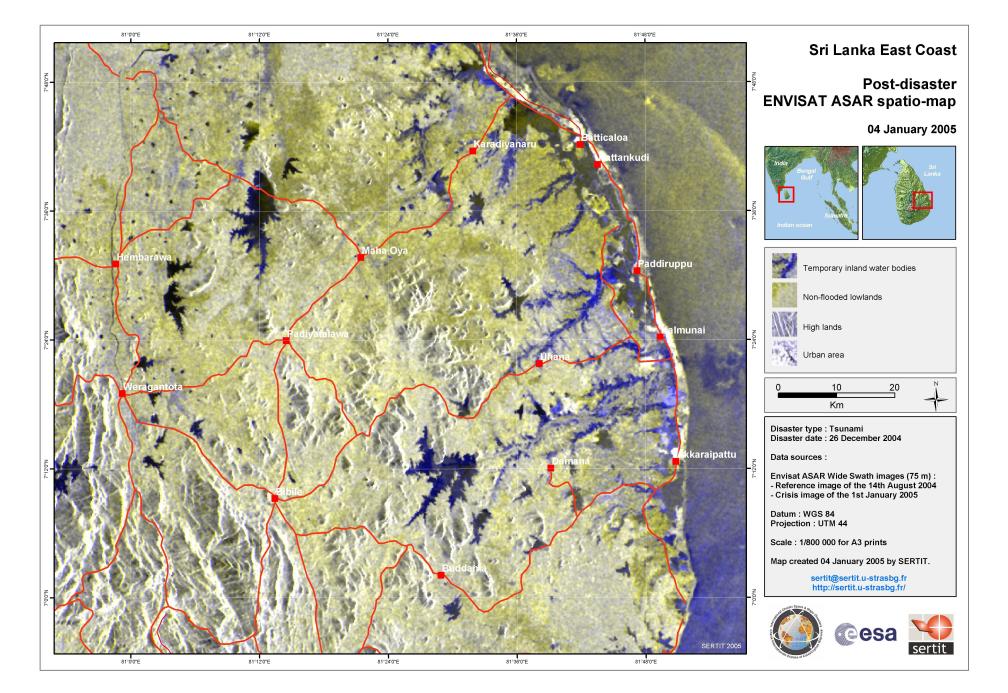
Satellite map of Eastern Sri Lanka.

Source: Post-disaster ENVISAT ASAR data.
Acquired: --

Copyright: Map produced 04/01/2005 by SERTIT.

Other info: --
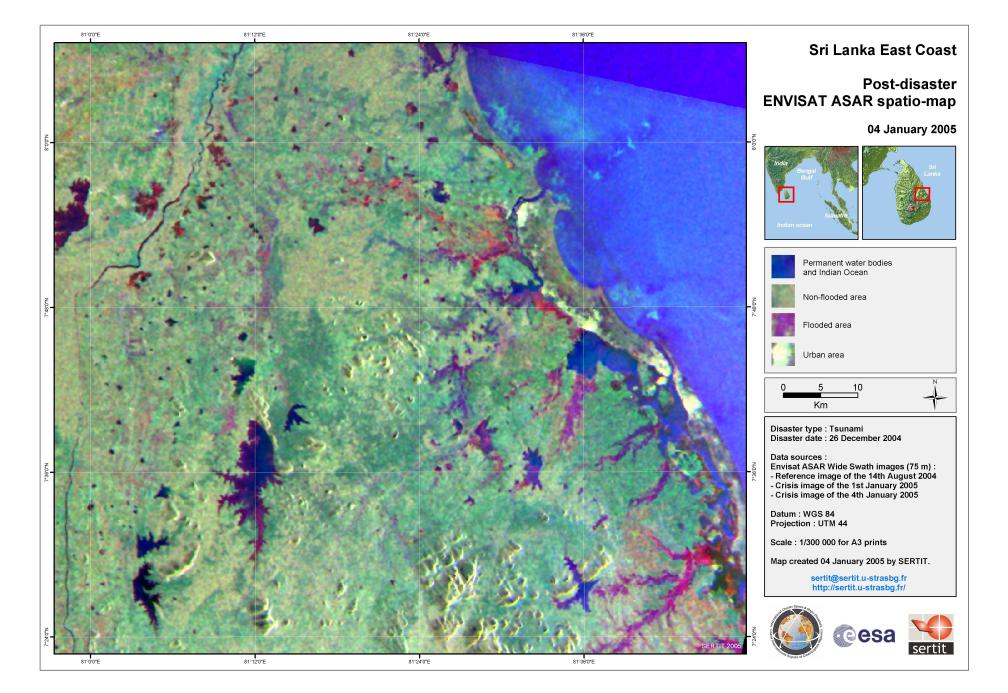
Post-disaster, East Coast.

Source: ENVISAT ASAR Wide Swath (75 m)
Acquired: 01/01/2005, 04/01/2005

Copyright: Map produced 04/01/2005 by SERTIT.

Other info: --
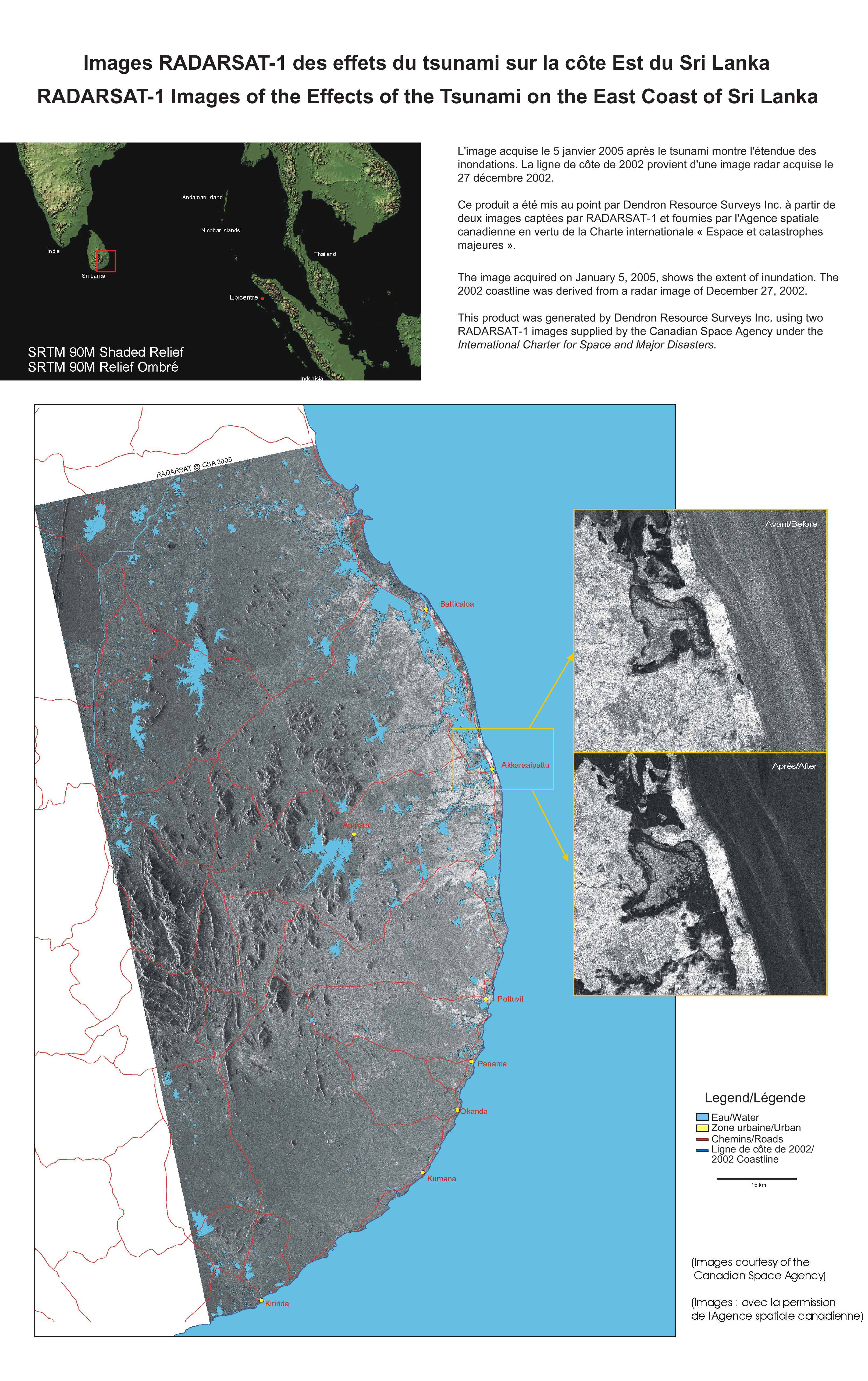
Dendron Poster, Sri Lanka

Source: --
Acquired: --

Copyright: --

Other info: --

Donnerstag, 9. Februar 2017

US FOREIGN DISASTER ASSISTANCE

Office of U.S. Foreign Disaster Assistance (OFDA)

The Office of U.S. Foreign Disaster Assistance (OFDA) is an organizational unit within the United States Agency for International Development (USAID) that is charged by the President of the United States with directing and coordinating international United States government disaster assistance.
In cooperation with other U.S. government offices and international humanitarian experts, OFDA continuously monitors global hazards, identifies potential areas of need, and stands ready to respond whenever disaster strikes.

History

After failed attempts to respond to the 1963 Skopje earthquake in Yugoslavia and the eruption of the Irazú Volcano in Costa Rica, the U.S. Government decided to create a central, coordinating agency to lead U.S. international disaster response efforts. In 1964, OFDA was established under the Foreign Assistance Act with the appointment of a Foreign Disaster Relief Coordinator within USAID.[1]
In 1975, the Foreign Assistance Act was amended with a "notwithstanding" clause in the International Development and Food Assistance Act, allowing the President to bypass any bureaucratic procedures that might hinder a timely response.[2] The "notwithstanding" clause gives OFDA the expedited authority to make grants and contracts without having to go through the lengthy procurement procedures required for other USAID offices. In addition, the clause allows OFDA to work in countries where other U.S. Government agencies are not present.[3]

Mandate

  • Save Lives
  • Alleviate Human Suffering
  • Reduce the Economic and Social Impact of Humanitarian Emergencies Worldwide

Disaster Response


Canine search working for USAID/OFDA on their way to Haiti to conduct rescue operation after the 2010 Haiti earthquake.
Each year, OFDA responds to dozens of international disasters, including rapid-onset events, such as earthquakes, floods, storms, tsunamis, and volcanoes; slow-onset emergencies, such as prolonged drought leading to food insecurity; and complex emergencies stemming from political crises, social unrest, or armed conflict.
An official disaster declaration allows OFDA to provide humanitarian assistance to affected populations. OFDA closely coordinates all activities with the U.S. Embassy or USAID Mission in the affected country. OFDA also conducts humanitarian assessments to determine if and when USG humanitarian assistance may be appropriate. OFDA’s response depends on the scale of the event and the needs of affected communities and may comprise a range of activities, including one or more of the following:
  • Immediate provision of up to $50,000—an amount designated as the Disaster Assistance Authority—to the U.S. Embassy or the USAID Mission in the affected country for the local purchase of relief supplies or as a contribution to a relief organization;
  • Deployment of a Disaster Assistance Response Team (DART) or other emergency teams to disaster-affected areas to conduct assessments, determine additional needs,deliver relief supplies,provide technical assistance, and/or recommend proposals for funding;
  • Activation of an on-call Response Management Team (RMT) in Washington, D.C.;
  • Procurement, transportation, and distribution of emergency relief supplies, such as plastic sheeting, water containers, water purification units, blankets, and health supplies, from one of OFDA’s three regional warehouses; and/or
  • Support for relief and rehabilitation activities through grants to implementing organizations, including international and local non-governmental organizations (NGOs), U.N. agencies, or international organizations.
Examples of OFDA-funded activities include purchasing local relief supplies for populations in remote locations, managing and/or supporting primary health care programs, implementing cash-for-work activities, providing seeds and tools to displaced farmers, or restoring water systems in drought-stricken countries. In addition, OFDA often prepositions personnel and relief supplies to prepare for a foreseeable disaster, such as a hurricane or volcanic eruption.
OFDA possesses the authority to request exemptions from USG regulations when doing so will expedite the provision of emergency assistance, as well as to borrow money from other USAID accounts when OFDA requires additional funding, although use of the special authorities is rare.

Transition from Relief to Development

As an emergency response transitions from addressing immediate needs to longer-term rehabilitation and reconstruction activities, OFDA works with other offices within USAID’s Bureau for Democracy, Conflict, and Humanitarian Assistance (DCHA) and USAID’s regional bureaus and overseas missions—among other partners— to ensure a seamless hand-off of assistance from relief to development entities.

Disaster Risk Reduction

In addition to disaster response activities, OFDA also supports a range of disaster risk reduction (DRR) projects designed to minimize the impact of natural hazards and conflict in emergency-prone countries and enhance the resilience of affected communities. OFDA’s DRR activities work to strengthen communities’resilience to and recovery from shocks and promote the sharing of technology and expertise between the United States and the affected country by building partnerships with national emergency response agencies. OFDA frequently implements DRR activities in conjunction with technical organizations, such as the U.S. Geological Survey (USGS), U.S. Forest Service (USFS), Pan American Health Organization (PAHO), and other offices within USAID. OFDA staff carefully monitor grantee programs to ensure that resources are used wisely and to determine whether projects need to be adapted to changing conditions.

Fiscal Year 2010 Response

In FY 2010, OFDA responded to 73 disasters in 56 countries to assist tens of millions of disaster-affected people. The response to one of these disasters—the January 12, 2010, Haiti earthquake—constituted one of the largest in OFDA’s history. In Africa, OFDA assisted populations affected by complex humanitarian emergencies, flooding, food security crises and drought, lead poisoning, a cholera outbreak, a cyclone, refugee returns, and earthquakes. Countries in the Asia and Pacific region experienced flooding, complex humanitarian emergencies, tropical cyclones, landslides, earthquakes, volcanoes, tsunamis, and a winter emergency. In Europe, the Middle East, and Central Asia (EMCA), OFDA assisted populations affected by complex emergencies, floods, wildfires, and food insecurity. Flooding affected populations across the Latin America and Caribbean (LAC) region, where OFDA also responded to wildfires, storms, a volcano, and earthquakes.
Following the onset of each of these disasters, affected populations required immediate humanitarian assistance, including safe drinking water, health care, sanitation services, emergency shelter, emergency relief supplies, and food security interventions. In countries experiencing complex emergencies, OFDA partners worked to protect vulnerable civilians, increase the sustainability of longer-term humanitarian responses, and facilitate the transition to development assistance in relevant countries.
OFDA provided more than $855 million for disaster response programs to support agriculture and food security, economic recovery and market systems, health, nutrition, protection, shelter and settlements, and WASH interventions; humanitarian coordination and information management programs; search and rescue efforts; and logistical support and emergency relief commodities. In FY 2010, OFDA deployed Disaster Assistance Response Teams (DARTs) and other emergency teams to Brazil, Chile, China, Colombia, El Salvador, Guatemala, Haiti, Indonesia, Laos, Madagascar, Mexico, Niger, Pakistan, the Philippines, Samoa, the Solomon Islands, and Vietnam. Of the more than $855 million provided in response to emergencies, $9 million supported DRR programs, and $181 million supported disaster response programs with DRR components. In addition to allocating more than $855 million for disaster response programs, OFDA provided more than $59 million for regional and global disaster support and more than $59 million for operations and program support.

References


  • "USAID's Office of U.S. Foreign Disaster Assistance Fact Sheet" (PDF). USAID. January 21, 2016. Retrieved 23 June 2016.  
  •  "International Development and Food Assistance Act of 1975" (PDF). United States Government Publishing Office. U.S. Government. Retrieved 23 June 2016.

  • Olson, Richard Stuart. "The Office of U.S. Foreign Disaster Assistance (OFDA) of the United States Agency for International Development (USAID): A Critical Juncture Analysis, 1964-2003" (PDF). USAID. Retrieved 23 June 2016.

    External links


  • "International Development and Food Assistance Act of 1975" (PDF). United States Government Publishing Office. U.S. Government. Retrieved 23 June 2016.

  • OFDA's unique disaster response capabilities help those suffering in the midst of the worst crises around the world.
    OFDA's unique disaster response capabilities help those suffering in the midst of the worst crises around the world.
    Mass Communication Specialist 2nd Class Chris Lussie, U.S. Navy
    The Office of U.S. Foreign Disaster Assistance (OFDA) is responsible for leading and coordinating the U.S. government’s response to disasters overseas.
    OFDA responds to an average of 65 disasters in more than 50 countries every year to ensure aid reaches people affected by rapid on-set disasters—such as earthquakes, volcanoes, and floods—and slow-onset crises, including drought and conflict.  OFDA fulfills its mandate of saving lives, alleviating human suffering, and reducing the social and economic impact of disasters worldwide in partnership with USAID functional and regional bureaus and other U.S. Government agencies.

    Our Work

    OFDA experts worldwide and in D.C. help countries prepare for, respond to, and recover from humanitarian crises.  OFDA works with the international humanitarian community to give vulnerable populations resources to build resilience and strengthen their own ability to respond to emergencies.

    Emergency Response

    When disaster strikes, OFDA sends regional and technical experts to the affected country to identify and prioritize humanitarian needs.  In the wake of a large-scale disaster, OFDA can deploy a Disaster Assistance Response Team (DART) to coordinate and manage an optimal U.S. Government response, while working closely with local officials, the international community, and relief agencies.  OFDA also maintains stocks of emergency relief supplies in warehouses worldwide and has the logistical and operational capabilities to deliver them quickly.
    In 2016, conflict in South Sudan, Iraq, Yemen, and Ukraine left tens of millions in need of assistance while Syria entered the sixth year of a brutal civil war that has destroyed entire communities and affected far too many lives.
    At the same time, OFDA took action amid one of the worst droughts Ethiopia has seen in 50 years. In partnership with the Government of Ethiopia, OFDA deployed a DART to respond decisively to meet the immediate needs of those most impacted by the drought, and has continued to provide critical aid.
    On April 25, 2015, when a powerful and deadly earthquake shook Nepal, killing nearly 9,000 people, OFDA deployed a DART that worked around the clock to provide medical care and perform urban search-and-rescue operations.
    In FY 2016, OFDA had (DARTs) responding to five major crises (Syria, South Sudan, Iraq, West Africa Ebola outbreak, and Ethiopia drought) and stood up just as many Response Management Teams (RMTs). In addition, we responded to an earthquake in Ecuador, drought in Southern Africa, and complex emergencies in the Democratic Republic of Congo, the Lake Chad Basin, Yemen, and more.
    Just as we have in these countries, USAID remains committed to responding to crises around the world, to help the people and places most in need.

    Disaster Risk Reduction

    Globally, where unplanned urbanization and population growth have placed more people in harm’s way, programs that help communities reduce risks, lessen the impact of disasters, and build resilience are critical.  OFDA’s approach to disaster risk reduction recognizes the central role of national and local entities as disaster managers and seeks to strengthen their ability to respond, emphasizing community-based initiatives.  OFDA helps establish early warning networks, train schoolchildren on what to do when an earthquake strikes, and teach local emergency personnel how to conduct search-and-rescue.  These activities not only reduce the number of lives and livelihoods lost during a disaster, they help communities become resilient to future crises. Achieving real resilience requires a range of approaches to help communities develop the capacity to manage an array of recurring shocks.  OFDA’s disaster risk reduction programs are specifically intended to limit the impact of these shocks.
    Following the deadly 2004 earthquake and tsunami, the people of Indonesia—with financial and technical support from OFDA—developed a tsunami early warning and evacuation system that got people out of harm’s way when a magnitude 8.6 earthquake struck off the island of Sumatra in April 2012.  Also, early warning systems and disaster preparedness activities established by OFDA in Mozambique saved lives following severe storms and flooding in January 2012.

    Early Recovery

    Recognizing the need to provide immediate relief while also setting the stage for recovery and rehabilitation, OFDA supports programs that give people tools to restart former jobs, provide psychosocial care to traumatized disaster survivors, and prepare individuals to get back on their feet.
    A key component of helping communities transition from the emergency to recovery phase of a disaster is linking OFDA’s work to the development work of the USAID Mission in the affected country.  For example, OFDA is collaborating with USAID/Sri Lanka to ensure displaced families have access both to emergency programs that provide employment training and to programs that support the Mission’s long-term economic development strategy.  OFDA programs also seek innovative ways to help disaster-affected communities begin to rebuild local economies.  In many African nations, OFDA provides mobile cash transfers, allowing people to purchase food or other items to restart small businesses, playing a direct role in helping local businesses and farmers recover.  Such programs not only help build resilience, they also protect hard-won economic and development gains.
    For general inquiries about the Office of U.S. Foreign Disaster Assistance, please email ofdainquiries@ofda.gov.
    For specific questions about OFDA's programs, view the USAID/OFDA Regional Contact list.
    For media inquiries about USAID's Office of U.S. Foreign Disaster Assistance, please email USAIDPressOfficers@usaid.gov.

    Who We Are

    USAID is the lead U.S. Government agency that works to end extreme global poverty and enable resilient, democratic societies to realize their potential.

    See how USAID and the U.S. Government are leading the fight to end poverty and support the #GlobalGoals: https://www.usaid.gov/globalgoals

    In order to support these goals, President John. F. Kennedy created the United States Agency for International Development by executive order in 1961. Learn more about USAID's History.

    Assistance to Foreign Countries

    U.S. foreign assistance has always had the twofold purpose of furthering America's interests while improving lives in the developing world. USAID carries out U.S. foreign policy by promoting broad-scale human progress at the same time it expands stable, free societies, creates markets and trade partners for the United States, and fosters good will abroad.
    Spending less than 1 percent of the total federal budget, USAID works in over 100 countries to:

    Disaster Assistance


    When a natural disaster or conflict destroys cities, homes and markets, or when hunger and disease threaten to spread, people caught in the middle are simply looking to survive. Helping them is at the core of what USAID does every day, all around the world.
    In fiscal year 2016, USAID’s Office of U.S. Foreign Disaster Assistance responded to 52 crises in 52 countries, providing life-saving assistance to tens of millions of people including those enduring:
    USAID works to help those in crisis survive every day, wherever people are in need.

    Learn more about:

    USAF TRANSSPORTATION COMMAND AEROMEDICAL EVACUATION UNITS


    The Flying Emergency Room

    One reason more soldiers are making it home alive.

    image: http://thumbs.media.smithsonianmag.com//filer/Intensive-Air-wounded-9-flash-631.jpg__800x600_q85_crop.jpg
    Wounded service members are taken off a C-17
    Wounded service members are taken off a C-17 and brought into Scott, which serves as a hub in moving the injured from the battlefield to U.S. treatment facilities. (USAF / Senior Airman Ryan Crane)
    Air & Space Magazine | Subscribe

    19 9 8 5 10 8 251
    19 9 5 10 8 251
    During the Vietnam War, it took an average of 45 days to return severe casualties to the United States, and the survival rate was 75 percent. By the time of Operation Desert Storm, in 1991, getting wounded patients home averaged 10 days, but their survival remained stubbornly at 75 percent. Today, the Air Force has gotten the time down to three days or less from virtually anywhere on the planet, and as for the survival rate, “if you make it to a field hospital in theater with a heartbeat,” says Justin Brockhoff, an officer with the Tanker Airlift Control Center at Scott Air Force Base in Illinois, “you have a 98 percent chance of living.”
    Two major factors account for the improvement in survival rates. First: Robust and sophisticated en route care, which is part of a continuum of advanced care that begins at the moment of injury—soldiers are trained and equipped to self-administer medical care, including tourniquets and even intravenous fluids. Second, improved evacuation logistics, thanks especially to aviation. Crews now move critical patients more safely and effectively with a wider array of equipment and airplanes. Much of this is orchestrated by planners at Scott, getting data on flights from a variety of sources.
    The base is home to the 375th Aeromedical Evacuation Squadron, one of four  active-duty aeromedevac units: Another is in North Carolina, one is in Japan, and one is in Germany. But Scott, about half an hour east of St. Louis, Missouri, is also the headquarters of the Transportation Command, the Air Force’s cargo-moving operation. “We’re like the quarterback: We make audible calls. We shift. We’re planning and tasking,” says Brockhoff of Scott’s NASA-style mission control, where banks of military and civilian staff watch flat screens and world maps sprinkled with icons representing airborne cargo, some of it U.S.-bound patients. “We’re here if they run into weather or maintenance problems.”
    Scott also runs an Aeromedical Staging Facility, which can accommodate 40 patients overnighting on their way to other points for specialized care or discharge. “The facility is a little bit of home,” says Army Sergeant Leonard Hathaway, a coordinator in a Transportation Command program that welcomes home wounded soldiers. While visiting Scott, I talked to Private Tanner Williams, 20, who had just flown in on a sunny Monday morning. Williams was a member of the Iowa Army National Guard. If you could ignore his cast and crutches, he looked no different from a college kid watching TV in a dorm lounge. Williams had been stationed at Forward Operating Base Kalagush in eastern Afghanistan. The prior Wednesday evening, he had been part of a routine patrol when an improvised explosive device went off beneath his all-terrain vehicle.

    http://www.airspacemag.com/military-aviation/the-flying-emergency-room-31127647/

    Read more: http://www.airspacemag.com/military-aviation/the-flying-emergency-room-31127647/
    Follow us: @AirSpaceMag on Twitter


    Evacuating the Injured

    A Marine Corps pilot flies CASEVAC missions in Iraq.

    image: http://thumbs.media.smithsonianmag.com//filer/CheccaFlash.jpg__800x600_q85_crop.jpg
    CheccaFlash.jpg
    (Cpl Mark Sixbey/Courtesy Rocky Checca)
    Air & Space Magazine | Subscribe
     
    After graduation from the Naval Academy and commissioning as a Marine Corps pilot, I went to flight school and selected the CH-46E Sea Knight out of Marine Corps Base Camp Pendleton, California. The CH-46 is the Marine Corps’ medium-lift assault support platform. I was detailed to join Marine Medium Helicopter Squadron 364 (HMM-364), the “Purple Foxes,” deploying to Iraq. Combat operations had supposedly concluded in May 2003 while I was still in flight school, well before I arrived on station. After I arrived, however, the insurgency began, and the situation in Iraq rapidly deteriorated. From early 2004 to February 2010, HMM-364, HMM-268, and HMM-161 operated on a continuous eighteen-month rotation at al-Taqaddum Air Base in Iraq.
    Al-Taqaddum Air Base was located in the heart of the insurgency, halfway between the cities of Fallujah and Ramadi, in the infamous Sunni Triangle in al-Anbar province, in western Iraq. The primary role and mission of our squadron was casualty evacuations, CASEVAC. We also flew hard-hit raids, insertions, extractions, snap vehicle checkpoints, and night external resupply missions. The commanding general considered CASEVAC the “no-fail” mission in Iraq, making it clear to us that there would be no dropped CASEVAC missions for any reason.
    Although CASEVAC were flown on a daily basis, multiple times a day, there was absolutely nothing routine about any of them. Each one presented unique challenges and problems. The pilots, aircrew, maintainers, and corpsmen prepared for the known task, but with ample contingencies for the “fog of war.” We had to be prepared to fly through any and all weather conditions, at any time, and into all kinds of enemy situations to save the lives of the people we were called on to evacuate.
    The CASEVAC process was important to everyone in theater. If an individual can be provided medical treatment within one hour of an incident, the chances of survival increase exponentially. This is known as the “golden hour,” and that is why the entire CASEVAC process, from start to finish, is standardized, efficient, and quick.
    Being on standby for CASEVAC was physically and mentally exhausting. We couldn’t leave the squadron area; food was brought to us; and if we had to use the bathroom, we hoped that the bell wouldn’t ring while we were sitting on the can. When the bell rang, we sprinted to the helicopters and would have a primary, a secondary, and a backup aircraft up and spinning four minutes after the CASEVAC bell rang. Many times we would be in the aircraft ready to taxi for takeoff having no idea where we were flying to or exactly what situation we would find once we got there. On many days the bell seemed to ring constantly, and we would fly CASEVAC after CASEVAC. Even on slow days, including days when no CASEVACs were flown, we would still be exhausted by the end of the shift because of the constant state of anticipation.
    We flew CASEVACs for all coalition personnel, Iraqi civilians, and even insurgents. The lives of our forces took priority over the insurgents’, but if an insurgent’s life could be saved, he potentially could provide valuable intelligence that might save American lives. There were times when we would pick up insurgents and Marines who had just been fighting each other and would load them together into the back of the helicopter.
    I experienced several close calls while flying. During my first deployment, on one of my first flights at night in Iraq, we received multiple RPG (rocket-propelled grenade) shots and small-arms fire while flying on final approach and on departure for a mass casualty call at Combat Outpost in Ramadi. The first RPG was shot from directly in front of us on final approach and passed 10 or 15 feet above our rotors. Another was fired from behind us on departure and passed the left side of the aircraft. RPGs and small arms were shot at our aircraft numerous times, and on several occasions aircraft took battle damage or were shot down. HMM-268 even had an incident where an RPG entered the bottom of the aircraft while it was flying, hit the crew chief in his back on his SAPI [Small Arms Protective Insert] protective plate and helmet—knocking him out—and then exited through the top of the aircraft, miraculously missing all the vital flight components and never detonating.
    I distinctly remember evacuating a Navy SEAL on my second deployment in 2006 from the very same zone. He was the first SEAL killed in action in Iraq. One of his fellow SEALs came with him on the flight when we picked him up. He had a severe gunshot wound to the head and face but was alive during the transit. He succumbed to his injuries after we dropped him off. It became clear early on that no one was invincible here, not even a SEAL.
    Mass casualties were the worst because improvised explosive devices and car bombs were usually the culprits. The odor of burned flesh is something I hope to never again smell. Lots of times, people with missing limbs were bleeding to death in the back of the aircraft. If it weren’t for the Navy corpsmen, who worked tirelessly to keep the wounded alive while in transit, many more would have died. They did the dirty work to keep everyone breathing or from losing that extra pint of blood that might cost the individual his or her life. They stopped bleeding from massive wounds or held someone’s guts in during the flight to keep them alive.
    One of the worst things to hear a corpsmen say to a pilot is “Fly faster,” because that means the patient is slipping away. During CASEVAC, the pilots already fly as fast as the aircraft can go, so to get such a request from a corpsman leaves one with a helpless feeling. There were times when patients would expire in the aircraft en route. Those are some of the longest and quietest flights a pilot experiences. No matter what the situation is regarding the enemy or what is occurring in the back of the aircraft, you must force yourself to compartmentalize what you are seeing and hearing, separating it from the task at hand, which is to get everyone out of there as quickly as possible.
    Read more: http://www.airspacemag.com/military-aviation/evacuating-the-injured-43013675/#YdoFcFeEBj26JR85.99
    Save 47% when you subscribe to Air & Space magazine http://bit.ly/NaSX4X
    Follow us: @AirSpaceMag on Twitter
    It was about two months into my second deployment in 2006 when I was assigned to fly a mission to al-Qa’im, near the Syrian border. I had been so glad when I learned I was flying to this desolate outpost, because I had heard a rumor that I could hardly believe. I had endured numerous months of compartmentalizing what I saw and only focusing on the task at hand. When we arrived and shut down the aircraft, I headed straight to the chow hall. As I approached the door to the small, rickety wooden structure, I saw the words “Winchester Hall” above the entrance. It made me smile ear to ear. I was nervous though, wondering about the rumor. I walked in the front door and looked around. There, just inside and to the upper left of the main entrance, was a glass case. Inside it, there it was—a big, bright-blue football jersey with white block letters on the chest: NAVY 73.
    It was the Navy football jersey of Ron Winchester (USNA 2001). He had been a teammate, killed in action in Iraq in September 2004, a few months prior to my first deployment. Navy football is a brotherhood, built through strong bonds among teammates. Ron was the first person I knew who had given his life during the conflict. His death was shocking; I had a hard time absorbing that he was actually gone. It was one of those things that people never think will happen to someone they know. Two months later, J. P. Blecksmith (USNA 2003), another teammate, was killed in action. Other teammates, Bryce McDonald (USNA 2003) and Scott Swantner (USNA 2001), suffered injuries. I received telephone calls about all of them. My reaction to seeing Ron’s jersey was immediate and uncontrollable. I turned away and walked outside so the other pilots and crew chiefs wouldn’t see me.
    Here, in this God-forsaken shithole of a place that looks like the surface of the moon, was the most beautiful thing I had seen in a long time. I pulled myself together by focusing my eyes on the metallic band around my left wrist that bears Ron’s name. I wore the band during all three of my deployments to Iraq. Every time it was hot, things were shitty, or I didn’t think I could do another day of the grind, I’d look at my wrist and be reminded of the numerous people, like Ronnie and J.P., who had counted on us on a daily basis.
    Once I had pulled myself together, I walked back in, had a little something to eat, and then walked over to the glass case. I left Ronnie a note on the glass thanking him for his sacrifice and letting him know it had not been in vain. I also left him one of the squadron patches that we wear on our flight suits. At some point, he had been in the back of a CH-46 being CASEVAC’d while mortally wounded or his remains were transported via an “angel” transport to al-Taqaddum, where Mortuary Affairs was located.
    Angel transport was a routine part of my squadron’s mission, so I knew that there was absolutely no delay in getting the remains of coalition personnel killed in action to al-Taqaddum. On the day they perished, the deceased were transported there and prepped for the return home. These missions were flown nightly, and like CASEVACs, I had to learn to compartmentalize and focus on the task at hand. One mission in particular, though, momentarily broke through the compartment.
    I had been assigned to transport five Marines out of Ramadi who died in an IED blast. As we flew in, the entire Marine battalion that operated out of Ramadi was off to the right of the landing zone, standing in formation, at attention. After they brought four of the remains to the aircraft on stretchers, someone handcarried the remains of the fifth Marine in two body bags to the helicopter. When we had landed, the battalion’s commanding officer had come on board the aircraft to tell us that one of his Marines was going to accompany the remains back to al-Taqaddum. Passengers and “angels” were never on the same aircraft together, but in this case an exception was made. The Marine accompanying one of the bodies back was the deceased Marine’s twin brother.
    Several months after seeing Ronnie’s football jersey in the chow hall at al-Qa’im, disaster struck within my squadron: Morphine 1-2, one of the call signs of our aircraft, was shot down by a man-portable air defense shoulder-fired missile near Karma while returning from a CASEVAC mission on February 7, 2007. Capt. Jennifer Harris (USNA 2000), 1st Lt. Jared Landaker, Sgt. Travis Pfister, Sgt. James Tijerina, Cpl. Thomas Saba, HM1 Gilbert Minjares, and HM3 Manuel Ruiz all perished. These individuals had saved hundreds of other people’s lives flying CASEVAC missions before giving up their own.
    As I considered my time as a member of the Purple Foxes, I realized that the hardest part was the mental aftermath. I would lie in bed after a mission, alone with my thoughts. I recalled everything in detail—the sights, smells, radio calls, and what the weather was like. I felt somewhat responsible for any deaths although there wasn’t anything else I could have done. I thought about the fact that that person had a mom and dad who did not yet know what horrible thing had happened to their son or daughter. I wondered about the person who had just made the ultimate sacrifice.
    It’s a mixture of emotions. I felt great about what we were doing, because we were saving lives, yet there were times when I knew that those who survived an incident were at the beginning of a painful postwar life. I often wondered about those whom we flew out of harm’s way because we never saw them again. Were they upset about their situation? Did they wish that they had not lived because their life from that point on would be so different and difficult? Were they glad they had survived despite their injuries? Were any of them like Lieutenant Dan from the movie Forrest Gump, who hated Tom Hanks’s character for rescuing him, forcing him to live life in a wheelchair instead of letting him die on the battlefield?
    These thoughts weighed on my conscious for a long time, and then on October 21, 2008, I received the answer to some of the questions that I had been afraid to share with anyone. On that day, I received an email from another pilot with whom I had done the first two deployments to Iraq. He said that he had received an email from one of the Navy nurses who had flown with us during the second deployment. An Army sergeant by the name of John Kriesel was trying to get in touch with the squadron. Our squadron had CASEVAC’d him on December 2, 2006, in Zaidon, south of Fallujah, after the vehicle he was in struck a pressure-plate IED wired with two hundred pounds of explosives. It left a crater seven feet wide and four-and-a-half feet deep. One person died at the scene, and another died in the helicopter, but Sgt. Kriesel survived. Now, two years later, Sgt. Kriesel was searching for the crew, flown by a USNA 2000 grad, that had picked up him and his men that day. He wanted to tell us the following:
    Read more: http://www.airspacemag.com/military-aviation/evacuating-the-injured-43013675/#DQdShDIDD1m6VbCy.99
    Save 47% when you subscribe to Air & Space magazine http://bit.ly/NaSX4X
    Follow us: @AirSpaceMag on Twitter
    (Continued from page 2)
     I know that you said I don’t have to thank you, but I will always have an appreciation for you guys at TQ and the military medical system as a whole. Both of my sons know the story and always ask about you guys and even at 6 and 7 say that they thank God that you guys were there for me and my men. They know and understand that I wouldn’t be alive without you guys. My seven year old built a CH-46E Sea Knight with Legos and it looks pretty good. Take care and thanks again.
    I remember reading that and bursting into tears. I got on my knees and thanked God that he and his family were grateful that he was alive, despite his having lost both his legs. Not only was he grateful that he had survived, but his kids were so glad to have their dad back with them. His email was an unexpected gift that helped relieve the weight I had felt about the missions we had flown. Sgt. Kriesel was grateful, and so was I.
    That is what Marine Air is about—supporting the guy on the ground, whether through assault support or close air support. It certainly is not about us. It always has been and always will be about supporting the guy on the ground. It is clearly understood that when a pilot screws up—whether because of a bad decision, lack of attention to detail, poor planning, headwork, or situational awareness—many times it is the Marines on the ground who pay the price for the pilot’s mistakes. The driving force is the fear of failure and the thought of possibly letting someone down. People are relying on you to protect or save their life. Failure is simply not an option. If that doesn’t motivate a pilot, then Marine Air is not the business that person should be in.
    Now, years later, I can say with certainty that the challenges of serving in Iraq combined with the lessons learned at the Naval Academy—along with the accompanying hurt, pain, adversity, and emotions—have built me into a much better person. I would not trade these experiences, the good and the bad, for anything. It was a gut check and trial by fire, a life experience that I will never forget. The lessons I learned are applied to every facet of my life every day.
    The American way of life is not possible without the sacrifice of the few. Edmund Burke wrote, “All that is necessary for the triumph of evil is for good men to do nothing.” Those that sacrificed did something and are some of America’s bravest sons and daughters. I can only hope that the families of Ron and J.P., the crew of Morphine 1-2, and others that made the sacrifice knew that when things sucked over there, they were the ones that I thought of, that kept me going. I know that there is nothing I can say or do to make their families’ pain go away, but I hope and want them to know that there were people over there who found strength and drive in themselves at the very thought of their son’s and daughter’s sacrifice. I will forever remember what my passengers in the back of the CH-46 did for our nation and how humbling it was to have served them.
    “Evacuating the Injured” by Rocky Checca is adapted from In the Shadow of Greatness: Voices of Leadership, Sacrifice, and Service From America’s Longest War, edited by Joshua Welle, John Ennis, Katherine Kranz, and Graham Plaster. Reprinted by permission of the Naval Institute Press.

    Read more: http://www.airspacemag.com/military-aviation/evacuating-the-injured-43013675/#lKt13LCA4jYZFoj6.99
    Save 47% when you subscribe to Air & Space magazine http://bit.ly/NaSX4X
    Follow us: @AirSpaceMag on Twitter